The Slow Waltz of Fall

Even before the leaves surrender their greens for red and gold, there are other changes afoot – creatures prepare for the coming winter, some rallying in their final efforts to survive before their lives slowly wind down to a natural end.

Each year in this house I watch an orb-weaving spider weave a large and complex web over the top half of a kitchen window.

It doesn’t seem a very auspicious spot, as her prey would need to be flying through the web to the glass not even a half inch behind. Yet each year, through some species memory I can’t possibly understand, a spider builds her web here. She catches an occasional small insect, and each night rebuilds her web. With temperatures becoming chillier and less prey about, she becomes weaker from lack of food. With less silk to spin, her web becomes less detailed until at last, the strands are a broken tangle of fine thread, a shadow of her once articulated masterpiece. And then she is gone.

I found myself watching her, in quiet awe of her determination to survive in spite of the reality of colder nights and imminent death. Some lesson in life for me, no doubt.

Perhaps a week or so after the spider’s web had disappeared, a seemingly small monster – from this side of the glass – cast a large shadow in the same window. A Chinese praying mantis. Where had he come from? Last year, a green praying mantis hung out all season on or around my office window, where we had several conversations and a few photo shoots. But I’d never seen the larger and brown Chinese mantis since I’ve lived here. He did his monster shadow for the morning, and then flew about my front and side porches in the awkward way they do, like a helicopter with a broken blade. No doubt he was scouting out a last meal as well. He, too, soon disappeared.

As we moved into late October, anticipating Halloween, temperatures dropped, moisture gathered and froze, and suffocated the clinging leaves, dropping trees like so many sticks.

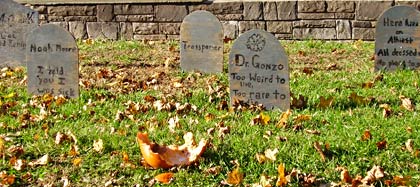
It was unexpectedly beautiful, but deadly, and the sudden snowstorm rolled long nights over the state, especially in my area. Halloween evening arrived and bundled children with chilled parents came from other towns to ours; they still had no power, but happily, here we all had our porch lights on, tombstones eerily lit, and plenty of candy.

I took a drive around my area the following day, where the severity of the damage was evident. It looked like a war zone. Barricades and closed roads were everywhere, but so much worse was the devastation of the trees. Magnificent elders had split and cracked like twigs, graceful limbs lay on the ground. It was heartbreaking.

And then, another sign of determination – the leaf which will not fall.

Many of the taller shrubs and a fair amount of surrounding trees still have quite a bit of their leaves. This tree? Only one stubborn leaf remains. I wonder did he win a contest this year with some other now-fallen leaf who could finally hold on no longer. Or is he a tall scout, updating the lower shrubbery on how advances the autumn. Or perhaps he’s simply the last man standing.

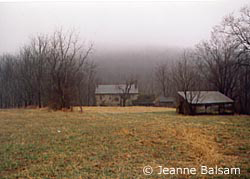
And then this morning … a thick autumn fog. It couldn’t have looked more lovely, an invitation to be lost for just a little while. I could have stayed until the sun shone through. But such is not my life.

A Way with Words – Heart Songs

I’m wondering if E. Annie Proulx is an acquired taste. She is unique among authors I’ve read for any number of reasons, perhaps most importantly … does she have a way with words!

I first met Ms. Proulx when I read The Shipping News, and found her style engrossing, challenging to read, and simply like no other. I most recently picked up her collection of short fiction, Heart Songs. She writes about people we average Americans rarely, if ever, see, in this case the longtime residents of rural New England, whose lives and lifestyles are coming into sharp collisions with wealthier newcomers embracing the “country life.” In this regard, reading about the people in these short stories was something akin to watching the movie Winter’s Bone, i.e., seeing for the first time how a segment of Americans live, people of whom we generally have no knowledge. It’s fascinating, sometimes disturbing and frightening, sometimes heartbreaking. Yet Proulx is not asking for pity or judgment for her characters. They are who they are; she is simply telling their stories.

But oh! her way with words … “Often his razor tongue stropped itself on the faults and flaws of his dead parents …”; “The corpse of a less-wise raven lay beneath a bush like a patch of melted tar. The fox rolled in the carcass, grinding his shoulders into it. He got up, shook himself and continued his tour, a black feather in the fur of his shoulder like a dart placed by a picador.“; ” … his face dark as a smoked ham, eyes like bird’s eyes, orange and inhuman.”

Whose writing could fail to be enlightened by an author whose use of words is so intense, lyrical, and magnificently descriptive. If, in each thing we read, we hope to not only gain from the enjoyment of the story itself but also some wonderful addition to our own skills as writers, then E. Annie Proulx’s Heart Songs speaks volumes on how to say what we mean. And how to say it with an incomparable richness.


How Do We Know If They’re Meant to Be Ours?

Times come in our lives when we are ready to open our hearts and homes to a new animal. But how do we know which is the right one for us? The one that is truly meant to be ours?

A little over 13 years ago, one of my two pit bull terriers passed away from complications of cancer. She had been starved and brutally abused. She’d had a very high prey drive and was dog aggressive, but she thrived in my care, and in time, also did so with my other pit bull terrier, Chloe. Chloe was at the opposite end of the spectrum; she truly loved ALL animals. With Chloe then twelve years old, I wanted her to truly enjoy her golden years with me and without the competition of another dog. But I knew she’d love a cat, and I began my search.

Every day that I was at work in the large city shelter, I took my lunch time to look at the over 200 cats awaiting adoption, asking that I please be shown the cat that was meant for me. That cat wasn’t there. Or at least not yet. Not so coincidental to this story, by the way, was the fact that in the office adjacent to mine, worked a lovely man in his 60’s. He was about 5’4″, and his wife was about 4’11”. They were a petite and adorable couple, totally devoted to each other from the days of their young marriage. I told him how happy it made me to see a couple still so in love. He told me it was bashert, i.e., “meant to be” in Yiddish. What a perfect word, I thought, and how perfectly fitting for them. I, too, was on the lookout for bashert, but on a much smaller scale.

One day in early August, I needed to go into work on my day off. Traffic on my usual route was at a standstill, so I took the back way through the neighboring town. As I drove over the familiar railroad bridge, I passed what looked like a crumpled piece of paper, but intuitively I knew better. I backed up and spotted a 5 week old tuxedo kitten, waiting to be hit by a car or plunge to his death 100 feet below.

I managed to catch the terrified and elusive kitten, brought him to the medical department for a gentle baby bath for fleas, and then to my office. Too young for inoculations, he wouldn’t fare well in a shelter with so many animals, so I decided to foster him until he was stronger – in my office on workdays, otherwise, home with me. He was so tiny, I was afraid he’d got lost or stuck in the house, so I set him up in my bedroom in a large Great Dane crate, complete with bed, blanket, litter and food and water. He screamed bloody murder.

The next evening the same. I closed the bedroom door and let him out. He made a beeline for a comforting spot under my Chloe’s chin. Mom! For two more weeks I followed this routine, everyone suggesting I keep him. My reason for not wanting to do so was that everyone will adopt a kitten; I would take a middle age or senior cat, a bonded pair, a cat with feline leukemia, i.e., a hard-to-place cat. Someone would surely fall in love with him quickly.

Then it happened. I looked at this very verbal little pipsqueak of a kitten, nestled with his new adoring mom, and found myself saying things like, “Now appearing in the Shakespearean production of I Claudipuss ….” or coaxing him with Monsieur Claude, or “Where’s my Cloudy Paws?” You get the picture.

I had asked to be shown the cat that was meant to be mine, and it had nothing to do with what I thought I wanted, but everything to do with who needed me. And so we need to be open to our choices in animals. I do believe every animal that I have had was truly meant to be mine. Perhaps I saved his or her life, perhaps in some other way, she or he saved mine. Animals are our teachers and guides, and may come to us in the most unexpected species, breeds, time and manner. They may be brought to us, or we to them, but we must always listen to our hearts.

Today that teensy feral kitten is a long and lanky 16 pound cat with tuxedo markings, but with all the features of an Oriental breed – short, smooth coat, long face, body and tail, and oh, yes, the (sometimes very annoying) vocalizations. His names today are Claudie the Dog Boy, (for all the dog tricks he happily performs), Mr. Freshy McFresh Face, and just plain Claude or Claudie. But it was those first silly names that were the tip off,  (that and his instant attachment to Chloe), that he was meant to be mine, kitten or no.

It was simply bashert.

I Wanted to Feel What They Felt

Once you become engaged more seriously in writing, you become much more observant of what you’re reading. It’s not that I am judging or critiquing as I read; I just seem to be much more aware of what is and is not grabbing me.

I just finished Kim Edwards’ The Memory Keeper’s Daughter, recommended by a friend. I actually found it hard to finish; it was simply not engaging me sufficiently. And I know why.

It wasn’t the premise. The premise was excellent and intriguing – David is a doctor who delivers his wife Norah’s baby in a snowstorm at his own clinic, unable to get to the hospital, further away. A healthy baby boy, Paul, and an unexpected baby girl, Phoebe, who clearly has Down’s Syndrome, are born. It is 1962 – a time in which it was sadly common to “get rid of” such babies and put them in institutions. The husband, with weighty memories of a sickly sister who died at 12, asks his nurse, Caroline, to take the girl away to such an institution, telling his wife that the infant died at birth. Caroline brings the baby girl to the institution and cannot bear to leave her there; instead, she brings Phoebe home and secretly raises her on her own. And so begin lifetimes of secrecy and deception.

The potential is here for so many feelings – Norah’s juxtaposition of  joy at her son Paul’s birth, and sorrow in her unknown daughter Phoebe’s supposed death; David’s own loss and guilt; Caroline’s joy in becoming a mother, tangled with guilt; the later developing conflictual feelings between Norah, David and Paul as he grows; and the challenges in Caroline and Phoebe’s lives. So why didn’t I feel them?

In my humble estimation, it seemed the author wrote from a distance. There was plenty of description of what these characters went through, but it wasn’t enough. I wanted to feel what they felt, and I didn’t. I wanted to spend haunted nights with Norah … I know what she did about her feelings, but I didn’t feel her heart. I wanted to feel Caroline’s conflict in a gut-wrenching way. I did not. And so it wasn’t until near the end of the book that I finally felt suspense and became more involved in possible outcomes, and that’s just too late. Overall, I was disappointed.

Granted, this is one woman’s opinion. True that I just came off reading a very powerful author, Barbara Kingsolver. But as I picked up E. Annie Proulx’ collection of short fiction, Heart Strings, I suddenly reconnected to the power of words and their ability to fully engage me, and I can’t wait to get back to this book.

Such things are always reminders of what a challenge it is to really write well, to really engage and touch a reader. Writing novels sure isn’t for sissies.

Thanks, Halls, for the Pick-Me-Up

Finally. My head was starting to clear a wee bit from this seemingly endless flu/virus/whatever and I actually had something I wanted to write about. So I popped a Halls honey-lemon cough drop, gathering my thoughts, and then was stopped in my tracks. There was a message on my cough drop wrapper!

Now, anyone that knows me or even occasionally reads this blog knows how hard I lean towards a positive or inspiring message. And suddenly, there was a whole bunch of them! I decided to scrap what I was planning to write and scan a couple wrappers just to share this unexpected little find. On the unwrapped cough drop at left, is “Dust off and get up.” Always good advice!

And here on the other two, you can read some more, plus a trademark saying Halls seems to have called “A pep talk in every drop.” Who knew?

I swear I don’t work for Halls Cough Drops and am not related to anyone who is, but this just took me aback. Do I expect a bit of wisdom from Celestial Seasonings or my Yogi tea? Of course! But my little ole OTC cough drops? Nah. Who’d think?

And what’s more delightful than a happy – and uplifting – surprise! So – keep your chin up, hi-five yourself, put a little strut in it and heal your sore throat. Go, Halls.