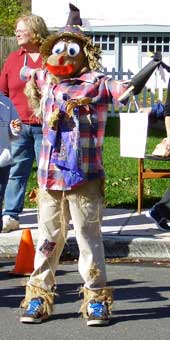
 OK, let me warn you right off the bat – this is not the parade in Greenwich Village or anything. Nothing like it. Just a very small town parade held each year with prizes for various age groups, cider and doughnuts for everybody, and people getting together. Almost all kids in the parade, but the whole town participates. I’m just posting a few pictures because I thought they were kind of cool, and it’s fun to see people getting involved with the costumes, especially the little ones.
This scarecrow is a little hard to see with the busy background behind him, but what was funny was his face kept moving around all the time in some bizarre way. Turns out, his hands are behind the burlap of his face and the arms aren’t arms. He made the costume all on his own. (His Grandma next to me swore it.)
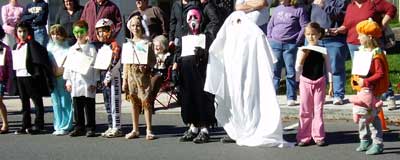
This age group, below, had a pretty good assortment of creative costumes in it – they were 6-8 year olds, I think. But I was just fascinated at how effective the plain `ol ghost was, and he or she was my definite favorite.
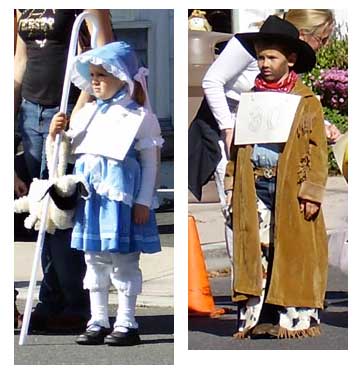
Then we had some younger kids whose moms and dads were very creative in putting together costumes that were definitely not from Party City or Wal-Mart. These two – Little Bo Peep and a cowboy with chaps and that long coat they wear, (uh – forgot what they call that) – were real cute.
 And then … what put a smile on my face was a really clever homemade costume … on a dog. (Well, yeah – of course that made me smile!) Her owners also had a head piece they’d made of the same fabric as the inside of the banana, but said the Doxie didn’t like it on very much so left it off. Wow! People that really care about their pet!
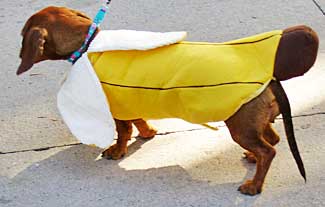
This costume and the presence of about 10 other non-costumed dogs prompted me to ask the master of ceremonies to consider including dogs in costume next year, and he thought it was a great idea and announced it immediately. (Now why do I think I’m somehow going to get roped into helping form guidelines as to pets in costume and how old a kid has to be to have a dog on a leash, etc.?)
Anyway. I started thinking if there was a children’s book story somewhere in all of this. If there is …. for me …. it’s going to be about that ghost or the Dachshund! Maybe both ….
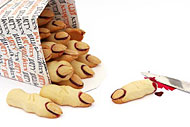 Fingers!

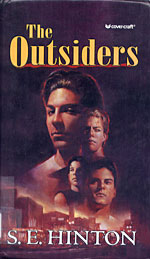 Have you ever read a book that exceeded your expectations? Great, isn’t it? I didn’t know quite what to expect from The Outsiders; I’d noticed it had a special placement in my library because it’s considered a classic, but I didn’t look twice. What got me bringing it home, was Patrick Swayze. Yup. Patrick Swayze.
