Stieg Larsson – The Millennium Trilogy

GirlWDragonTattoo2What a writer! Oh, my. Talk about books you cannot put down.

I just finished The Girl Who Played with Fire, not all that much later after reading The Girl with the Dragon Tattoo*. Is it any wonder Larsson won so many awards? He was truly a masterful writer. Not only does he have that whole end-of-the-chapter-page-turning thing going on big time, but he is able to effectively flip back and forth into different places and characters’ situations in rapid succession, never losing, but rather only building, the momentum of the story.

The fact that the names of the characters and frequently referenced locations are all Swedish and unfamiliar to the English-speaking reader still does not slow one down. Larsson periodically goes into paragraphs of description, such as in his providing the background of each member of the murder investigation team under Bublanski in The Girl Who Played with Fire, but that doesn’t seem to slow you down either. The information proves to be relevant later on in the story, but in the hands of a lesser writer, such descriptions might leave one meandering and lost down some other path. Larsson’s twists and turns keep you turning the pages and reading far later in the night than you should.

GirlPlayedWithFire2His characters are engrossing, particularly, of course, the main character, Lisbeth Salander, a brilliant computer hacker with a profoundly painful past. She can be violent, yet is at the same time, highly moral, and always complex and challenging. Mikael Blomqvist, the investigative journalist, is also compelling in his own way, but more so, I believe, in his relationship to Lisbeth. The trilogy is classified as crime thrillers/murder mysteries, and, of course, this is true, but for me, I also found them fascinating character studies.

Sometimes we have to be in the mood for a certain kind of book – I don’t always feel like reading a crime thriller any more than I do any other genre. But if you are in the mood, these are books you will not easily put down. I was lent the first two by my neighbor, but for the third, The Girl Who Kicked the Hornet’s Nest, I will need to go to the library in town. Starting Monday morning, I am committed to being home for the tree people to come at a currently unspecified time to remove a very large and threatening dead branch high up on an older spruce next to my home. Start a new book? Wait to get to the library? All life’s decisions should be this enticing.

* The movie version of this book with Rooney Mara and Daniel Craig is also outstanding, in my opinion.

Learning from Others’ Writing

I hate giving up on a book. When I’ve chosen one to read, I really want it to be terrific, so when it continues to disappoint, well, even I give up the ghost. But I realized, much as we can learn from fabulous writers, we can also learn from those who still have more to learn, (myself certainly included.)

WomanReading2A book I picked up recently at the library sale lured me in – great title, fabulous cover art, subject matter strongly appealing to me, and what seemed like an intriguing storyline. But each time I picked it up, I just couldn’t get into it. I finally gave up about 1/5 through. I wondered, what wasn’t working and how could it help me be a better writer?

First, voice. The novel was supposedly told by a 12 year old girl, but the voice was clearly that of an adult woman saying she was a 12 year old girl. Never once did I feel like I was reading a story written by a 12 year-old, so it just didn’t ring true. As children’s book writers, we know how tricky voice can be and the importance of feeling that we’re reading the age group targeted.

Next, character development – I wanted to like this kid, but I just couldn’t really connect with her emotionally. The same went for the other characters; they weren’t able to pull me into their worlds. The characters seemed flat, and sometimes stereotypical, whether adults or tweens. Is it possible that the author wasn’t able to deeply feel her own characters? Or just had difficulty expressing what they felt? She was very capable of describing emotions quite well. This is a huge challenge in writing – to have our readers feel what our characters feel, but when it’s not there, we just feel left out.

Focus – I think there were too many characters and story lines and not enough space to write in depth why things were happening with them, the reasons that would make me care. I felt a little pulled all over the place. As we know, a really good author can juggle multiple story lines and then weave them all together for an astounding ending – we’ve all read these books – but I didn’t see that happening here.

So I write this post certainly not to bash another author, who I leave nameless, but to share the difficulties in making our writing ring true and in writing the stories that have readers coming back for more, looking forward to the moment when we can get back to our book. I want to be aware when I write, not only what I need to do, but of the pitfalls I want to avoid.

GirlWDragonTattoo2So then I picked up The Girl with the Dragon Tattoo. One might say there is far too much detail to remember, family names to keep track of, and yet … I can’t put it down. How did Stieg Larsson do it? I’m keeping my  eye on that, too!

I’ll tell you one thing. He knows how to end a chapter and make you want to turn that page!

Children’s Books and Fused Glass

FusedGlassVotive2The journey of writing and illustrating children’s books, as in any serious endeavor, has been packed with a wide variety of experiences. The learning curve has been tremendous between a writer’s critique group, caring support from fellow writers and artists, and the many opportunities to grow offered through the SCBWI, (Society of Children’s Book Writers and Illustrators.)

Conferences, workshops, individual critiques and sometimes just time to sit down and talk with professionals in our field have given us all hope and sustained us on the road to being published and beyond.  I consider myself very fortunate that, in the time I have belonged to the SCBWI, my New Jersey chapter has been extremely pro-active in providing so many ways to become involved in the world of children’s books.

Our current NJ SCBWI Regional Advisor recently put together a really fun workshop at the Fire Me Up glass studio. It was a chance to create something new and to also sit down and brunch with the Executive Editor of Children’s Books at Sterling Publishing of NYC, Meredith Mundy. And getting there early gave my friend and I the opportunity to sit right opposite her and talk about all manner of things. It was a friendly gathering of about 20 writers and artists in the children’s book field, some published, some not yet, trying our hand at a glass project while talking about our favorite subject.

FusedGlassVotive-Lit2After brunch and getting instructions about our projects, Meredith chatted with us, talked about changes in the industry, what Sterling was looking for as well as what she, in particular, was looking for in terms of stories and subjects. And when our afternoon was done, we were each given our individual critiques of whatever manuscript we had submitted ahead of time.

Meredith’s critique was very helpful and included wonderful insights and detailed suggestions for improvement, really challenging me to expand the ideas I was already working on, while acknowledging what I’d already accomplished. What a treat! I have since been working hard on my MS, getting ready to make a pacing dummy, and sketching my main characters for still new insights.

And what about the fused glass project? We had a variety of options to choose from, and I took a fairly simple one so I could focus on the conversation around me. (You don’t want to lose attention when you’ve got such a talented Executive Editor sitting across the table!) One of the options was a glass votive holder, and as a candle lover, this seemed perfect. So with an 8″ square piece of clear glass and a variety of jewel-colored glass in the form of spaghetti, linguine, flat marbles, small chunks and other possibilities, I made what you see here. TaDa!

If you are an aspiring author or illustrator in the area of children’s books, I encourage you to look into and join the SCBWI, take a look at what’s going on in your own state, get involved and amp up your learning curve and grow!

Shadow of Night

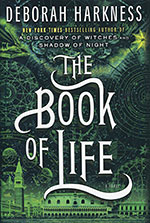
ShadowOfNight-DHarkness2Deborah Harkness is on the top of my list right now for being a simply brilliant writer. I just finished Shadow of Night, her second in the All Souls Trilogy, and am as spellbound as I was when I finished A Discovery of Witches, her first.

What blows me away, aside from the sheer endurance it must take to write a nearly 600 page novel, is the fact that Harkness sets most of this book (which, although it begins in modern day France and New Hampshire), in Elizabethan times —  in England, Prague, returning to the Blackfriars in England, and finally a return to France in the present day.

When one of the two main characters, Matthew DeClermont, a centuries-old vampire and modern day geneticist, time walks back to 1590 with the last of the Bishop witches, Diana Bishop, we see him as Matthew Royden. Royden, a spy for Queen Elizabeth, actually once lived and was a member of The School of Night, which also included Christopher Marlowe, Sir Walter Raleigh, George Chapman, Thomas Herriot and the Earl of Northumberland. Part of the author’s genius is writing a story that integrates all the above-mentioned, plus others who lived at the time, with fictional characters against a backdrop of historically correct time and place. It is simply amazing. DiscOfWitches-DHarkness2Some of the characters are witches, daemons and vampires; some are human. In the back of the book, Harkness lists all her characters with an asterisk next to those who actually lived in Elizabethan times, (including Shakespeare, though he didn’t belong to the School of Night.)

Harkness’ characters, whether human or creature, are rich, complex and utterly believable. I don’t know if her novels fall under the category of urban fantasy or perhaps fantasy, but I can tell you, she is hardly riding the coattails of anyone who has created tales in the popular vein of vampire mythology. She is in a category all her own. Although I have highly praised Deborah Harkness’ talents, I have not revealed the story line of the All Souls Trilogy, and for this I suggest, if interested, you read more about the two novels published so far. You can find a concise summary of Shadow of Night here and of Ms. Harkness’ first novel, A Discovery of Witches here.  About the latter, goodreads.com says, “Debut novelist Deborah Harkness has crafted a mesmerizing and addictive read, equal parts history and magic, romance and suspense.”

Like so many good novelists, Harkness demands your full attention; the novels are challenging, but so very worth the journey.


Shall We Bloom?

Poppies2

“This is the season when growth in the garden, which has been gradual, now accelerates. Maybe today you’ll realize that remaining tight in the bud
is more painful than blossoming.”

~ Sarah Ban Breathnach