Taking the Easy Read

Have you had times in your life when you just couldn’t get through a book? No focus, no attention, but somewhere inside still longing to read? I think we all have, and as one who loves reading, I find it quite disconcerting, but there it is.

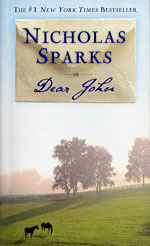
Difficult times are just a part of life, and for months there have been a bit more in my own than I’d like. During this time, I switched from book to book, but couldn’t really focus. So I returned to my ever-faithful and always-waiting selection of unread books, hoping to find the one that would ease me back into reading. And I found it, Dear John by Nicholas Sparks. I checked out all the quickie reviews, and this seems like the book for me – a love story that will engage me but not rip my heart out, that will entertain me without boring me. It’s taking the easy read, but I believe it will hit the spot right now.

And then … much like baking muffins for myself in broad daylight … I did what I really needed, (and wanted). to do. I gave myself the gift of curling up in a chair in the afternoon sun and I began to read Dear John. The cats take this sunshine-seeking in stride; they find the brightest spot of light, position themselves for maximum exposure, and luxuriate in the warmth. I decided to do the same. The dust, the vacuuming, the laundry … it’s not going anywhere.

We need to give ourselves these small gifts, whatever they may be. They make us feel whole. And happy. Why not give yourself a gift today?
A Way with Words – Heart Songs

I’m wondering if E. Annie Proulx is an acquired taste. She is unique among authors I’ve read for any number of reasons, perhaps most importantly … does she have a way with words!

I first met Ms. Proulx when I read The Shipping News, and found her style engrossing, challenging to read, and simply like no other. I most recently picked up her collection of short fiction, Heart Songs. She writes about people we average Americans rarely, if ever, see, in this case the longtime residents of rural New England, whose lives and lifestyles are coming into sharp collisions with wealthier newcomers embracing the “country life.” In this regard, reading about the people in these short stories was something akin to watching the movie Winter’s Bone, i.e., seeing for the first time how a segment of Americans live, people of whom we generally have no knowledge. It’s fascinating, sometimes disturbing and frightening, sometimes heartbreaking. Yet Proulx is not asking for pity or judgment for her characters. They are who they are; she is simply telling their stories.

But oh! her way with words … “Often his razor tongue stropped itself on the faults and flaws of his dead parents …”; “The corpse of a less-wise raven lay beneath a bush like a patch of melted tar. The fox rolled in the carcass, grinding his shoulders into it. He got up, shook himself and continued his tour, a black feather in the fur of his shoulder like a dart placed by a picador.“; ” … his face dark as a smoked ham, eyes like bird’s eyes, orange and inhuman.”

Whose writing could fail to be enlightened by an author whose use of words is so intense, lyrical, and magnificently descriptive. If, in each thing we read, we hope to not only gain from the enjoyment of the story itself but also some wonderful addition to our own skills as writers, then E. Annie Proulx’s Heart Songs speaks volumes on how to say what we mean. And how to say it with an incomparable richness.


I Wanted to Feel What They Felt

Once you become engaged more seriously in writing, you become much more observant of what you’re reading. It’s not that I am judging or critiquing as I read; I just seem to be much more aware of what is and is not grabbing me.

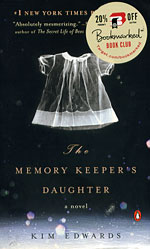
I just finished Kim Edwards’ The Memory Keeper’s Daughter, recommended by a friend. I actually found it hard to finish; it was simply not engaging me sufficiently. And I know why.

It wasn’t the premise. The premise was excellent and intriguing – David is a doctor who delivers his wife Norah’s baby in a snowstorm at his own clinic, unable to get to the hospital, further away. A healthy baby boy, Paul, and an unexpected baby girl, Phoebe, who clearly has Down’s Syndrome, are born. It is 1962 – a time in which it was sadly common to “get rid of” such babies and put them in institutions. The husband, with weighty memories of a sickly sister who died at 12, asks his nurse, Caroline, to take the girl away to such an institution, telling his wife that the infant died at birth. Caroline brings the baby girl to the institution and cannot bear to leave her there; instead, she brings Phoebe home and secretly raises her on her own. And so begin lifetimes of secrecy and deception.

The potential is here for so many feelings – Norah’s juxtaposition of  joy at her son Paul’s birth, and sorrow in her unknown daughter Phoebe’s supposed death; David’s own loss and guilt; Caroline’s joy in becoming a mother, tangled with guilt; the later developing conflictual feelings between Norah, David and Paul as he grows; and the challenges in Caroline and Phoebe’s lives. So why didn’t I feel them?

In my humble estimation, it seemed the author wrote from a distance. There was plenty of description of what these characters went through, but it wasn’t enough. I wanted to feel what they felt, and I didn’t. I wanted to spend haunted nights with Norah … I know what she did about her feelings, but I didn’t feel her heart. I wanted to feel Caroline’s conflict in a gut-wrenching way. I did not. And so it wasn’t until near the end of the book that I finally felt suspense and became more involved in possible outcomes, and that’s just too late. Overall, I was disappointed.

Granted, this is one woman’s opinion. True that I just came off reading a very powerful author, Barbara Kingsolver. But as I picked up E. Annie Proulx’ collection of short fiction, Heart Strings, I suddenly reconnected to the power of words and their ability to fully engage me, and I can’t wait to get back to this book.

Such things are always reminders of what a challenge it is to really write well, to really engage and touch a reader. Writing novels sure isn’t for sissies.

Some Authors Just Never Get Old

Sometimes it seems like it will take forever to finish a book. No comment on the book itself, just a million distractions, some good, some bad. But how wonderful is it when you are reading an author you love to read and can finally come back to and re-immerse yourself in the story.

I am always amazed when people tell me they don’t like to read. I can’t figure out how that happens. I was most fortunate to be reading at a very early age, perhaps because I was being read to at a very early age. Whether my mother, grandmother or father – or actually even my grandfather sometimes reading us the Sunday comics! – it does seem that there was always someone engaging us in the magic of reading. For this, I am deeply grateful.

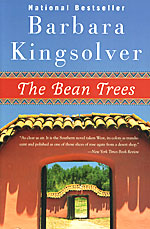
I am also deeply grateful that there are so many wonderful authors writing. One whom I’ve loved to read, though I have admittedly only read 3 of her novels thus far, is Barbara Kingsolver. When I first read The Poisonwood Bible, I was blown away. The storyline, the characters, the premise, the setting, but most of all, just how she wrote. So recently, I read The Bean Trees and reread Pigs in Heaven, more wonderful than I remember it.

I am sad to end one of Kingsolver’s books, though I have another one from that annual book sale awaiting me on the shelf, but I got the chance to peruse the many novels I’d chosen from the sale, and am starting The Memory Keeper’s Daughter. Having shelves of books awaiting to be read is, indeed, an embarrassment of riches.