The Secret Garden – Frances Hodgson Burnett

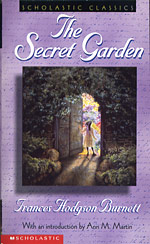
The Secret Garden is a children’s book classic. It’s a novel written in 1911, pretty much at a YA reading level, based on vocabulary and complexity, but with a fairly simple plot, (told in extensive detail), of 10 year old children. I believe that The Secret Garden must be looked at as a piece typical of its time, and for many reasons I doubt it would be published today.

The main characters’ age would be looking for a middle grade or younger audience; the reading level required would be older still. A contradiction. In addition, the author is often highly critical of her own characters, and in describing them, does not engender empathy for them, but rather a dislike. It’s what the reader brings to the characters, I think, that makes them likable. And the detail … there’s an awful lot of it. I suspect The Secret Garden could be told in a fraction of it’s length. But such was not the writing of the time, and this story is nearly a 100 years old.

So what was the attraction in reading this for me?  First, I wanted to remember what it was about, as it was so long ago that I’d loved it. I still love the plot – the healing of two children, Mary and Colin, who suffered greatly through lack of love, and yet being utterly spoiled in their different circumstances. Their healing comes through the wonders of nature and a third child, Dickon, who is inextricably a part of the natural world. His relationship with animals and his understanding of all green, growing things is magical. I also enjoyed the location, the Yorkshire moors, and how Burnett shares the lives and language of the characters who reside there.

And I do so like Burnett’s message – that the magic that ultimately heals is not just the magnificent natural world around us, but the belief in the power of positive thought. Reading the story tells us so, but Burnett’s gem is briefly made clear in one small section of the story, where she reveals this to be the key to both Mary’s and Colin’s recovery from their physical and emotional ailments. “Much more surprising things can happen to anyone who, when a disagreeable or discouraged thought comes into his mind, just has the sense to remember in time and push it out by putting in an agreeable determinedly courageous one. Two things cannot be in the same place at the same time.”

The message of The Secret Garden, written a century ago, is as current and powerful as that of many books written today. It’s a bit of a long read, but a trek into an interesting life and time, and with an uplifting message and satisfying conclusion. However, I don’t know who its audience today might be.

November is PiBoIdMo!

Created and hosted by Tara Lazar, PiBoIdMo – Picture Book Idea Month – is a 30 day challenge during the month of November to come up with a new idea for a picture book every day of the month. This is Tara’s 3rd year hosting PiBoIdMo, and my first year of participating. I’m excited! I find I am already buzzing with ideas in my morning shower or while making coffee.

To participate, you are asked to take the PiBoIdMo pledge to record a new idea daily, (you’re on the honor system), and when you sign up at the beginning of November and end the month with a note of completion, you’re even eligible to win prizes, such as critiques with literary agents. Go, Tara! And …. when you are signed up to participate, you can also put this cool PiBoIdMo Pledge button on your blog.

PiBoIdMo, was inspired, by the way,  by NaNoWriMo, the November writing challenge for novelists, but this one is just for us picture book folks.

So go visit Tara’s site, read all about it, and if inspired you’ll find a link to sign up. But hurry – Nov. 7th is the last day to comment/sign up and you’ll have a bit of catching up to do.

Simple Words of Wisdom

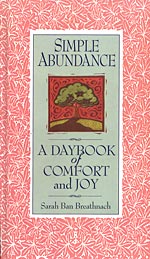
No doubt, you find and read books that inspire you, whether you read them on an ongoing basis, re-read them, or discover them for the first time. Same here. One of my favorites, that I fall back into periodically, is Simple Abundance – A Daybook of Comfort and Joy by Sara Ban Breathnach. Having read it from cover to cover when I first received this as a gift many years ago, I now always have it nearby and let it fall open from time to time to see what Ms. Ban Breathnach has to say on a particular occasion.

I thought I would share with you a line of inspiration that she wrote …  and an example of how the seemingly simplest thought can say it all —

“Learning to shrug is the beginning of wisdom.”

Chronos vs. Kairos

How interesting that chronos and kairos should appear in my reading materials in so close a time frame. Not long ago, I read Madeleine L’Engle writing about it. Then on October 12th, in one of my favorite books, Simple Abundance – A Daybook of Comfort and Joy, Sarah Ban Breathnach addressed it. And as always, these “chance” messages were of particular relevance to my life at the moment, and my feelings of far too much to do in too little time all too often. Might you find yourself in here, too?

Ms. Ban Breathnach defines chronos as how we try and control time – clocks, calendars, datebooks, agendas, beepers, etc. Chronos is time at its worst and a delusion of grandeur – it is the world’s time.

Kairos, on the other hand, is time at its best. Kairos is transcendence, infinity, joy, passion, the sacred. Kairos let’s go and allows us to escape our own confines. It is spirit’s time.

We, who never seem to have enough time, are at the mercy of chronos … or allow ourselves to be. But we need kairos so desperately. We do already know it – it’s any time when we have been so wondrously involved in what we are doing at the moment that we lose track of worldly time and just are. And there we find joy, rapture, oneness with our own spirit.

But how to be in more kairos? Ms. Ban Breathnach recommends the following:

“* By slowing down
* By concentrating on one thing at a time
* By going about what we are doing as if it were the only thing worth doing at that moment
* By pretending we have all the time in the world, so that our subconscious will kick in and make it so
* By making time
* By taking time.”

She says, “It only takes a moment to cross over from chronos into kairos, but it does take a moment. All that kairos asks is our willingness to stop running long enough to hear the music of the spheres.

“Today be willing to join in the dance.

“Now you’re in kairos.”

Sorry, Henry — Sorry, Clare

I tried – I really did – but The Time Traveler’s Wife just jumped around too much for me to follow at this juncture in time, when I am reading so sporadically. This book has such a unique and interesting premise, but I found, that with very little reading time available at the moment, (and often at the end of the day), that The Time Traveler’s Wife was not getting the true attention it deserved. And by all reports of friends who have read it, it’s tricky to follow anyway. So, back on the shelf it goes, to be picked up when I have the luxury of reading for hours on end and truly appreciating Henry and Clare and their time-spanning relationship.

What, then, should I choose? The finds from the Hunterdon County’s Annual Book Sale beckon! There awaiting me are best-sellers, favorite authors, new-to-me authors, and children’s books – lots of them. Among these are fairly current offerings and some classics. Of the latter are some I have not yet read, like Old Yeller, and some I have, including my current choice – The Secret Garden by Frances Hodgson Burnett.

I can remember the copy I borrowed as a child from the Dixon-Homestead Library in the town where I grew up – it was a hardcover, and a medium dark green. I also remember loving it, and am curious to see how it stands up today. Written in 1911, The Secret Garden intermixed some of the history of Burnett’s own life with her imagination, and became instantly popular, and then in time, a classic.

Do you remember reading this as a child?