Eat, Pray, Love – Elizabeth Gilbert

Are the words #1 New York Times Bestseller a draw for you? For me, generally not, though I find and read some by chance every now and then. And sometimes one comes to me through a friend, as did Eat, Pray, Love. Because we are kindred spirits and she thought I might enjoy it, I began to read.

Eat, Pray, Love is the story of one woman’s journey to find balance in her life, to become whole. It is a spiritual journey with many revelations along the way, as she travels, spending 4 months each, in Italy, India and Bali. With everything a woman in her thirties is supposed to be grateful to have – a husband, a great career, and the house in the country – Elizabeth Gilbert is utterly miserable. She makes the year long journey after a painful marriage and an even more painful divorce, followed by a profound depression.

One of the things that is so striking about the story told through her travels is that Gilbert had the courage to embark on this journey at all. I find the book to have its shortcomings, but as I finished it, I found myself impressed with the bravery it took for one woman, on her own, to pick up and travel to 3 foreign countries. She spoke none of their native languages, although yes, English is commonly spoken in all these places. In fact, she went to Italy in part to learn Italian. What she learned – in the Eat chapters – was to enjoy and appreciate … food, beauty, life, and she began to recover, putting on weight and feeling a greater balance.

In the Pray chapters, she is at an ashram in India, working through more of her issues and finding her religion, her God, the spirituality that resonates with Elizabeth Gilbert. She learns to truly pray. And while I found this section too long at times, it was still easy to get lost in India, as in Italy, in cultural experiences so totally different from our own and so rich in their own right.

And then Love. Bali was engrossing. One of Gilbert’s strengths as a journalist is describing so many aspects of the culture where she is living, and I found the Balinese to be fascinating. Here, Gilbert continues to heal and grow, and at long last find what she thought she might likely be without the rest of her life after her marital experience – love. And sex. It is interesting to watch how this plays out, and how, only in a book promo at the end, we find how it all truly ends.

In a conversation about Eat, Pray, Love that I had with another woman, she felt that Gilbert was spoiled and self-indulgent … who could just drop their lives and travel the world for one year on a search for themselves? Who could afford such a luxury? Especially in our pressured economic times, it’s easy to see where that may come from, for how many of us could take such a journey? And yes, at moments, Gilbert did seem a bit self-indulgent. Does she seem to belabor points at times? At times, for me, yes. Ultimately, however, this should not detract from the wonderful adventure – one woman’s search to find herself , find balance and to recover from paralyzing pain – and the depths within herself Gilbert was willing to plumb to do this.

There are life-changing experiences throughout, wonderful people Gilbert meets and befriends, and a spiritual search … I think there’s good stuff here for lots of us.
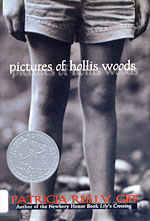
Patricia Reilly Giff – Pictures of Hollis Woods and Lily’s Crossing

Here are two books for middle grade readers by the same author, Patricia Reilly Giff, and both winners of the Newbery Honor Award. I think, in addition to their both being very strong pieces of work, they demonstrate how an author has grown in even a few years.

I first read Pictures of Hollis Woods a few months ago as part of a list I’d made to learn more about writing for middle grade by reading Newbery winners. This book is the strongest, most memorable, and deeply touching of any I have read to date. Hollis is an artistic 12 year old girl who was abandoned at birth, and who has been in several different foster homes ever since, ultimately running away from them all. In the present, she is placed with Josie, a retired art teacher and artist who is slowly losing her memory. Hollis develops a real fondness for Josie, and does her best to not let the foster system know that Josie is becoming incapable of caring for her.

Interspersed with chapters of the present, are chapters describing pictures that Hollis has drawn of a situation in the past, where a foster home wanted to adopt her … a home where she was truly happy. However, something terrible happened and she ran again. Giff has artfully balanced Hollis’ present day circumstances with the pictures she’s drawn telling the story of what happened in the home where she wanted to stay. The two juxtapose until they are woven together into the present. The two story lines become one, building to a great climax. I am amazed at how skillfully Giff has done this. I am deeply touched by Hollis’ character; she is so sympathetic, that it never matters a moment that she “is trouble” or can be flip or fresh. I only cared to see what had happened at that special home and how it would turn out. Talk about a book I couldn’t put down! What a wonderful story and group of characters, and what an inspiration, I would imagine, for Giff’s middle grade readers.

I just finished reading Lily’s Crossing, written 5 years earlier. It’s a very different story, and without the alternating of present with past. Again, the story takes place in Queens, (which, having lived in NYC for quite some time, I always enjoy), in 1944 at the time of the Normandy Invasion. Lily’s Crossing brings with it a much deeper glimpse into a period in time than Hollis Woods, and for that I thoroughly enjoyed it. However, and it may not be fair to compare, Lily’s character, while very likable, isn’t as deeply sympathetic for me as that of Hollis.

Lily is cared for by her father, Poppy, and Gram, his mother. Her mother passed away when she was much younger. When school is out they go to Gram’s house in the Rockaways, where Lily meets Albert, a refugee from Hungary. He has escaped the Nazis, but lost his parents and left behind a sister, from whom he was separated, in France. As Lily and Gram prepare to go to Rockaway, Poppy is called into the service and ships out to France to fight the war. Lily is a funny, somewhat flawed but appealing character, who happens to tell lies quite often, one to her new friend Albert that later endangers his life. But for me, the dramatic tension could have been so much stronger. Still, the characters were all well drawn, the 1944 backdrop always of interest, and the ending very satisfying.

What was missing? I think I was spoiled by the strength of Pictures of Hollis Woods! These stories were written 5 years apart, and really are both ones to read. But it also showed me the growth of an insightful author who clearly cares about her characters and their growth over the course of a novel. I like it when I really care about a character and what happens to her. Patricia Reilly Giff earned those Newbery awards for a very good reason.

NJ SCBWI First Page Session

In our, (and I speak for all my fellow aspiring children’s book writers), desire to be published, or to expand our horizons in terms of who we know or wish to meet, there are plenty of things we can do. One of the best is joining the SCBWI. I belong to the NJ SCBWI, which is a phenomenal chapter.

The NJ Chapter, headed up by Kathy Temean, Regional Advisor, has more exciting events on an ongoing basis than any chapter I’m aware of. This weekend, there is an Illustrator’s Intensive, a Picture Book Intensive and a Novel Writer’s Intensive, all conducted by luminaries in their field, E.B. Lewis, Sudipta Bardhan,  and Agent Scott Triemel. However, I’m writing about one of the smaller of the SCBWI events, a First Page Session.

I attended one of these in Princeton, our Chapter’s usual hosting location, this past Wednesday. We were 22 attendees with two editors – Shauna Fay from G.P. Putnam and Lindsay Winget from Atheneum. For those of you not familiar with First Page Sessions, you submit your manuscript anonymously and properly formatted to fill one page, indicating only your title and genre. Each first page is read aloud and the editors spend their time critiquing it.

While this is not as in-depth as a one-on-one critique received at a mentoring workshop or other event, the input by two editors/agents on just one page can provide great information as to whether your story has a good hook, a good title, appropriate language for the targeted audience, good rhyme scheme, an original theme and so on. Ms. Fay and Winget did a great job of enlightening us to the strengths and weaknesses of our submissions. (One of them even got a little choked up when mine was read, and I am so flattered!) Most definitely worth the very modest price  – for SCBWI members – of only $25. For an additional $25, for members only, you can stay for a delicious dinner and sit and chat with the editors. Another advantage for all attendees is that you may submit a MS to these editors for a limited time period and they will look at your submission as a priority vs. being sent to the bottom of the slush pile.

The humble First Page Session is not only a means of getting a lot of information about your work-in-progress, but also a connection with two editors/agents .. and, if a member, a really good dinner for what today is a pittance. Not an SCBWI member? Check out the NJ SCBWI page for upcoming events and other goings-on – if it looks good to you, click on the kite link up top and join the SCBWI!

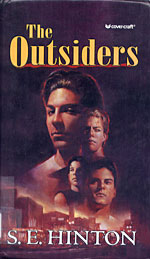
The Outsiders – S.E.Hinton

TheOutsiders-SEHintonHave you ever read a book that exceeded your expectations? Great, isn’t it? I didn’t know quite what to expect from The Outsiders; I’d noticed it had a special placement in my library because it’s considered a classic, but I didn’t look twice. What got me bringing it home, was Patrick Swayze. Yup. Patrick Swayze.
After he passed away, there were many reviews of his film career on TV, and in one pastiche of his films was The Outsiders. Checked it out on Netflix to find it has an all-star cast, (undiscovered at that time), was directed by Francis Ford Coppola, and sounded really interesting. But first I had to read the book.

The Outsiders is a story about a band of brothers and friends called Greasers for the way they wore their hair. They weren’t really hoods, by their own definition – not that hardened or criminals yet – but were a gang of sorts. They were picked on regularly – pretty much for kicks – by another gang, the Socs, the rich, upper class kids from the other side of town. The story’s focus is primarily on Ponyboy, Soda and Darry, three brothers aged 14 – 20, living on their own after their parents were killed in an accident. Social Services agreed to let them stay together if they don’t get into trouble. Darry, the oldest, gave up his dreams of college and works long hours; Soda dropped out of high school and got a job to help; both hoping that Pony, an A student and successful in track, can make something of himself, maybe be the brother to get to college.

But life in their neighborhood is fraught with danger as the Socs take any opportunity to beat up on the Greasers, regardless of their age, Pony being just 14. One friend, Johnny, has been beat up so badly, he’s constantly terrified. Another, Dally, has been in the most trouble of them all, and is the most dangerous … yet a caring protector of Johnny. Each of the characters is very well drawn; while it might be easy to criticize them for their lifestyle of constant smoking, shoplifting, quick inclination to fight and so on, it is soon apparent that they are all each other has in an area that has few breaks for them and a dim future, further clouded over by the threat of getting beaten up as a way of life. Some of them get tougher and angrier, some sadder, more frightened. But as tough and irreverent as they are, you are compelled to care about them.

The story comes to a head in an incident where what would have been just another case of the Socs beating up a Greaser gets horribly out of hand. Everyone’s life changes in a heartbeat. S.E. Hinton has built the characters and events up to this climax masterfully, and from this point, the boys’ lives get catapulted into a series of events, both heroic and tragic, that define their lives and futures.

The Outsiders is a truly terrific read. Considering it was written in 1967, it’s barely aged at all. Those same kids are still toughing it out somewhere on the rough side of a town in the USA. Hinton’s characters are every bit as believable as well-drawn characters written about today. Maybe they turn to drugs now instead of cigarettes; it makes no difference. Hinton has taken boys who might seem like the bottom of society’s barrel and made them believable, 3-dimensional, and totally deserving of our respect and empathy.

For writing The Outsiders, along with several other YA books, Hinton was the recipient of the ALA’s first Margaret A. Edwards Award in 1988, recognizing an author whose writing for young adults provided “an  authentic voice that continues to illuminate their experiences and emotions, giving insight into their lives.”

Now here’s what surprised me. I read the biography in the back of the book to find that S.E. Hinton is a woman. I did not see that coming. I did not imagine that such a gritty story about gangs and greasers in the 60’s would have come from a woman’s pen, (and trust me, I am not at all sexist.) And then I wondered – if she had not been published as S.E., versus Susan Eloise, would this particular book have found such a broad audience? Would people have trusted that a story of this nature would have been as well-written by a woman as by a man? (George Eliot came to mind.)

Clearly, it couldn’t have been better written.

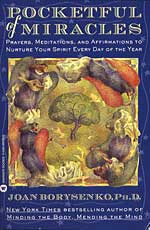
Books to Feed the Soul-A Pocketful of Miracles

PocketfulOfMiraclesIt is often said that when the pupil is ready the teacher appears. I believe that said teacher can also be in the form of a book by an inspiring author. So in addition to whatever novel, picture books, etc. I am reading at any given time, I am also reading a book of a metaphysical/inspirational nature. I find checking in with this book on a quasi-daily basis helps me keep my balance in a terribly hectic schedule, and where I am always trying to find time for my writing and illustrating.

The most recent teacher to appear is Joan Borysenko, Ph.D.,  a scientist, psychologist and mystic whose “guiding vision is to bridge medicine, psychology and the great spiritual traditions of the ages.” A Pocketful of Miracles was sitting on the front sale table at my local library when I most recently returned some books. It wasn’t there 2 weeks ago, and I remember Borysenko’s name as being in the  bibliography of Sarah Ban Breathnacht’s Simple Abundance, another favorite of mine. Could I not pick it up?

Pocketful of Miracles is a perpetual calendar kind of book, divided into seasons in the tradition of much spiritual thought. Each day offers a  seed thought and a prayer or practice. What has enticed me most is the weaving of the world’s great spiritual traditions, with the goal of bringing peace first in our own souls, and then peace and compassion to all on earth. I’m enjoying randomly letting the book fall open and finding my wisdom for the day, or turning to today’s date’s page.

The beauty of keeping going a book of this sort, is that it is always there, always ready to share the wisdom of its author, and should another teacher come along, it will always be waiting when the time is right once again for me to open its pages. I’ve temporarily put aside Change Your Thoughts, Change Your Life by Wayne Dyer, a study of the Tao, as that will always be waiting as well.

A small amount of time spent each day journaling and soaking in some of the wisdom that feeds a soul helps me keep my balance in an often overly-demanding life. And I’m looking forward to A Pocketful of Miracles being my new teacher for now.