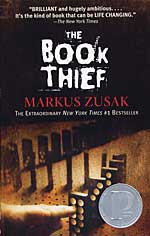
 Here are two things that are connected – I couldn’t fall asleep last night. I finished reading The Book Thief. A book that keeps me up at night after I’m done reading, can often be said to be a good book. Or maybe a disturbing book. Or maybe a haunting book. I think it’s safe to say that The Book Thief is easily all three.
I bought this book in a local bookshop in Clinton in December while shopping for Christmas gifts. I’d wandered over to the YA section and was looking for something interesting. I’d already found a few things for others, a couple for me, and was talking with one of their very knowledgeable staff. He recommended The Book Thief to me, saying it was one of the most incredible books he’d read in a long time, and gave me some background. I bought it.
And there it sat. And sat. And sat. I wasn’t sure if I was ready to read a book set in Germany at the time of the rise of Hitler, no matter how well recommended. I started the book in March, just finished last night.
This is a difficult book to read. Zusak is a phenomenal writer; he has a brilliant way with words that you practically have to read to believe. His idea to have Death be the narrator, sometimes writing in first person and sometimes in third was an extraordinary, if not startling, concept. But it was slow reading. I wondered if it was because I was usually reading it at night; were the realities of the economy weighing on my mind, and so on. But in the end, I believe it is simply the subject matter. This was a horrific and shameful chapter in the history of humankind, and you cannot read The Book Thief without your heart being broken a hundred times. Or at least I couldn’t.
The story really does pick up in the last third of the book where the characters’ lives are all moving into more intense situations seeking some hopeful, but never hoped for, resolution. Each character, including Death, is extremely well drawn. Liesel, Rudy, Rosa, Hans, Max, Ilsa Hermann … are, if nothing else, real people in real relationships. But it seemed for me that it took a long time reading before they had become characters that I truly cared about, and I’m not sure why. It may be that the weight of Hitler’s Germany, woven well into the story line, drew me away from feeling more. Or perhaps I was afraid to feel more for them, knowing that Death was always nearby, ready to reach in and carry their souls away. And as he says, it was a very busy time for him.
So while a story dealing with pain and persecution, it is, however, still a story about love, friendship, loyalty, forgiveness, triumph over adversity, hope, and compassion. Markus Zusak is an amazing writer, and he has woven his story and characters together well, even if there is tremendous loss throughout the book. I do recommend The Book Thief … but to whoever reads it, be prepared for being drawn in to the tragic misfortunes of others in a frightening period of history, even while it is oftentimes no more than a backdrop to everyday lives and commonplace circumstances.
What I’m wondering as I write … not even 12 hours from finishing this book … is do I want to pick it up and read it again. And I’m not sure what to make of that.
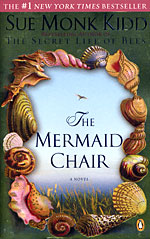 What a terrific read! In The Mermaid Chair, Sue Monk Kidd has given us a tale of a woman searching for her lost soul. Jessie Sullivan, the main character, tells us her story in first person … that of a woman deeply restless in her marriage, lost and unhappy. She is called back to the place where she grew up, Egret Island, by friends of the family on the occasion of her mother having taken a meat cleaver and chopped off one of her fingers.
  I liked Smoke Signals; I was left thinking about a number of things afterwards — the characters, their situations, how the story was told. The two main characters, Victor Joseph and Thomas Builds-the-Fire, grew up together on the Spokane Reservation, bonded by Victor’s alcoholic father having saved Thomas when his doomed parents tossed him out the window of their home, engulfed in flames. Victor and his mother are abused by the alcoholic father, who although he loves them, will not give up drinking and leaves the rez. Sometime later, he passes away, and Victor wants to make the trip to Phoenix to pick up his father’s ashes. As Victor is unable to afford the trip, Thomas offers to pay if he can go along. Victor is troubled and angry, Thomas, nerdy, always optimistic and forever telling intricate stories. Their trip becomes one of discovering friendship, and for Victor, learning who his father really was, forgiveness and understanding.
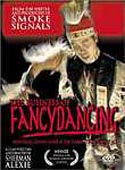 The Business of Fancydancing, based on Alexie’s poetry, was quite different. One of the successes of Smoke Signals for me was that I could really relate to Victor and Thomas. In Fancydancing, the main characters Aristotle Joseph and Seymour Polatkin are defined, yet for me, Alexie failed to create them as fully rounded characters deserving of my empathy. I believe one of the problems is the film has far too many special “techniques” or whatever one would like to call it. I get the metaphor of Seymour fancydancing, and other characters dancing in simpler blankets or more traditional Indian dress intermittently throughout the movie, but overall, there were just too many different moviemaking techniques jostling my sensibilities around. From the periodic one-on-one interviews with Seymour, to the washed-out-lighting home camera effects from the past, to Mouse playing violin in the background, or Aristotle singing in Seymour’s ear – the constant jumble of treatments really took away from the continuity of the story. And I wanted to like this movie.
 Here’s a fine case of not judging a book by its cover, or better said, an author by her previous book. The Secret Life of Bees by Sue Monk Kidd was going to be a hard act to follow. There isn’t a soul I know who didn’t think Bees wasn’t one of the best books they’d read in a long, long time. When The Mermaid Chair arrived on the scene, there seemed to be a consensus that, before even reading it, Kidd’s new book would not be able to compare to The Secret Life of Bees.
 Still A Dreamer