Moving through The Flame

I believe it was the Christmas before last that a dear friend gave me The Book of Awakening by Mark Nepo. Nepo is a poet who writes a daily (prose) offering of guidance for the reader, drawn from his own experiences, from others who struggle with their own humanness as well as the wisdom of the great traditions and teachers. Every day is a different subject and a beautifully written piece.
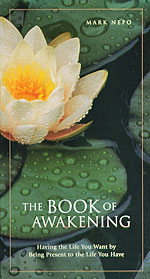
When I first got the book, I diligently followed along every day, enjoying the wisdom offered for the entire year. Now I dip in when I feel the call to do so which almost always assures me of a nugget of truth which is exactly what I need to hear at that time. I opened the book this morning to where my bookmark sat, May 25th, Through the Wall of Flame. The first paragraph reads:

Living long enough, we each find ourselves surrounded by an old way of being, thinking, or loving that is going up in flames. In that unexpected moment, we usually find ourselves full of fear, feeling trapped by an old way of life coming in on us. But this is the passage of rebirth that we must move through if our lives are to unfold. It is the momentary and painful crossing from what is old into what is new.

Nepo goes on to say how understandable it is to stall at this wall of flame, not wanting to go through, but that old ways can burn forever, and we can waste years in the waiting for the flames to go out. And they often never do.

I find there are times in life where things seem to be going smoothly, where we are moving easily forward in positive ways, where our goals and dreams are clearly in view. And then there are other times when they are obscured by Nepo’s described wall of flames … time to learn another lesson to help us grow. Oftentimes, the lessons are the same ones we have been learning and struggling with all along, but now at a new level, a new depth, with a greater challenge and … with a greater reward for pushing through. Even though we may occasionally lose sight of it in the trying.

Over the years, I have been told to be thankful for these challenges as they are opportunities to grow and to grow closer to my dreams. It’s not always easy to cross through the flames, and, while our hands are burning hot, to be grateful as well. The choice, however, is to stay safe at a far greater cost. What I have learned to do when it seems there are flames all about me is to just put one foot in front of the other and believe. Believe that I am always loved, believe that I will always survive the jump through, and believe that what is on the other side is richer than what I ever imagined.

In front of a wall of flames? Let’s all of us take a breath. Ready? Jump!
Books vs. Movies – Part 1

There’s something exciting about reading a terrific book and then going to the movies to watch the film created from it.  However, I, and most folks I know, are of the opinion that the book generally outshines the movie, if for no other reason that so much of a book’s depth and detail cannot possibly be portrayed in the short time allowed for a film. This is not always the case, but I get ahead of myself.

Having recently read The Bridges of Madison County, I rented the movie. I must say I was really disappointed. First, the book is a very short novel; the movie ran 2-1/4 hours long. As mentioned in an earlier post where I wrote about the book, I had my doubts about Meryl Streep and Clint Eastwood cast as the main characters — both outstanding actors, but I didn’t imagine them in these roles. Again, my personal opinion. I would have much preferred Sam Elliot, or even Kevin Costner, (as he is now), as Robert Kincaid; maybe I’ve just seen Clint Eastwood in too many hard and/or violent roles. Meryl Streep, so brilliant, just couldn’t cut it for me as an Italian woman, now Iowa farm wife. It really took away from the story, and that seemed so drawn out over the course of the 2+ hour movie. I’d stick with the book.

So I’m wondering … did you read the book and/or see the movie? Who might you picture in the roles of Francesca and Robert? Or did Eastwood and Streep fill the bill for you?

p.s. This is just Part 1. Down the road, we’re going to have some fun with Part 2 and onward … it’s all about reading and imagination and what we see.

The Bridges of Madison County

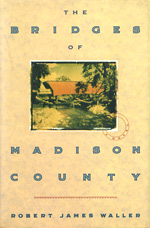
This story by Robert James Waller is a wonderful, short novel – the depiction of a romance, an affair, between two people whose paths crossed in a juncture in time and space which neither expected. The thought that seems to stay with me about the author’s style is that he writes with the heart of a woman, but the pen of a man. This is not a criticism, but rather a compliment. He tells the story of  Robert Kincaid and Francesca Johnson with the lush feel of romance that a woman knows in her heart, yet without a touch of cloying sentimentality. Waller writes with a rich, but simple and straightforward style that I would generally attribute to a man. It’s a great combination and makes The Bridges of Madison County a fast and engrossing read.

The gentle unfolding of this once-in-a-lifetime experience for the two of them and the simply told background of both characters made them especially real to me. I also really appreciated how the loose ends were tied up in the discovery of Kincaid’s belongings and Francesca’s letter after her death to her two adult children, then followed by an interview with a jazz musician in Washington who’d come to know Kincaid before he died. It was all beautifully done.

The romantic affair that lasted for four days while Kincaid was on assignment for National Geographic and Francesca’s family was away for the week at the state fair was the focus – and gem – of the book. Who wouldn’t be sent dreaming a bit after reading this novel?

As for the movie, I added it to my Netflix queue, but I must say I have my questions about Meryl Streep, brilliant as she is, as an Italian. I know Clint Eastwood plays Robert Kincaid, but I see Clint Eastwood as a bit more hard-edged than I saw Kincaid. He’s an excellent actor, but I’m not imagining that wild romantic streak of Kincaid. I guess I’ll just have to see on that one. I’m always ready to be surprised.

Here is the video and song that Robert James Waller created based on his book. Quality not great, but the song is fantastic. What a talented man.

I See You Everywhere – a Novel

I See You Everywhere by Julia Glass was another selection from this year’s annual county library sale. Why did I pick it up?

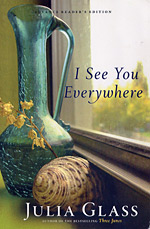
Several reasons. One, I loved the title. All you can see at the book sale are the titles in the way they are arranged. That title drew my attention because of the many possibilities of what it might be about. Two, I was totally drawn to the cover, with this magnificent pitcher of crackled turquoise glass and the seashell. So simple, and yet so arresting. And, I just realized as I write this, each of these two objects may symbolize the two main characters.

Three, the storyline. I was intrigued by the story of two sisters, four years apart, so totally different and how they grew both individually and in their relationship to each other over 25 years. (I also picked I See You Everywhere because a fellow writer has a middle grade novel of two sisters, twins actually, and I thought this might be helpful to her in her characterization.) So an unknown book and author that can appeal on numerous levels right off the bat? A good thing!

The story starts when Clem is still in college and Louisa graduated and beginning a career. Louisa is the conservative and conscientious sister who yearns for a career in art, a good marriage and a family. Clem, 4 years younger, is a rebel who takes on adventurous assignments working with animals in faraway places, daring, and not one to settle down with any one man. Louisa’s and Clem’s stories are told in first person, present tense, alternating between the two sisters. How they move through their lives and their feelings about each other reveals their own personal issues, their challenges, their sisterly resentments, jealousies, and compassion for one another.

I found this to be a very well-written novel. I’ve never read Julia Glass before, but she has a National Book Award behind her for Three Junes, and has written another novel as well. Her use of language is lovely, and I enjoyed that immensely. I was able to identify more readily with one of the characters, though both are entirely relatable, and that character – Clem – drew me in more perhaps for what wasn’t said than what was. This was a good read.

The only thing I noticed, and this was probably only because I just finished How to Save A Life by Sara Zarr, is that I felt I was always reading the author’s voice, not the individual character. What really wowed me about Zarr’s YA novel, also two females, (teens), written first person, present, is that whether you read Mandy or Jill, you always felt they were writing their own chapters. This is no small feat, and I was truly impressed.  In I See You Everywhere, although I was reading Clem or Louisa’s thoughts, it seemed the same beautiful language either way. Happily, it is beautifully written, but following on the heels of Sara Zarr’s book, it was something I noticed.

As for the story, I did enjoy it. I cared about Louisa and Clem. I enjoyed watching them grow, deal with heartache and pain, challenges, successes and failures. The story takes a twist at the end that I never saw coming, and I’m still not sure how it’s sitting with me. But that the author has me thinking about it after I’ve moved on to my next read … well, that says something about a good storyteller.

How to Save A Life – YA Novel

YA NovelHow to Save A Life by Sara Zarr is aptly titled, though it’s not quite clear whose life (or lives) will ultimately be saved nor how until the tension starts building well into the book. I really liked this novel. The story is told in first person in alternating chapters by the two main characters, Jill and Mandy. The book designer was insightful enough to use a different font for each chapter and head it with the character’s name, which made it ever so easy to always know who was speaking. (Unlike an adult book which I am reading now with 2 characters alternating, but which does not help the reader with this very simple aid.)

Jill, a senior in high school, is trying to adjust to the sudden death of her father, with whom she was most closely identified. In addition to her future plans being unclear, Jill now has to adjust to her mother, Robin, having decided to adopt a baby. Mandy is a pregnant teenage girl from Omaha, who needs to get away from an abusive home situation and who has connected with Robin online to give her baby away. Additionally, there is a love interest or two for Jill, but plenty of conflicts for all of the characters.

One of the things that is so very impressive in How to Save A Life is the absolute consistency of voice of both Mandy and Jill, and I say kudos to Sara Zarr for pulling this off so amazingly. I found the story to move along at a slow and gentle pace for quite some time, gradually revealing Jill and Mandy’s situations, feelings and conflicts. It builds quite  seamlessly to the point that could change everything, and then the pace picks up rapidly.

Mandy and Jill are as different as day and night, as are their life circumstances, but Zarr never gave me any real reason to change my mind about how I felt about them, no matter how they behaved or what choices they made. Mandy and Jill’s choices were always understandable, always forgivable, no matter how seemingly selfish, unwise or uninformed. This is the mark of a great author, to create characters we genuinely care about and with whom we can identify.

I recommend How to Save A Life to anyone who enjoys a good read and wonderful character development. For those of us who are writing, how Sara Zarr has put it all together is enlightening, as well.