So This is Lemony Snicket! (The Miserable Mill)

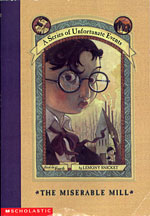
I may be the last person on the planet to have finally read one of the Lemony Snicket series. I may also be one of the only to not be totally enamored by the one I read, as well. Another selection at the wonderful annual library sale, it was an opportunity to increase my familiarity with what kids are/have been reading nowadays.

I must say, as I read The Miserable Mill, the 4th in the Lemony Snicket series, I wondered what would be the attraction for children in a continuing series of misfortunate events happening to the Baudelaire orphans. It just seemed like an awful lot of doom and gloom … not that I am one to revel in endless parades of flowers and fairies … but I was curious as to the attraction of the never-ending succession of misfortunes that befell the three main characters – Klaus, Violet and Sunny.

It kept my attention enough that I wanted to see how it all came out for the orphans, and it did manage to become rather silly and enjoyable towards the end, but what is the appeal of knowing that the children’s lives continue to get worse with each chapter? It was quite dour and gloomy. What I did certainly enjoy was Sunny, the baby’s, bursts of nonsensical words and phrases, which were always interpreted by the author afterwards. That was funny.

Are the other books in the series this gloomy? Perhaps I’d try another, but probably it won’t be tops on my list just yet.
Where Do Picture Book Ideas Come From?

The recent PiBoIdMo challenge, which I am continuing into December and onward, showed me a couple things about where picture book ideas come from, so I thought I’d share.

  1. They come from our everyday experiences. Yesterday I posted a couple pictures of the sky at dusk. As it happens, 2 of my PB ideas had to do with the sky. They are both totally different, but where did they come from? My direct experience with what I viewed outside … a cloudy day and a brilliant sunset. I got to wondering … how did they get that way? And the answers started popping. Whatever we’re involved in at any given moment may give us ideas. Look out the window; go for a walk; watch a few kids playing at the park; discreetly listen – there’s some ideas right there!
  2. Ideas come from what we know. The advice we get from editors and agents is to write what we know … I’m always involved with animals in one way or another, and it is something I do write about. Many of my story ideas. although all different from one another, are about animals … inspired by my own cats, or dogs, birds in the snow, a parrot I know, etc.
  3. Ideas come from what inspires us. A true story that happened a few years ago about a heroic rescue of a huge animal …  a story of men who risked their lives to save one animal, and who in her own way returned to thank them. I’m not sure how I can parlay that into an exciting PB yet, but I’m not letting go. The entire event was inspirational, and I do believe children would be moved and inspired as well.
  4. Ideas come from something important we have to impart to a child. Hopefully, by the time we’re writing children’s books, we’ve learned a thing or two in life, and maybe, just maybe, we have some gem of wisdom to bring to children. Not in a preachy or obvious or pedantic way, but in a way where they’ll love a story with a subtle message that speaks to them … the value of friendship, being kind to others, whatever it may be. Quite a few of my story ideas have – surprise! – no animals in them, just children, and something I’d like them to know. And so …
  5. Ideas also come from past experience – different from what we know. How we overcame being bullied at 5 on the monkeybars, might be fodder for an idea. (That wasn’t me – I wasn’t allowed to climb up beyond that second bar.) We all grew up and had all kinds of experiences – what we learned from them, or didn’t, can feed a PB or two.
  6. Ideas come from that most special kind of childhood thought .. magical thinking. I fall into magical thinking alarmingly easily, and it’s not just fun it’s .. well … magic! The unexplainable, the mystifying, don’t we all love it? It’s the unexpected twist of fate, the reveal of a character’s true identity, that makes us sit up and be curious about how things may REALLY work. What small child doesn’t have some brilliant, albeit “unrealistic”, (in our very serious adult world), ideas about how things go. We can learn a thing or two about small children’s thought processes.
  7. Ideas come from reading. Not that we are ever taking anyone else’s ideas, but that by constantly reading books of all kinds – fiction, non-fiction, for children, for adults – we are literally soaking up creativity. Without always noticing, we are sorting out what things work, what don’t, how we feel when certain things happen. Or when they don’t. I am always reading and have been since the day I could. Reading is not just a joy, but today, it’s grist for the writer’s mill.
  8. Images – ideas come from images – photographs, paintings, illustrations – ever look at a picture book’s illustrations, compare it to the story they accompany, and think “that’s not what happened!” Leaf through a magazine – what are people talking about? Whose child is that really?
  9. Did I mention food? Ha! Now there’s an inspiration that needs no explanation.

Any sources of inspiration I missed?

Traveling in Time

I’m really enjoying this book … it’s one that I feel drawn to when I’ve finished whatever else needed to be done during the day and when I have some time and space to relax with a book.

Written in 1970, Time and Again does not have the fast-paced style of some of our current novels; Finney is no Dan Brown, but … he has a great story — within a story, as it turns out — and he has my attention. I am about mid-way through and my interest is only picking up.  Our main character Simon Morley has committed to a top-secret government mission to see if people can travel back to points in time, to particular locations, and return with information. A good portion of the beginning of this book details Morley’s being approached, his being interviewed, and then prepared to step back in time.

He returns to February 1882 in New York City to observe a particular transaction between 2 men which seems to have precipitated the financial ruin and suicide of one of them. One of the project’s directives when Morley enters an earlier time is that he not take any action which might change future events. The question we see, when he is in his third visit is, is this possible? And this is what will be revealed as I read on.

Another attraction in this story is that it takes place in NYC. Being familiar with the Dakota and the 72nd St. entrance to Central Park, knowing its proximity to the much-loved Museum of Natural History, having been in Trinity Church more than once, and having worked in the tangled web of narrow streets that is the Wall Street area is, in itself, a big draw for me. But reading his in-depth descriptions of what this all was like in 1882 … is riveting. As an artist, Morley sketched the areas of the city that he saw and some of the people he met … and these all appear in the book.

I think what may be the clincher in this story is that while reading it, and it’s written in the first person, it is absolutely believable that Kinney/Morley is writing not fiction, but a first hand experience of his involvement with the project and actual regressions into 1882.

So while the book’s writing style may be a bit dated, it’s a real attention grabber nonetheless. And I always like a book I can’t wait to pick up again.

12/11/10 – FINISHED! I finished reading this last night, and it lived up to – and even beyond – my expectations. Although a bit long when Morley is on the run from the police, it soon changes into several unexpected scenarios, primarily a great final twist. Like time travel? A good mystery? A good read!

PiBoIdMo – A Month of Ideas

What a great month it was in terms of writing picture book ideas … as hosted on Tara Lazar’s site, PiBoIdMo – Picture Book Idea Month –  was certainly an inspiration. Whether I win one of the 3 idea critiques by agents offered as random prizes or not – and wouldn ‘t that be nice? – PiBoIdMo kept the ideas flowing, and what’s more they are continuing to flow even now through December.

I have a book upstairs, written a while ago, entitled A Kick in the Seat of the Pants. The title pretty much says it all and it’s about getting off our respective duffs and doing what we aspire to do. Well, PiBoIdMo did just that .. and I now have 30+ ideas from which to build new picture books. (And I got that nifty completion winner button, too!)

Are you stalled in your writing? Though November is the official month, one could really do this at any time … it could be for picture books, novels and even illustrations. Or sketches. The idea is getting us moving and in that, it succeeded! Inspiration is definitely a good thing!

November is PiBoIdMo!

Created and hosted by Tara Lazar, PiBoIdMo – Picture Book Idea Month – is a 30 day challenge during the month of November to come up with a new idea for a picture book every day of the month. This is Tara’s 3rd year hosting PiBoIdMo, and my first year of participating. I’m excited! I find I am already buzzing with ideas in my morning shower or while making coffee.

To participate, you are asked to take the PiBoIdMo pledge to record a new idea daily, (you’re on the honor system), and when you sign up at the beginning of November and end the month with a note of completion, you’re even eligible to win prizes, such as critiques with literary agents. Go, Tara! And …. when you are signed up to participate, you can also put this cool PiBoIdMo Pledge button on your blog.

PiBoIdMo, was inspired, by the way,  by NaNoWriMo, the November writing challenge for novelists, but this one is just for us picture book folks.

So go visit Tara’s site, read all about it, and if inspired you’ll find a link to sign up. But hurry – Nov. 7th is the last day to comment/sign up and you’ll have a bit of catching up to do.