When the Title Doesn’t Fit the Story – Taming the Star Runner

When I’m offered coffee, I don’t want tea. When I’m offered a ride, I don’t expect to walk. When I choose a book entitled Taming the Star Runner, with a number of horses on the cover, and a jacket liner which pumps up the story of a horse named Star Runner, I don’t expect a story about a teenage boy named Travis. But that’s what I got.

Taming the Star Runner  by S. E. Hinton is a coming-of-age story about a 15 year old named Travis, who, while he sees himself as very cool, is always on the edge of getting in more trouble than he can handle. After attempting to kill his abusive stepfather and doing some time, he is sent to live with his uncle on a ranch in Oklahoma. Here he meets, among others, a teen barely older than himself, Casey, rider and riding instructor, and then we finally meet who seemed to allegedly be a main character, her horse named Star Runner. Had I not been excited to read a story about this wild horse, who only first appears halfway through the book, I may have liked the story more. Or maybe not picked it up at all.

S.E. Hinton, deliberately using only her initials as an author, (lest it be realized she was a very young woman author), broke ground in the 60’s, writing about gangs. Her first published book was The Outsiders, written when she was 16. This story is similar in the sense that Travis is another angry, angst-filled teen, feeling unappreciated, isolated and ever on the edge of an emotional explosion. The story is fairly good, actually. Travis’ character is well-drawn, as are other characters, and the plot has some interesting twists and turns, even if, in my mind, they are not all tied up that well in the end. Still, this particular tale became more interesting for me when the powerful spirit of Star Runner was introduced and the girl who wanted to tame him.

Having read a number of Newbery-winning and other middle grade novels, and having learned what editors are looking for and what is being published nowadays, I can’t help but wonder if Hinton would have been published today. Or at least if she remained in her own writing style. Being mindful of what we are told at workshops, conferences, online, etc. I am sometimes amazed at how she worded things, switching tenses, using unmarked self-reflective dialogue in the same paragraph as lengthy descriptions, etc. It made me realize how much more refined the craft of writing – in this case, for teens – has become.

I don’t mean to sit and criticize S.E. Hinton for what she did – she brought a whole new way of life and type of character to light in her novels. They were groundbreaking, have become classics, and continue to resonate well with many readers today. I only wish the book had really been about what the title told me.

 

When Life Gives You ….

Most of you will probably finish that line with “… lemons, make lemonade.” It’s an old adage about making the best of things, to which I have added my own variation. “When life wakes you up at the crack `o dawn, get up!”

At first, I was really fighting this. For whatever reason, this year and last, I have been waking up with the sun, this year even more so with a bumper crop of birds singing about 40′ from my open bedroom windows.  I’m a morning person,  but 4:45 am? Come on! But awake I was. I tried going back to sleep, to no avail. I lay there and harrumphed – needless to say, that didn’t help. But I was becoming more and more tired as I was still going to bed at the same time. What to do?

Adjust! I started going to bed about 10, so when 4:45 rolls around, sometimes heralded by the sun, but always by the birds, (clearly I am now synching with their bio-rhythms), I can actually get up and start doing stuff. By the time I start my jobs, I’ve often accomplished quite a bit. Ergo, the photo of the carrot bread.

I got out all the dry ingredients and mixing bowls, loaf pan, etc. last night and grated the carrots. After feeding the small fry this morning, I opened up the windows to a nice cool 65˚, whipped it together and popped it in the oven. Voila! a cooling carrot bread at 7:50 a.m.! By the time you see the finished photo with a cream cheese icing, it will be a few hours later.

Sometimes reality is a pain in the butt. We don’t always want to hear about it, nor deal with it. But the fact remains – whatever the reality is, if it’s not something we can change, it’s not going away. So for now, one of my realities is waking up at 4:45 a.m. And although this was a carrot bread morning, I discovered that this new reality also affords me extra time to work on my children’s books with no interruptions.

Maybe tomorrow I’ll give the little choristers a standing ovation.

Me? Write A Novel?

A novel? Really? A couple years ago, Sheri, from our children’s writer’s group, said, “You have a novel in you.” I didn’t find that to be something impossible, yet didn’t see it as highly likely at the time, either.

Aside from one story of mine which hasn’t yet found its proper genre – picture book, chapter book or middle grade – I have been focusing on picture books. I read novels all the time, but had not really thought about writing one of my own. The meager story beginning I had written for a First Page Session was a starting point, and even then, I wasn’t all that focused on it. Until I got a critique from two editors on my storyline, and things that did and didn’t work for an MG reader.

Since that time, I’ve had a unique experience. The story is writing itself.

I’ve read online, and seen among my fellow writers, how some novelists just write it all down straightaway, while others make an outline, map it out, etc. This is not what’s happening. The story is telling itself to me … at odd times, when I’m relaxing, working, whenever it pleases. I mentioned this to my friend, Linda, who told me I’m channeling my story. Well, that’s kind of exciting, and makes sense. Although I envisioned a most basic structure for how the pattern of the chapters would go, beyond that, it just keeps coming.

I’m not writing anything down; there’s no way I’ll forget it. I’m allowing it to just come through. I cry, I laugh, I see who’s becoming a character. This is very new to me. Some ideas require some of my attention – for ex., should that character enter my heroine’s life in the same chapter as another? Why IS my character like that? And I let it go. The answers come back in a fairly short time.

I don’t need too many facts at this time – I can fill in the realities of horses, riding, racing, later. But I realize I can also feed my storywriter within, so am reading Taming the Star Runner by S.E. Hinton, and perhaps returning to other horse related books I have here or reading some new ones or checking out some videos. I am fortunate to have friends involved with horses who can help me with facts, as well as one of the sources for this story’s inspiration … the horses of Mylestone Equine Rescue, for whom I volunteer and help in other ways.

Perhaps the best part of all – is I’m not in a rush. It comes as it comes, and I’m quite grateful for that.

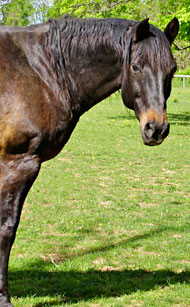
At top left is a photograph I took of Calvin, one of Mylestone‘s rescued horses.

Where Do Story Ideas Come From?

Back in December, I devoted a post to where ideas for picture books come from. With energy still running high from the NJ SCBWI June Conference, I feel inspired to expand that post. I’ll start with an example.

The photo below tells a story that may or may not have interest to you, but it definitely does to me. You may not even see the story right away. But stick with me. By way of background, I put food and water on my back porch for the 2 cats next door who are outside most of the time, and often visiting me. In time, a small tuxedo feral whom I’ve named Little Fee found the food, and now he’s a regular. I feed him morning and night, and he can graze whenever he’s inspired until I bring the food in. But who else is at the food bowl?

Well, if you know animals, you can look at the photo and know that it’s not just a cat. Towards the end of this past winter, when food sources were slim, I had two visitors who discovered the food – a young skunk, and a young opossum. While neither bothers me, I don’t need animals with lots of teeth or who can spray horrible smells on my porch. So I started bringing the food in as soon as it got dark. They left and found food elsewhere.

Feeling confident, now that it’s June, I started leaving it out a bit later again for when Little Fee comes around. So look again … and check that footprint. Here it is enlarged – Exhibit A. Based on my research last time, I’m pretty sure that I have a possum again. But he’s not the only visitor … I started noticing an increase in bird poop on my porch railing. Closer observation has revealed that a mama Blue Jay swoops down several times in the morning and late afternoon, takes a piece of food and flies away. She’s either feeding her young or eating it herself and regurgitating for her young.

For me, that’s a story idea. Three cats, a skunk, a possum and a Blue Jay all coming for dinner. I’m always enamored with nature, and this inspires me!

So where do story ideas come from? Always something of meaning and interest to ourselves. It can be something as simple as an observation of nature on our back porches, or something we’ve always wanted to know more about, or experiences or observations we feel compelled to write about. It’s when we are trying to write about “not us” that stories fall flat. We need to know ourselves, (or be willing to discover), and write from our hearts. So simple.

At the June Conference, I had a PB critique which inspired me to improve my story and rework my dummy. In a First Page Session, I got some suggestions that got wheels turning about really writing that middle-grade novel I only occasionally thought about. Where are those ideas coming from? My past, my love of horses, and all the information I’ve been absorbing over the last 7 years from helping an equine rescue and having friends who ride. The ideas are flowing as through an open faucet. I didn’t expect that from a simple First Page critique.

And in one workshop about breaking picture book rules, we split into 2 groups halfway through, and one of the two presenters, Alison Formento, gave us a writing exercise. What we participants wrote in such a short time was both amazing and moving to us all. And right there was another idea for each of us, because Alison had triggered our writing about something meaningful in our lives.

It all starts with an idea … what has meaning for you? What MUST you share with the world in whatever genre or whatever format or voice you choose? That’s where story ideas come from. And sometimes it can be as tiny as a muddy little paw print.

Hold on to the Dream – NJ SCBWI Conference

There’s always one bad thing about the NJ SCBWI Conference … it’s over.

Dr. Seuss, now …. my book, tomorrow!

Driving home from the conference, I am always tired, but also revved up, thinking of all the things I learned, what manuscripts I want to get right back to, editors/agent’s comments, etc.  And then there’s the next step – I walk in the door. Lo and behold, the life I left behind to immerse myself in days of children’s books is still there. Waiting for me. Needing me. Demanding of me. I don’t imagine it’s terribly different for many of you. And unless you have reached that wonderful position in life where you spend your waking hours writing and illustrating children’s books, you, like me, can watch your dream start to fade into the laundry, kids, pets, dinner, work, etc. And we haven’t even put our bags and portfolios down yet.

So, I’ve been working on some ways to hold on to that wonderful dream we nurtured at the NJ SCBWI June Conference. I hope these work for you.

  1. First off, I make the time to make a list of all the things I want to do as a result of the Conference, from sending a thank-you to jotting down what I will be focusing on. (Details can come later.)
  2. In the next day or two, I write out thank-you’s to the editor’s and/or agents who have helped me with my work.
  3. I find a couple of photos of the conference – or even the conference center – and print them out and put them on my desk. If I can find a printable one of the agent I met with, I do that, too. Even on days when I have no time to write or draw, those images keep the experience alive.
  4. I follow up by filling out the survey that Laurie sends out and by checking Kathy’s blog for post-conference news and updates. (I check her blog daily anyway, because she is such a wealth of information about children’s books, but especially now, I look forward to her posts on this event.)
  5. I pull out whatever MS was/were critiqued over the weekend and put them in a separate folder – this is what I will be working from – I put the names of the MS on the front, and place it in plain view.
  6. I next set up a real schedule for myself regarding what time frame I want to get what done – what is the date I want to get a revised MS back to the agent?, etc.  I also, at this time, review the bios of the editors and agents attending – who might be appropriate to send something to …. now while the iron is hot!  Some of those submission windows close sooner than others. And then I send them within the next few weeks. Setting up a special calendar where you mark your deadlines can be very helpful. It’s one thing to do it on your computer, but another when it’s 3-D and you look at it every day!
  7. Back to the list – take a little time to think .. how can I fit what into my schedule and when. I managed to really step up my game pre-conference. How can I keep that energy going, (and yes, still sleep, etc.)? When can I block out some time consistently to focus on one of my dummies and/or illustrations each week? Where can I block out some time to write until it becomes a habit again? If I really want to write and illustrate children’s books, I must figure this out now.

That’s what I do. I admit that I do well with a list, but … I don’t want this experience to fade, or fold in on itself in the face of the many demands of everyday life. I plan to hold on to the dream, and imagine that the little reading group up there is reading MY children’s book. Who knows? They might be reading yours!

If you have any more ideas of how to hold on to the dream of writing and illustrating children’s books post-NJ SCBWI June Conference, let me know.