Outfoxing Your Reluctant Artist – 2

Kerry Blue ProfileStalled? Change your venue!

I prefer the word stalled to blocked, because sooner or later we always get going, and blocked is so …. well, final. One of the things I have found to work when I am feeling stalled is so simple it sounds like the obvious – do what you’re doing someplace else. If you normally draw in your studio, but the space now seems as arid as the desert, take your sketchpad and your materials someplace else. Try the kitchen table, the back porch, the patio, the park, a favorite restaurant or someplace further away.

If it’s writing, and you, as many of us do, write at the computer, but it’s staring back at you with all the blank stare it can muster, shut it off. Grab a notebook and your old-fashioned pen or pencil and go elsewhere. If in the house isn’t far away enough, go further, maybe even for a drive or a subway ride to some other part of town. Sit in a gallery or the library; go eat someplace with fabu food. Hang out with your friend’s dog or cat. You get the idea.

When we have associated our art with a particular location, that very same location can seem the antipathy of inspiration when we have something really BIG to do or are looking at a looming deadline or want to get back to something we started a while ago. Perhaps you haven’t spent time in your creative space recently. So jump start your project somewhere else and you may just find your self rolling along in no time. Works for me; hopefully, for you, too.

How Many Story Elements Are Too Many?

How many sub-plots are too many? When are there too many POV’s? Too many characters?

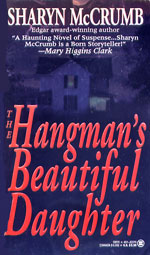
HangmansDaughterExample  – A suspense/mystery novel I just finished by an author new to me, The Hangman’s Beautiful Daughter by Sharyn McCrumb, brought these questions up – and had me thinking about their relevance in children’s books.  Particularly as we write stories of greater length, they are important points to consider, but they can be equally important in picture books.

In novels, I enjoy those which utilize more than one POV. What comes to mind is The Poisonwood Bible by Barbara Kingsolver, an excellent book. Each chapter is written, on an unevenly rotating basis, from one of the family member’s POV as they all try and come to grips with the harrowing situation to which their husband and father has brought them.  Each writer’s POV is unique, yet always moves the overall story forward, while masterfully intertwining the relationships of each family member.

In contrast, while it is a good read in many ways, The Hangman’s Beautiful Daughter has too many characters to keep track of and too many sub-plots going on, one of which seems irrelevant to the overall story. The POV remained omniscient throughout and was clear, but I found myself wondering why certain characters and their seemingly separate story were included.

These same points need to be considered when writing children’s books. I notice in my own writing, I tend towards more than one POV. This is fine if a) done well and b) if it’s suitable for the reader of  that particular story. I’ve been reworking one of my picture books, in which, while I find two POV’s working for me, they will not work for the age child who reads a picture book. 4-7 year olds are not yet that sophisticated in their comprehension skills and will be confused.

Keeping our chosen genre(s) and their audiences in mind is critical to a story’s success. We can observe in anything we read what is working and what is not, especially the books we absolutely love, and how that applies in our own writing. Does the story have more than one POV? Should it? Are there too many characters for our intended audience to remember? If there is a sub-plot, is it so relevant that the reader will find it totally compelling? Or might it become confusing?

I think what we all strive for is writing the book that our reader cannot put down. And to that end, everything we read can enlighten our own writing.

NJ SCBWI June Conference – A Few Thoughts

ChildReadingThe June 2009 Conference was, once again, spectacular. There was an amazing group of agents, editors, illustrators, authors, and art directors waiting to critique, guide, challenge and enlighten the 240 participants. And there was plenty of talent on the attendee side as well. Both new and familiar faces were present to submit manuscripts and illustrations, in hopes of landing that book deal or finding the perfect match in an agent or editor. And it happened or is in the works already for some of the folks who were there!

This year, I attended Saturday only, but it was no different than Friday in that critiques, first page sessions, and talks were scheduled all day long. At the same time, items were available for bids in 2 separate auctions; participating  illustrators’ work was on view; and the Book Fair was open for perusing. As we rushed from one activity to the next, up and down the stairs in Stuart Hall, it couldn’t have felt more like being back in college and trying to figure out where our next class was. It was familiar, crowded, and wacky, and more than one of us – way more, actually – were periodically to be seen standing stock still trying to figure out what we were supposed to be doing next. 

Everyone, by the end of Saturday, is totally wiped out. But in a good way. If you want to be published in children’s books and are not attending conferences, you need to consider it – you’ll be amazed at the jolt of inspiration you’ll get.

It had been my thought when I started this to offer a few tips about attending a conference such as this, but I suspect they’ve all been written up somewhere online. Or maybe a few would help. Here’s the most important ones overall I can think of …

  • Reduce your stress – The activity is non-stop, so it behooves attendees to minimize stress, and I suggest doing this by being totally prepared ahead of time – right down to what you will wear, directions, being all packed up and ready to go the night before. Be prepared by being somewhat familiar with the editors and agents who will be attending – come already having researched at least some of the author or agent’s web sites, their bios, what kind of books they’re doing, etc.,  (that is, if you didn’t do all this before you sent in your application!) When you have minimized your stress, you will also be much more able to hear your critiques.
  • Have the right attitude – being optimistic is the best way to go. Every editor’s and agent’s view on your work will be a little different, and it is important to be open to all comments. The faculty are present to offer their input with the best of intentions in helping you further your work. Be prepared for both praise and criticism and for things you do and don’t want to hear. Listen carefully, ask questions, and let what is said sink in, as you will be revisiting their suggestions later. And later again. Stay positive.
  • Follow-Up – Once home, write thank-you notes or letters to the faculty that you met with. Review the critiques you received and make additional notes while everything is fresh in your mind. Bring your experiences back to your writers’  groups, (you do belong to a writers’ group, right?), and share what you’ve learned with one another. This is another way to keep your critiques fresh in your mind, and to go over the feedback with the people who know you and your work the best. Plus, it’s a great way to figure who you may or may not want to meet with in the future, who may be most open to your particular style of work.
  • More follow-up – get down to the re-writes, the edits, the next dummy or illustration revisions. Get ready to submit to those faculty members who expressed an interest or openness in seeing your work again. But don’t wait too long – the next conference will be here before you know it!!

If you want to get the most from your writing, join SCBWI, and find where your local SCBWI is and join them, too. (New Jerseyans, you’re here.) Get in the know about the big field of children’s books. Search out a children’s book writers’ (and/or illustrators’) group nearest you. The support, encouragement and shared information is invaluable.
Kathy Temean Exhibits in PA

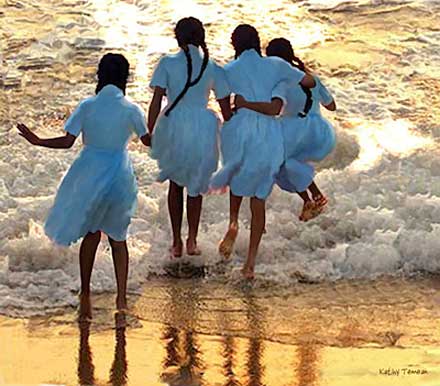
Kathy Temean is an outstanding illustrator whose work is being featured the entire month of June in a one-woman show at the Newtown Public Library in Newtown Square, PA.

KTemean-GirlsInSurf-w

While you can view Kathy’s work online at her web site, seeing the color and texture of her work in person, as is so with any artist, demonstrates the real depth of her talent. The illustration above, Girls in Surf, is just one of many images that are on view during June.  Kathy’s illustrations appear in children’s books, on book covers and in web sites she builds under Temean Consulting, and have  a unique quality which brings a richness and vibrancy to each image. Worth a look!

To see Kathy’s work on exhibit, visit the Newtown Public Library – 201 Bishop Hollow Road – Newtown Square, PA.  Phone: (610) 353-1022.  For you online art exhibit visitors, check out Kathy’s web site.

Hope Was Here – Joan Bauer


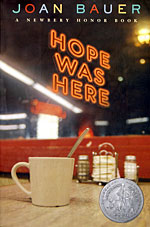
YA novel - Hope Was Here

Hope certainly was here in this Newbery Award winning YA novel. Hope is 16 and raised by her single aunt, Addie. Hope’s mother, Deena, felt the best thing she could do for her baby was to have her raised by Addie, her sister. Named Tulip at birth, Hope decides to legally change her name at 12, often wondering if she can live up to her new name.
Addie and Hope have moved several times across the U.S., Addie following needed jobs as a short order cook in diners, and Hope, a young but experienced waitress, repeatedly having to leave the friends she’s made. Hope longs to one day know her father who she wants to believe is trying to find her, while Deena occasionally shows up in her life.
The story begins with Addie and Hope arriving in Mulhoney, a Wisconsin dairy town, to run the diner for the owner who has been stricken with leukemia. Hope Was Here is about hope for so many things, not just in Hope’s own life, but in the lives of those around her … in a man hoping to go into remission who runs for office to defeat a corrupt system; in the hope that good will prevail in this small town; that the undercurrent of love that streams through so many of the characters will prove, not only that love can prevail, but that hope is worth holding on to. Much of the story’s action takes place in and around the diner, where the customers and dishes Addie whips up serve as a colorful backdrop.
Life changing experiences abound for every character in Hope Was Here, in a can’t-put-down tale, that not only manages to beautifully explore relationships, but amazingly, also weaves in politics and the difference that teenagers can make in influencing their and others’ lives. The food served up by Addie in the diner may have you wanting to find something in your fridge, but Hope’s story will have you sitting, smiling, and definitely believing in the value of hope.