Precepts, Quotes and Words to Live By

Wonder-RJPalacio2I am always a big fan of these, which, to me, are more or less the same thing. I tend to think of them as quotes, but in the book I just finished, Wonder, by R.J. Palacio, these are referred to as precepts by Mr. Browne, a character in the book and a middle grade English teacher at Beecher Prep. (I will write more on Wonder soon – this is what lit my spark today.)

Mr. Browne found that his students were more inspired by a quote he had once discovered than by how it had greatly influenced his life, so at the beginning of each month, he wrote a precept on the board. The class discussed it during the month, and at the end of the month, the students wrote an essay about it. Over the summer, his students were encouraged to write their own, or some other inspiring precept and send it to Mr. Browne. What a great teaching idea for real life, eh?

The copy of Wonder lent to me by a friend was part of a boxed set which also included a second volume called 365 Days of Wonder, Mr. Browne’s published selection of a year’s worth of quotes on the issues written about in Wonder, which, in a nutshell, is about kindness as well as overcoming adversity and bullying.

Midsummer Eve painted by Robert Hughes, 1908

Midsummer Eve by Robert Hughes, 1908

He also includes some precepts submitted by his fictional students. This is a really great accompaniment to a book that addresses these issues so well and would hopefully be an inspiration to Wonder‘s middle grade readers, (not to mention a brilliant marketing idea.)

So I started to read the precepts/quotes.

I was entranced by the quote on January 2nd written by Roald Dahl, (of Willy Wonka and the Chocolate Factory and James and the Giant Peach fame, if you’re not familiar).

“And above all, watch with glittering eyes the whole world around you because the greatest secrets are always hidden in the most unlikely places. Those who don’t believe in magic will never find it.”

It just brought a rush of imagery and creativity to me – “glittering eyes”, indeed, and sparkling thoughts. I am always amazed how such seemingly small tidbits drop right into our laps when we least expect and need them most. Or I am just paraphrasing Roald Dahl?

Have an inspiring day!

Diversity: Writing What We Know – II

parttimeindianOne of the big topics in children’s books today is diversity, and although there are far more accomplished people addressing this subject than I, children’s publishing is where my energy is focused. For me, it also ties in to writing what we know. (See my first post on this topic.) So while there are many ways of supporting diversity in children’s books, from book purchasing to publishers themselves, I am just looking at writing.

What does diversity in this context mean? As I understand it, it’s a need for the stories we write and publish to include or be from the perspective of people of diverse races, cultures and backgrounds. When I was growing up, the subjects of all the children’s books I read were white, (unless we went into fairytales where Aladdin was darker skinned and exotic, but that was different.) The kids who were the main characters — think Dick and Jane — were only white. Those few stories where black people were featured were of a derogatory nature and a sad comment of the times. Hispanic or Asian individuals were non-existent. Indians were part of Thanksgiving stories, but otherwise, also absent.

Holes-LSacher2How much has changed in the world of children’s books? Again, I am hardly an expert, but our books have not changed nearly as much as the changes in population of the people around us. What is true is that we as authors do need to be aware that the world is way bigger than the little enclaves where we live or where we grew up.

In my humble experience, I have found that Americans, on the whole, tend to be a rather insular people,with a focus that is primarily on our own culture. While exceptions are found in sports and music and a few select other fields, a lot of people don’t seem in touch with the breadth and diversity of the world beyond their own boundaries. A broader experience of the world would bring a lot more to a writer’s plate than what we see just at home. Representation of other races and cultures in children’s books is dragging way behind the actual reality of diversity in everyday life.

ManiacMagee-JSpinelli2How does this affect how we personally write? And how do we write what we know in this context? There’s a lot of opinion on that. Needless to say, I can most comfortably write about my own experience in the world, and this comes from a Western European background of diverse nationalities. If I write what I know, it will be primarily from this perspective, but it doesn’t mean that I can’t include, in both my writing and illustrating, characters of the many races and cultures I have come to know along the way in my life and/or others that exist. But does that also mean that I can’t write from the perspective of a race or culture for whom I feel a deep kinship? That I don’t, or can’t, know enough?

Dogsong-GPaulsen2I was fortunate to have been raised in an area with easy access to New York City so that many of our family outings were in the city where we were surrounded by diversity. When I went to college in NYC, my exposure was expanded as my school was known for drawing talent from all over the world. For this amazing experience I am very grateful. I know that I can bring this, my ongoing living and working experiences, as well as my travels to my writing, but when it comes down to writing what I know? I will still always know my own culture the best. My question continues to be, where is the line drawn? Could I pull off, for example, the true voice of a black girl? Raised in the South? For that matter, as another example, could I even pull off the voice of a rich or entitled girl regardless of race? I don’t believe those are my stories to write, but to the degree that such individuals may be in my stories, in our stories,  it becomes our challenge to do research — among our fellow humans as well as in books – to make sure we are authentic in creating our characters.

Ultimately, I think we, whoever we are and whatever background we come from, do need to include characters of diverse backgrounds in our work when we have the opportunity for this very important reason. Children, from their earliest reading, need to see that the books they read aren’t simply their own reflection. Children of color, different cultural backgrounds, different socio-economic backgrounds, sexual orientation, etc. need to see themselves on the page as well, to have their existence validated and honored. We all may AskThePassengers-A.S.King2be called on to stretch a bit beyond writing what we know, but what loss could there possibly be?

We have the opportunity of expanding writing what we know to become richer as artists and human beings and to raise the consciousness and world view of eager young readers, and … to share a little reality.

Pictured on this page are a few MG and YA books I have read in the recent past which are either written by someone of a different culture/race or are inclusive of characters of diverse backgrounds/orientations. Finding picture books of the same is, unfortunately, a much greater challenge.

Here are a few interesting articles on this subject:

Lynn Joseph on Diversity in Writing
the Children’s Book Council on Diversity
Diversity in Children’s Books – Huffington Post
Where are the People of Color in Children’s Books? NY Times
Diversity Book Lists by GoodReads.
Diversity in Canadian Children’s Book Publishing -Publishers Weekly


The Books that Saved A Life

A fellow writer and book-loving friend of mine just sent me this link, and as I have a moment, I want to share it that more people will get to see it. Please share.

We have all read books that were in some way life-changing. In this YouTube video series named “Call Me Ishmael,” a fellow, (named Ishmael), transcribes and shares a voicemail of one person each day telling about a book they love. In this day’s video you will hear the call made by a young man named Ethan whose mother was a crack addict and the books that quite literally saved his life. Not to be missed.

The Measure of Success – Fun!

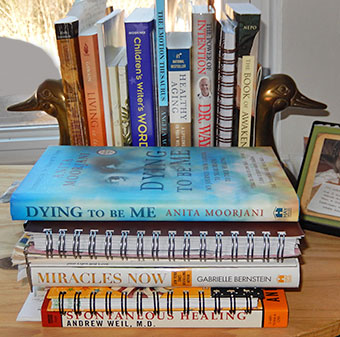
MiraclesNow-GBernstein2We have often heard when the student is ready the teacher arrives. Sometimes that teacher arrives in person, at other times, in the form of an author and her book.  Recently a friend bestowed a lovely gift on me, a book by a metaphysical author of whom I’ve been unaware, Gabrielle Bernstein.

In her book, Miracles Now, Gabrielle, (she feels like a friend already), gives us 108 simple tools that we can all apply right now to help ease our stress, feel happier, and find our path in life. These may be in the form of affirmations, meditations, (both short and long), quick ways to change our thoughts, etc. Today – and yesterday – I”m reading the same one – #46. Measure Your Success with How Much Fun You’re Having.

Uh-oh. I suddenly felt I must be failing miserably! Not that I don’t have fun, I do, but as a measure of my success? Hmmm … Methinks I need to up my success rate!

I can’t imagine that this doesn’t strike a chord with anyone reading this post. We are often told by our spiritual teachers and guides that we need to find the joy in the moment – to not worry about the past, because it’s gone, nor the future, because it hasn’t arrived, but to cherish and enjoy the present moment, the never-again-to-be-repeated-NOW. We all know that this is not always that simple … we’re human and live in a challenging world. But I don’t think there’s a one of us that couldn’t bear being happier; however, that means taking responsibility for it, too.

So while success is often measured in what we have or what we do, Gabrielle Bernstein affirms what I think most of us really know to be true; “happiness is an inside job.” Our job is to stay in the flow with joy and let pass all the things in life which we cannot control. Her Miracle Message is “I measure my success by how much fun I’m having.”

Here’s a toast to all of us being enormously successful!


Tough Acts to Follow

BookOfLife-DHarkness2There’s always a sense of being a bit lost after finishing a fabulous book, not to mention the third and final in a fabulous series. Here I am referring to Deborah Harkness’ The Book of Life, the final in the All Souls Trilogy. But couple that with just having seen the movie, Lucy – well, what will I read or watch that will measure up to either of them?

I can tell you the movie it isn’t and that’s August: Osage County. Great cast, but maybe I’m just not in the mood for such a visually dark movie about family dysfunction, drug and alcohol addiction, and suicide. And that was the first 20 minutes. All that was needed to take it out of the DVD player.

Lucy-MovieI searched my many awaiting library sale books – I realized that after Diana Bishop in The Book of Life and Scarlett Johanson in Lucy, I needed to read about another brave heroine, as totally different as those two were. Probably neither this book series nor the movie is for everyone, but both amazed and captured me. (If interested this is a description of Lucy, but it does tell you how it ends, too, and here is Deborah Harkness’ website for more info on the All Souls Trilogy.)

After a search, I came up with Gathering Blue by Lois Lowry, whom I know as a brilliant writer in another venue, picture books. Its book jacket describes it as a companion to The Giver, but it is a story that also stands independent of that book. I’m hoping Kira is the heroine who will further capture my imagination.

p.s. Cheers to our small town library! Not only had our librarian remembered my interest in reading The Book of Life, but she e-mailed me the moment it came in to let me know. When I returned it, I asked if  The Giver by Lois Lowry might be there, and sure enough, it was. With the movie so close to opening, I expected there’d be a waiting list to read it, but this is  small town … and it has its advantages, this one of many.