Rich Beyond Words – The Annual Library Book Sale

“Wouldn’t it be great if the world could be run like a book sale?” A fellow book lover and I chatted and laughed over the metaphysical/self-help section in the armory annex, home to all the non-fiction books organized for purchase. Why not? Helpful, knowledgeable people running the event, happy shoppers roaming the aisles in delight, and fellow book lovers sharing their reading experiences and recommendations with their fellow man, (and woman), while we graze over the 149,000 titles available.

Above, my haul minus one.

It can be a mind-boggling experience for the newbie. One friend, a first-timer, went with nothing particular in mind and became immediately overwhelmed. She only brought home 3 books. The friend I went with – it’s now an annual tradition – had the goal of picking up more good novels to read. She went home with a full tote and a second tote filled with books for her daughter. It’s not uncommon to see people leaving with multiple cartons of books. At $1 for a hardbound and $.50 for a paperback on Sunday, (double that for Saturday), it’s hard not to get a little crazy.

This was my plan – I had a short list of 1) authors I would like to read more of, 2) one specific title, 3) some selections from children’s books at whatever level appealed to me, and 4) surprise me! Oh, and with a peek, of course, in the metaphysical section. How did I make out? Like a bandit.

In the 1) section, I found something by Sue Monk Kidd, Firstlight, Barbara Kingsolver, The Bean Trees, and Anna Quindlen,  A Short Guide to A Happy Life. Check! In 2), I found A Thousand Splendid Suns by Khaled Hosseini, (which will take me a bit to get to, as I am still kind of blown out from The Kite Runner.) Check! In the 3) group – who could go wrong with another Jerry Spinelli book, (Maniac Magee), and one I saw as a movie when I want something light, The Sisterhood of the Traveling Pants. Check! In 4), I picked up a a book by Eckhart Tolle, A New Earth, an author recommended to me by a fellow writer.

But the main armory, which is crowded with novels of every kind – including best sellers, best-selling authors, mysteries, science fiction, romance, and books made into movies – is where I really found the most, my 3) section.  Some of these are by authors I’m totally unfamiliar with, but the book jackets sold the books; others, I knew of the author or the book and wanted to broaden my reading experience.

So I picked up Snow Falling on Cedars, by David Guterson,  which was made into a movie, an unexpected find from Annie Proulx, That Old Ace in the Hole, because I loved The Shipping News, two books that have been on a list in my computer that I’d forgotten about completely – The Story of Edgar Sawtelle by David Wroblewski and The Joy Luck Club by Amy Tan, several books whose titles just drew me to them – The Last of the Honky Tonk Angels, (Marsha Moyer), World of Pies, (not a cookbook), by Karen Stolz, The Bluest Eye by Toni Morrison,  and By the Light of My Father’s Smile by Alice Walker. Then a couple best sellers, The Lovely Bones by Alice Siebold and The Memory Keeper’s Daughter by Kim Edwards, and a recommendation by a fellow shopper – his favorite by Toni Morrison – Beloved. I picked up The Poe Shadow by Matthew Pearl because The Dante Club was pretty good and I have a friend who also loves Poe, and Henry Beston’s The Outermost House, because it’s been in the back of my mind for some time. Check! Throw in 2 cookbooks that have great recipes and photos to match … and I’m done!

Quite a haul! Have I read everything from last year’s sale? No, not yet, but as every one is a book I want to read, that’s OK, too. All that’s left now is to find a place to put them, toss the totes in the laundry, and figure out where to start. Let the reading begin!
The Kite Runner – Layers of Heartbreak

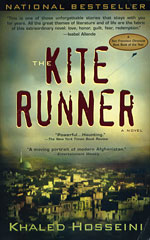
I am still sitting with The Kite Runner. Not moving onto another book yet, and not really wanting to. That’s how powerful this book is for me.

I feel compelled to write about it, though I wonder what I can say that hasn’t been said a thousand times over. I have no intention of writing a synopsis or the like – this is personal. I can say this … Khaled Hosseini is an outstanding writer – part of the brilliance of this book is that it’s hard to imagine that it is not completely autobiographical, yet I know it is not. I can say that I don’t believe one could read The Kite Runner without easily forgiving Amir for what he felt was his horrific betrayal of Hassan. From the standpoint of an observing adult, Amir’s was the realistically-based fear of a child that he would have suffered the same cruelty as did Hassan at the hands of Assef. Yet Amir bore the burden of failing his friend, and this is a pivotal point around which spins The Kite Runner’s tale.

The relationships between the characters are so beautifully drawn … the tender yet precarious boyhood friendship between Amir and Hassan; the  great need of Amir to please Baba; the much needed acceptance in Amir’s relationship with Rahim Khan, his father’s business partner; his later love with Soraya; and then his overwhelming compassion for Sohrab. I must say, I loved being taken to a land of which I know so little. Despite the telling of its tragedy and violence, it was someplace I’ve never been, and in this, Hosseini artfully painted a picture. The beginning of the story takes place against the backdrop of a beautiful, richly colored Afghanistan, but which is then torn apart and destroyed in the Soviet invasion, followed by the chaos of a civil war, leaving people in the even more cruel hands of the Taliban.

As moving as this story is to me, so artfully woven around the characters and the painful events of their lives, I was almost equally as moved by the devastation of a land, of a life, where people had known happiness. The destruction and poverty which changed all of the characters’ lives forever is, of course, a critical part of the story … broken characters, a broken country. The brutality of man against man – even amongst different sects/classes within the country itself, (Baba and Amir, Pashtun, and Ali and Hassan, Hazara),  eloquently described and tragic beyond words. Thankfully, Hosseini found them.

As mentioned, I know very little about Afghanistan. That part of the world was never a subject of much attention when I was growing up and studying history. The Soviets invaded Afghanistan in the late 70’s followed by 10 years of war. Not long after the Soviet withdrawal, more chaos followed in civil wars within the country and greater world repercussions, but I am no expert here. Different parts of The Kite Runner took place over these periods, and it all brought an immense sadness to me … over man’s relentless quest for power and control over one another, of his endless and shameful inability to respect, if we cannot love, our fellow man.

Yesterday, I went online to learn more about Afghanistan – something to help me better understand The Kite Runner and the events befalling its characters. I looked at maps and traced the routes of the characters to Jalalabad, and at other times to Peshawar and Islamabad in Pakistan. I watched videos where the author spoke about this, his first novel, and his country. He is an insightful, likable and empathic man, trying still to bring attention to the plight of his people who are living in desperate poverty. Some of these videos included the Afghani … they are a very handsome people. I felt much like a child with my eyes just opening to another part of the world which has, up until now, escaped my attention, my consideration. It just got me thinking …

I wondered if the man who pumps gas in the town next to me might be from Afghanistan … did he leave his country at some point as Baba and Amir did … to try and find a better life here? Although Baba and Amir were escaping the Soviet invasion, might this man have left behind the Taliban or some other political pressure of which I know nothing? Considering the deep resentment, and often hatred, this country can have for the West, would he see a question of where he came from as a rude intrusion, or maybe a moment of unexpected friendliness from an American? I am not saying I would, (or would not), ask, but I know The Kite Runner tore open another part of my heart … a part that has more questions, more curiosity, for what I have not known … a part brimming with compassion for the Amirs, the Hassans and the Sohrabs. This is the gift Khaled Hosseini gave to me, and for which I am grateful.

p.s. I have just found that Khaled Hosseini has established his own foundation to help the Afghan people. The Khaled Hosseini Foundation‘s site lists the needs of the people, what the foundation is doing to help, and what you can do to help if you are inspired.

Rambling

I find there are periods of time in which I am all over the place. I’m working on several graphics jobs that call upon very different mindsets, am fielding a proposal to do a new job, wondering when I should follow up on something I am waiting to hear back on, when I’ll get the time, (or desire), to simply pull the remaining paperwork from my files so I can put away all my 2010 tax stuff, and it goes on and on.

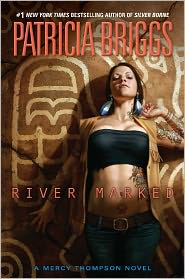
I finally used my Barnes & Noble’s gift card from Christmas – bought the reference book I’ll need for some of my characters in the picture book I’ll be bringing with me to the upcoming NJ SCBWI June Conference, and surprise! David Cook’s CD, (yup, from American Idol.) Usually, when I work at my desk, I listen to new age, light classical piano or guitar, or Indian (American) music because I can’t do creative writing when someone is singing lyrics, but lately, when on other types of work, I find myself listening to the radioio IDOLS station in iTunes. Sometimes I watch the show, sometimes not – this year I seem to be interested. I do know, however, when I hear David Cook’s voice, I hear something I like, so he’ll be arriving in a few days. And then I went to read a bit about Patricia Briggs’ latest in the Mercy Thompson series, River Marked, but let’s not go there just yet.

Forrest Gump arrived today. I must be the only person on the planet who hasn’t seen Forrest Gump, but so be it. I, unlike a friend of mine, am a constant juggler of movies in my queue. He just adds something, and when it comes up, it comes up. Not me. I seem to ponder how it will fit in with the current tenor of my life, my feelings, etc. Do I want to laugh? (or need to?) Am in the frame of mind to deal with something powerful and disturbing? I can’t say how many times I have pushed Hotel Rwanda down as it begins to surface in my queue. And I just watched Alice in Wonderland, which I really enjoyed a lot. Makes me think that maybe when I’m done my current book, that I’ll read Alice – she’s a fixture on my bookshelf.

Now watching Alice in Wonderland and Forrest Gump may be an offset to that current book – The Kite Runner. I was told it was a very sad book. I didn’t ask why my friend found it so, so am discovering the many levels of sadness for myself. Certainly, reading a book like this makes it that much more obvious what fabulous, often spoiled, lives we are living here in the land of the free and home of the brave. Visualizing the bombed ruins of Kabul and other parts of Afghanistan and the cruelty of the Taliban as described by the author is sobering to say the least. And it made me think of how that happened here in its own way, except that the victims weren’t Afghani people, they were native Americans.

Imagining the abject poverty the Afghan people were subjected to is heartbreaking, but that same poverty is also right here in America. Many of those living on reservations are living in conditions that are below those of third world countries, yet no one ever talks about it. Or even seems to know. Indians have the highest rate of poverty of any group in the United States.

Years ago at a pow-wow, I saw this great tee shirt. It was funny, well, no – not funny – more ironic. Clever. Ultimately, more sad than anything else. It features Geronimo and several other Indians, the tee shirt saying – Homeland Security – Fighting Terrorism since 1492. Here it is – you can order it at Northern Sun along with many items which have something to say. Was their experience so different than what happened in Afghanistan? Their world destroyed, families killed, homes taken away, forced to live where their terrorists demanded. It was a very dark chapter in American history. I wonder if that history is being taught. Or that this impoverished way of life, so unlike our own, continues on in many parts of this country. Or are we all just too busy?

Well, rambling I am. I also wonder when one of my cats will get past the hairball she seems to be harboring somewhere in her digestive tract, and which she feels compelled to try and push up in the vicinity of 2 – 4 a.m.

And I can’t wait to start photographing my friend’s little boy, my model for the MC in aforementioned picture book. Yeah, just all over.

Synchronicity

I’m a big believer in synchronicity, which is simply to say, there are no coincidences. I’m also of the mind that when the student is ready, the teacher appears. Or, in some cases, appears again.

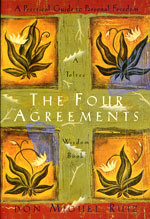
I am currently reading The Four Agreements, A Practical Guide to Personal Freedom by Don Miguel Ruiz, a Toltec nagual, or shaman. It’s my own book, and this is probably the third time I am reading it, and as with most books of this kind, gaining a deeper understanding of Ruiz’s words. The synchronicity? Two different people mentioned this book to me in a space of as many days. I hadn’t even thought of The Four Agreements in quite some time, but loved it when I read it. So I soon found myself sitting on the floor in front of that bookcase starting it again.

I believe when we have such experiences, we are being pointed in a direction of something we need to know or which will benefit us in some way. So I am again reading about Ruiz’ four (seemingly) simple guides to a meaningful life: Be impeccable with your word, Don’t take anything personally, Don’t make assumptions, and Always do your best. It may seem like something you’ve read before, but written in the framework of the Toltec wisdom, it is quite different.

Some of these lessons are easier to learn than others, some have more personal meaning, and some are exactly what I am focusing on in my life right now. You might find the same. A little Toltec wisdom might be just what you need now, too. After all, you did come to this blog post, didn’t you?

Traveling in Time

I’m really enjoying this book … it’s one that I feel drawn to when I’ve finished whatever else needed to be done during the day and when I have some time and space to relax with a book.

Written in 1970, Time and Again does not have the fast-paced style of some of our current novels; Finney is no Dan Brown, but … he has a great story — within a story, as it turns out — and he has my attention. I am about mid-way through and my interest is only picking up.  Our main character Simon Morley has committed to a top-secret government mission to see if people can travel back to points in time, to particular locations, and return with information. A good portion of the beginning of this book details Morley’s being approached, his being interviewed, and then prepared to step back in time.

He returns to February 1882 in New York City to observe a particular transaction between 2 men which seems to have precipitated the financial ruin and suicide of one of them. One of the project’s directives when Morley enters an earlier time is that he not take any action which might change future events. The question we see, when he is in his third visit is, is this possible? And this is what will be revealed as I read on.

Another attraction in this story is that it takes place in NYC. Being familiar with the Dakota and the 72nd St. entrance to Central Park, knowing its proximity to the much-loved Museum of Natural History, having been in Trinity Church more than once, and having worked in the tangled web of narrow streets that is the Wall Street area is, in itself, a big draw for me. But reading his in-depth descriptions of what this all was like in 1882 … is riveting. As an artist, Morley sketched the areas of the city that he saw and some of the people he met … and these all appear in the book.

I think what may be the clincher in this story is that while reading it, and it’s written in the first person, it is absolutely believable that Kinney/Morley is writing not fiction, but a first hand experience of his involvement with the project and actual regressions into 1882.

So while the book’s writing style may be a bit dated, it’s a real attention grabber nonetheless. And I always like a book I can’t wait to pick up again.

12/11/10 – FINISHED! I finished reading this last night, and it lived up to – and even beyond – my expectations. Although a bit long when Morley is on the run from the police, it soon changes into several unexpected scenarios, primarily a great final twist. Like time travel? A good mystery? A good read!