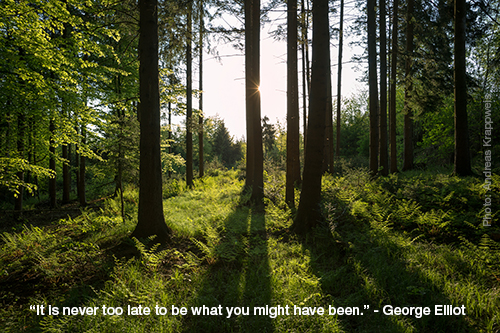
Dreaming the dream …
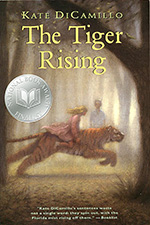 What first draws you to physically pick up a new book? The title? Perhaps. But what makes you think that it may be truly wonderful? Chances are it’s the cover. And when it’s a children’s book? The artist’s cover illustration is what will make you long to see more.
As an artist/illustrator myself, I am always thrilled to come across new and fabulous illustrators whose work I’ve never seen. This has happened twice recently and I was so impressed with these two artists’ work, I thought I’d share with you.
The first artist is Chris Sheban and I searched him out because I was so taken with the cover art on the Kate DiCamillo book I’m reading – The Tiger Rising. Turns out, Chris has also illustrated another favorite middle grade novel of mine, same author, Because of Winn-Dixie. Take a look at Chris’ portfolio – he’s amazing.
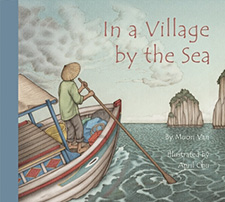 The second artist is April Chu. She came to my attention because she is the illustrator of the soon-to-be-published Ada Byron Lovelace and the Thinking Machine, the debut children’s book written by author and dear friend, Laurie Wallmark. What inspired me about April Chu are the illustrations of her most recently published book, In a Village by the Sea. It takes a lot of talent to portray the ocean as beautifully as she has, not to mention everything else in her illustrations. Take a peek at April Chu’s portfolio. Her work is truly outstanding.
Just as reading, as well as watching plays, movies, and yes, even TV, adds to our depth as writers, looking at other artists’ work adds to our richness as illustrators.
 I’m going to add one more artist who has been a longtime favorite of mine. I can’t add a link to his portfolio because he is no longer alive, but his work glows with a richness and vibrancy that I have loved since I first set eyes on it many years ago. He is Edmund Dulac, born in 1882, passed away 1953. You can get background on him here, if interested, but will see more of his images here, where prints of his work are for sale. Pictured here is a 1911 illustration of Dulac’s for The Princess and the Pea.
It’s a good day to be inspired!
Those of you who stop by with any regularity often see at least one photo of the stash I garner after the Annual Library Sale. Not this year, but I did bring home some wonderful selections, adult, MG and YA, which were accompanied by another bunch of tantalizing books which my Library Sale Buddy offered me. (She opened her trunk like she had hot merchandise in there – dozens of books she’d read over the year, and was offering to me and other friends. It was pretty funny.)

A few days ago, I was ready to dive in to one of those picks and chose a book by John Irving, Cider House Rules. I’d seen the movie years ago, which was fabulous, but as I  began the book, it didn’t seem right. I wanted something that would feed my creative self, the me that wants to work on my Middle Grade novel. I put it back on the shelf and drew out the Joan Bauer MG novel I’d picked up, Close to Famous.
I like Bauer’s style – her characters are believable, palpable people you might know or like to get to know. No high drama, but real life in a compelling way. This would both feed my creative self and provide an enjoyable read.
For those of us who create, who aspire to bring something new and of value into the world, feeding that part of ourselves is so important. I know, for myself, it can also get sorely neglected when life’s demands are peaking, and Creative Me can get tossed into a corner like a shucked-off backpack, full as it is of wondrous things.
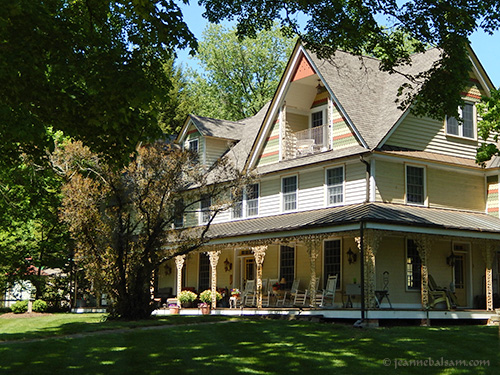
What writer isn’t enriched by reading, what artist by looking at art that inspires? Imagine a baker who doesn’t sample fabulous cupcakes, tasting every nuance of flavor, checking the texture for mouthfeel – how could she possibly produce truly delicious cupcakes herself without knowing what really good cupcakes taste like? It’s no different with us.
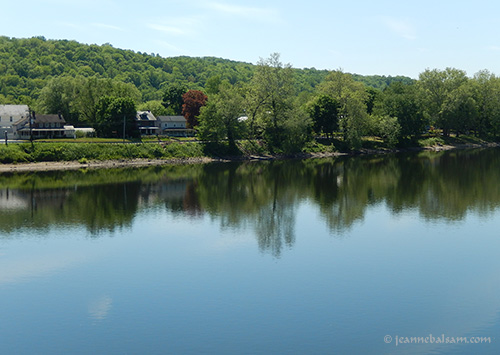
Another way to feed our creative selves is to get out in nature — take a walk, take a drive to a nearby park, sit in your garden, watch a bird, a bee, a squirrel. Nothing fancy. Let the wonders of nature inspire you, help you feel at peace, connected. In that serenity, our creativity can come out to play.
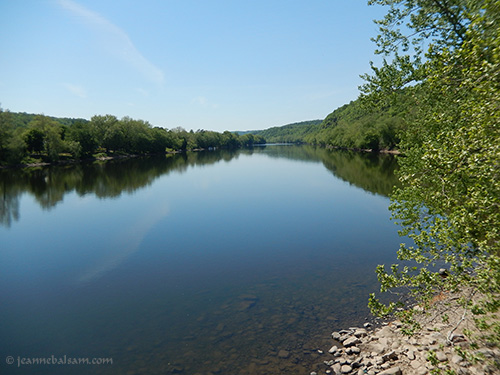
I took the photos you see here on a recent walk – blue sky, sunny day – reminded me of the me that longs to create despite the daily demands of life. It was like a cupcake for my creative soul.

Take a little time for yourself, especially when you most think you have none. Treat yourself to a creative cupcake. Add extra sprinkles; be inspired.
The morning skies were overcast, and the roads were fairly quiet. So I brought along my camera on my trip to the supermarket. The photos below were taken on an approximate 5 minute stretch of my 20-25 minute return trip from food shopping.
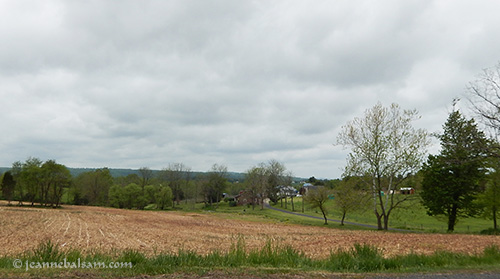
Fields have been tilled and planted. Set far back
from the road, a horse farm.
When I first moved out to this beautiful side of the state, I learned from my neighbors/soon-to-be-friends that we “transplants” were not always welcome here. Of course I asked why. I was shocked by their answer. “Because,” they told me, “no sooner do people move out here than they want a supermarket down the road and a 7-11 on the corner, a MacDonald’s in walking distance, etc. etc., just like they had back in the burbs.”
Needless to say, this made no sense to me either. Why would you move out to the country and want to change it? I very soon adopted their attitude. Don’t like it here? Go back to where you came from. Because here … is gorgeous. As is.
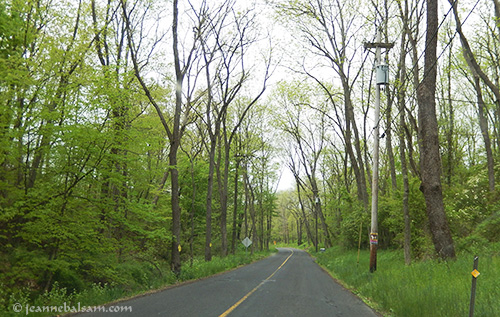
There are plenty of woodsy roads to be found.
I was enamored of this county the moment I moved out here. The more I drove around and saw, the more I loved it. It is truly the most beautiful place I’ve ever lived.

Approaching the upcoming curve, I always get excited for what’s to come.
Driving the backroads – passing farms and wide open land, seeing horses, cows, goats and sheep living the life they deserve, through densely forested areas, over burbling creeks, watching crops grow – I just can’t wipe this idiot grin off my face.
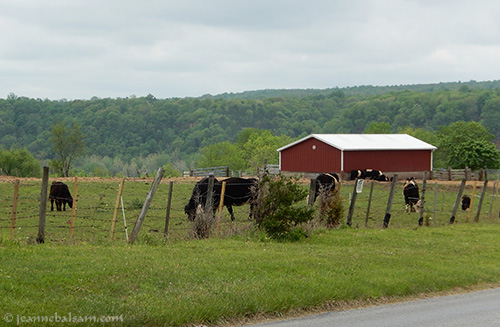
It’s a huge farm with Beltie, (and some Hereford), cattle/cows.
With no one else behind me, I pulled over and took a few shots of the farm across the road, always one of the highlights of my ride. There are numerous large pastures and upon them graze what are known as “Belties” – officially, Belted Galloways.
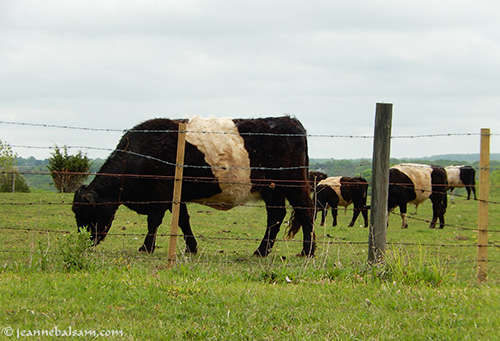
Belted Galloways are a heritage breed of beef cattle originating from Galloway in southwestern Scotland. They are known
to be a very hardy breed, originating from the 1700’s.
When I first saw these cows, maybe 15 years ago, I nearly went off the road. I was utterly transfixed by their markings. It’s no surprise that people, including breeders, sometimes refer to them as Oreo-cookie cows.
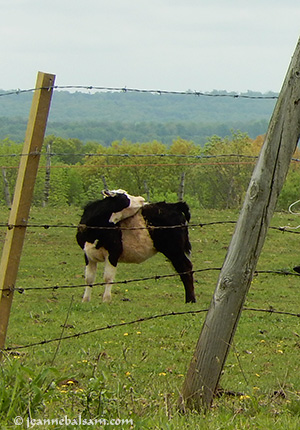
A young Beltie. “I can get that itch if I just stretch far enough.”
At some point, I would like to contact the farm owner and ask if I might go out into the fields with the cows and really do an expansive photo shoot. Cows are such wonderful, sweet and curious animals. However, the bulls out there might not take kindly to me among them, farmer-escorted or not. (Not to mention this might be a major inconvenience for the farmer.) But I can assure you I would be in heaven, just hanging out in their midst and photographing them.

It’s still spring, and the foliage you see is actually just beginning to bloom.
The next leg of the ride on this particular road has multiple sharp curves heading downhill, banks of trees ascending steeply on either side, until you are essentially in a gorge, but alas, there’s no opportunity to stop for a photograph. When summer is full blown, it’s a riot of dense green – trees, foliage and lots of moss. It reminds me of the parts of New Zealand where they filmed Lord of the Rings.
If I can see such beauty as this in just a tiny part of my ride home from the supermarket, why would I want one on the corner?
Don’t like it here? Let me help you pack!
Wisdom from the master himself …
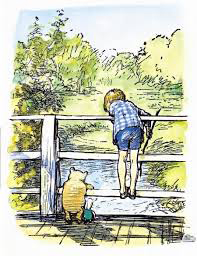
For a long time they looked at the river beneath them, saying nothing, and the river said nothing too, for it felt very quiet and peaceful on this summer afternoon.
“Tigger is all right really,” said Piglet lazily.
“Of course he is,” said Christopher Robin.
“Everybody is really,” said Pooh. “That’s what I think,” said Pooh. “But I don’t suppose I’m right,” he said.
“Of course you are,” said Christopher Robin.
~ A.A. Milne, Illustration E. H. Shepard
Life is an interesting journey. Here are journals, stories, reflections of a traveller of this journey. (songoftheheartsite@gmail.com)
Sharing my journey of a calm, intentional life.
Sharing Information About Writing and Illustrating for Children
Aren't songs of grief lullabies to the lost?
Immersive Tales for the Curious Explorer
Life in a flash - a bi-weekly storytelling blog
Becky Ross Michael: author & editor
Observing, Gathering, Gleaning, Sharing
Official Home of Lavinia and Rick Ross
Thoughts on life, writing, creativity and magic
Canadian Author & Memoir Writing Coach
 Still A Dreamer