Baking Simple, Delicious and Vegan – Strawberry Oatmeal Bars

I won’t lie. Baking makes me feel good. Just thinking about baking actually makes me feel good … looking at yummy recipes, the photos that make me want to drop everything and run to the kitchen, considering the ingredients … all part of the process. (And I like to blog about baking!)
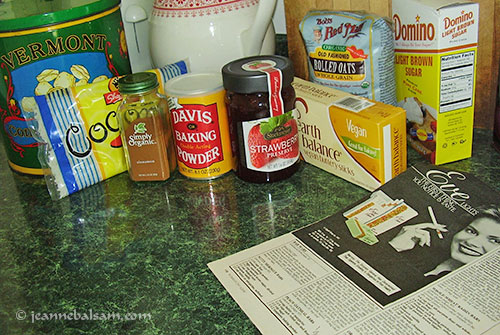
OBars-Ingredients2First, we gather the ingredients together. You might, (correctly), surmise that I collect recipes for eons, as this one, in a copy of Woman’s Day, carried a 2/3 page cigarette ad!  You won’t be finding
that in its recent history.

I committed to making a dessert for a volunteer picnic this Sunday for the local equine rescue I help. I wanted to also make something vegan, in keeping with my own direction, and also because when a bunch of people gather who are committed to the mission of rescuing horses, often from slaughter, (and becoming horse meat), there’s always a fair amount of vegetarians, and some vegans. I went searching OBars-Flour2through my recipes, and selected one without eggs and where I could easily replace the butter with Earth Balance vegan margarine. All other ingredients are vegan.
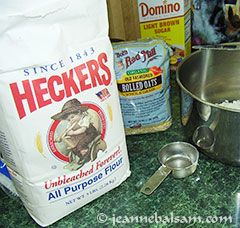
All you eagle-eyed bakers may have noticed something missing in that top photo – flour. NOW I have all the ingredients.

I’ve made this recipe before, but with butter and different flavors preserves. This time I also mixed it up and used brown sugar for half the sugar, as it’s such a natural with oats and cinnamon.This recipe is incredibly simple and whips up in no time.

OBars-BottomLayer2

After mixing the margarine, flour, sugar, baking powder and oat mixture together, the next step is pressing the mixture into the bottom of the pan.
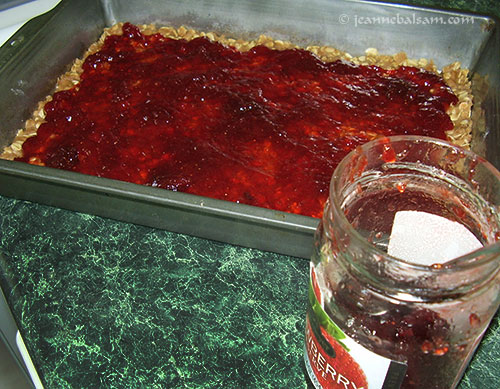
OBars-Preserves2

Next, spreading the preserves to within a half inch of the edges.
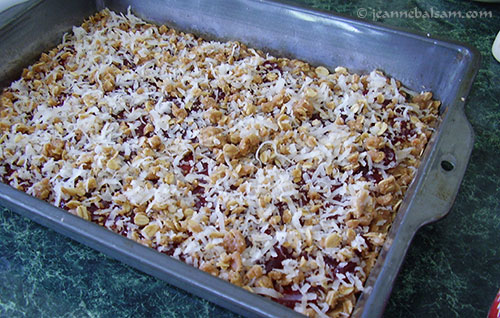
OBars-Topping2

Sprinkle top with reserved crumb mixture and coconut.
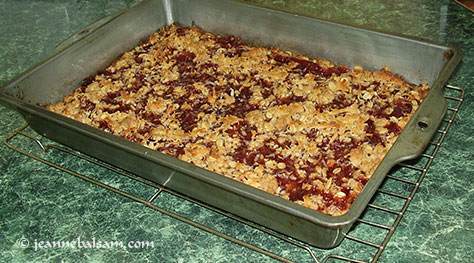
OBars-Done2

Voila – Done!

One of the things that is most difficult for me is the concept of baking vegan. I don’t have a problem with not eating meat. I know enough about what happens to animals, particularly in the factory farming system, to not want to participate in it. But eggs and dairy, particularly when it comes to baking? Now this is rough.
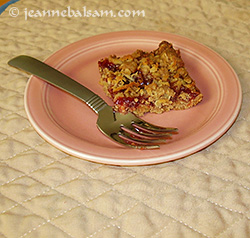
OBars-OnePiece2Established vegans say that once committed, you won’t miss the eggs and dairy in food. Maybe not in some food, but in baking … I don’t know. As I go through my many clipped recipes and cookbooks, I can envision making a vegan version of some, but others? Simply not possible. I am in a quandary.

But for today, I made something simple and vegan, which, of course, I had to taste to make sure it’s safe for consumption.

Because I have modified this recipe significantly, I am including it here, should you want something fast and easy, vegan or not, (just use butter.) Enjoy!

Strawberry Oatmeal Bars

3/4 C. butter or margarine
1-1/4 C. each rolled oats and flour
1/2 C. sugar I used half cane sugar, half brown sugar)
1-1/2 tsp. baking powder
2 tsp. cinnamon
1 C. strawberry preserves (or peach, apricot – anything seedless)
3/4 C. flaked coconut

In 13 x 9″ baking pan, melt butter while oven is heating to 350˚; cool.
Stir in oats, flour, sugar, baking powder and cinnamon until blended. It will be crumbly.
Reserve 1/2 c. crumb mixture.
Press firmly onto bottom of pan.
Spread preserves to within 1/2″ of edges.
Sprinkle with reserved crumb mixture tossed with coconut.
Bake on center rack for 25 minutes or until edges are lightly browned. Cool in pan on rack. Makes 36 bars. (per bar – 12 mg cholesterol with butter, 0 mg cholesterol with margarine.)

And now for me … back to the picture book I’m working on.

Seward Johnson Retrospective at Grounds for Sculpture

GroundsForSculpture-SJohnson2

This piece is titled “Were You Invited?” and was inspired by Renoir’s “Luncheon of the Boating Party”

This brilliant sculptor is now having a major retrospective at the Grounds for Sculpture museum. Seward Johnson founded the non-profit museum whose doors opened in 1992.  Johnson is known for his likenesses of famous figures as well as characters in well-known paintings from different eras, some of which are life-sized and some of which are truly of monumental size. He is also known for his sculptures representing people of all ages from all walks of life, including the boy bicycling in front of the post office in town to the couple looking up at the towering version of “American Gothic” by Grant Wood near the highway exit.

You may have stopped by and viewed some of his amazing sculptures in previous posts on my blog – you can start with Grounds for Sculpture III; the others are all linked. When my friends and I went to visit this 42 acre outdoor sculpture museum, there were so many examples of his work, and so many other wonderful sculptures as well, that I went into a picture-taking frenzy, and never found the time to get them all up. When we  go again over the summer, I plan on just focusing on Johnson’s sculptures that I haven’t yet seen or photographed, including the 26′ tall Marilyn Monroe, titled “Forever Marilyn.”

The retrospective will be on view from May 4, 2014 through September 21, and if you are anywhere within traveling distance and can make it to the Grounds for Sculpture, I promise you will not be disappointed in Johnson’s amazing work or the collection of sculpture on the whole. Read more here about the exhibit, and more here on his own website. I can’t wait to go!

UPDATE: By popular demand, the Seward Johnson Retrospective‘s stay has been extended and will be available through July 2015!

Your Coffee Changing Your World

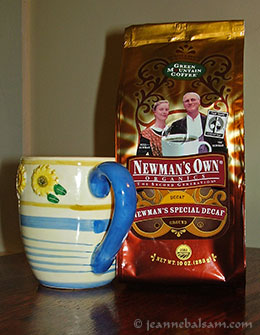
NewmansOwnCoffee2Once vilified as being a troublemaker to your health, coffee has been getting a whole new appraisal as of late. Its health benefits are now being recognized. An article in Prevention magazine wrote up how coffee can help lower your risk for Type-2 diabetes.

Researchers at Harvard University looked at 28 studies with more than a million combined participants and found that people who drank six 8-ounce cups of coffee daily had a 33% lower risk of diabetes. The good news is that each cup lowered your risk by 9%, so you don’t have to go crazy with coffee consumption, but just be aware of the possibilities.

What’s even more exciting is that it’s not the caffeine responsible for the effect, so if you drink decaf, this still applies to you. Researchers suspect that it’s a naturally occurring chemical in coffee called chlorogenic acid that reduces the rate at which the intestines absorb glucose.

So that’s how you can change your personal world, but how about expanding your vision and changing the world at large?

The coffee you drink can make an actual difference to the rainforest and to saving the lives of migratory and resident birds. With the advent of agri-technology, sun-grown coffee became the new big thing, but is not without a goodly number of drawbacks. Here are a few differences between your typical coffees and shade-grown coffees in their benefits to wildlife and the environment.

Poco-Coffee2* Migratory birds and many resident birds, (such as Poco, a rescued macaw, right), find sanctuary in the forest canopy of traditional coffee plantations, while in sun-grown coffee areas, there are 90% fewer bird species.

* Shade trees protect the coffee plants from rain and sun, help maintain soil quality, and aid in natural pest control, thanks to the birds. These traditional coffee plantations also help to conserve watersheds, leading to higher water quality and quantity for local populations. Sun grown coffee requires chemical fertilizers and pesticides and year-round labor, placing financial demands on the growers. It also leads to greater soil erosion and higher amounts of toxic runoff endangering both wildlife and people.

* Shade coffee plants can produce crops of beans for up to 50 years, while sun grown plants produce for only 10 – 15.

* The higher quality beans produced by shade grown methods produce a better tasting coffee!

FairTradeLogoWhere do you find shade-grown coffee? Most coffees marked “Organic Fair Trade” will also be shade-grown. Read the labels and check out the producers’ literature and/or web sites for details. Smaller merchants, health-oriented food stores, and, increasingly, your local supermarket now carry shade grown coffee. There is one more bonus – when you see the “Fair Trade” logo on your bag of coffee, or elsewhere, it assures you that the farmers and their families who grow the coffee are being paid a sustainable living wage for their work.

While it may be a bit more expensive than sun grown coffee, it preserves the biodiversity of our planet, the rainforest, and a multitude of bird species, plus it helps humanity. A pretty good deal all in one cup of coffee.

So you can change your personal world, and spread your wings and change a whole lot more of it.

A House IS A Home

You’ve all heard that line from a song, “A house is not a home …”, and while that’s true in some ways, I beg to differ. A house is surely a home when you love where you live.

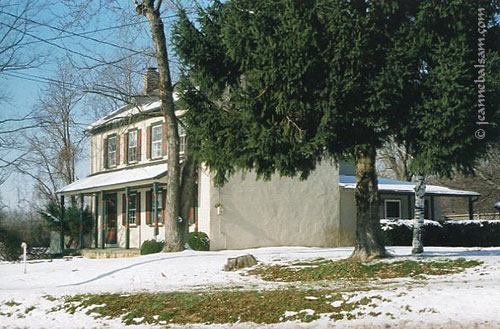
ST-HouseFront2

As I’m crawling out from a week with way too much work, I’m contemplating cleaning off my wonderful deep porches, and getting together what it takes to sit out there, pot some plants, etc.. This reminds me of how lucky I’ve been that the houses I’ve lived in in this side of the state have all had fabulous porches, sometimes more than one. Then I drifted further in my continued wonder/curiosity that every place I’ve lived since I left home and left my college high-rise dorm has been in a specific time period, 1810 – 1920. So for those of you that love homes, I thought I might share some of my photographic, and other house-related, memories.

ST-HouseSide2

The house you see here is the oldest I lived in. The front of the house, top photo, is 1810 and that was added on to the smaller part of the house built in 1742. The 1742 portion is now the dining room, and has another room above it, connected by a narrow circular staircase. It was once the home of the farm workers who worked for the gentleman farmer who lived across the road. In the photo just above, what looks like a large addition in the back is the original house. The small section in front with hedges was my entrance and housed a full kitchen, a full bath and a huge walk-in closet, (just to give you a sense of scale.) This was added on about 30 years ago by a woman who restored the house down to the last authentic detail of each period and added those modernizations.

ST-DRFireplace2

The dining room has original, unpainted wide-plank floors, a beamed ceiling and a walk-in stone fireplace with a bread oven and original wrought iron hooks to hold pots of cooking food and meat. When I was looking for my next place to live, I walked into this room, and knew this was it. It was so warm and cozy; I loved sitting in this room. The 1810 part of the house was built by the gentleman farmer and included two stories, a full attic and basement. He brought his family to live here after his home across the road had a fire. The 1810 portion included two large rooms in the front and the same above with another full bath. The main bedroom was approximately 18′ x 18′, and did I mention, every room had a fireplace, (all non-working, which was a good thing for me, as I know nothing about building fires, properly or otherwise.)

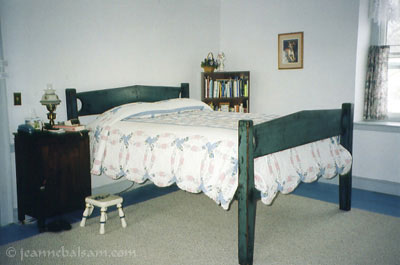
ST-RopeBed2

I painted much of the house when I moved in, keeping more or less to what was there before, but a bit nicer. The bedroom had in it, left by the previous owner, this gorgeous replica antique rope bed which she had custom built. The cats loved playing underneath it, and it was quite an experience at first, sleeping that high up. This house, excepting the dining room, had wonderful 9′ ceilings throughout.

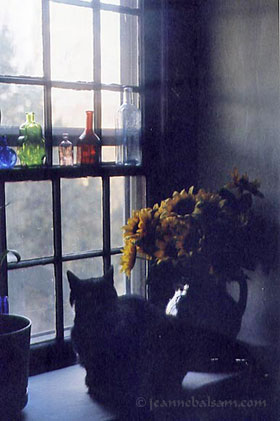
ST-DRWindow-Claude2

Because it was a stone farmhouse, the walls were about 18″ thick and provided outstanding built-in space for cats to enjoy at every window. Above, dining room window with Claude.

If there were any drawbacks to this house, I’d say the heating system, which was forced air and left the house feeling cold again as soon as the heat went off, but on the flip-side, it felt like air-conditioning in the summer with  nothing more than a dehumidifier in the DR and an occasional fan. And then there were more than enough small creatures – centipedes the size of alligators and plenty of field mice. The centipedes were too big too kill, for me anyway, so they got used to being herded, and the mice? I had a humane mousetrap and plenty of farmland all around me where they could start a new life.

These were a small price to pay to live here – two porches,  deck on the back, a wide circular staircase in front and bright, airy rooms upstairs, cozy ones down. It was a great house, and indeed it was a home.

Stay tuned … we’ll soon be going forward to 1870.

“There is no place like home.”  – L. Frank Baum, The Wonderful Wizard of Oz