Idea for New Year’s

As mentioned about a year ago, I am not one for New Year’s resolutions for a variety of reasons.  However, in talking with a dear friend on New Year’s Eve, she had come up with a very helpful idea for the turning of the New Year … better than resolutions.

She made up a list of all she had accomplished in the past year. Before the clock struck midnight, I did the same. Let’s face it – we all know what it is we want to do and what changes we have to make. That’s nothing new. And New Year’s Resolutions, for me, anyway, just state the obvious and indirectly, point out all our shortcomings in the year gone by.

But a list of what we HAVE accomplished – now that’s a feel-good list, because whether we accomplished specific goals or not, we have definitely done many things over the year that we can be happy with. And that list isn’t just about career goals or the like. It’s about ALL we accomplished – were you a good friend the past year? a great Mom? did you donate time or expertise to a charity that means something to you? Help a neighbor? Repair something that’s been waiting forever? Finally treat yourself to something you’ve put off for years? Finish even a part of a project that’s been really challenging? Create a new resume? Leave a painful relationship behind? Exceed your own expectations of what you believed possible?

Here’s your chance to review the year and realize that you actually did quite a bit. Life isn’t measured only in “got a new job” or major milestones, though they’re nice, too. It’s often measured in day to day growth. So make a list of all that good stuff you’ve been doing – it’ll make you feel better about tackling whatever dreams you have for the New Year.

Happy New Year!
Chronos vs. Kairos

How interesting that chronos and kairos should appear in my reading materials in so close a time frame. Not long ago, I read Madeleine L’Engle writing about it. Then on October 12th, in one of my favorite books, Simple Abundance – A Daybook of Comfort and Joy, Sarah Ban Breathnach addressed it. And as always, these “chance” messages were of particular relevance to my life at the moment, and my feelings of far too much to do in too little time all too often. Might you find yourself in here, too?

Ms. Ban Breathnach defines chronos as how we try and control time – clocks, calendars, datebooks, agendas, beepers, etc. Chronos is time at its worst and a delusion of grandeur – it is the world’s time.

Kairos, on the other hand, is time at its best. Kairos is transcendence, infinity, joy, passion, the sacred. Kairos let’s go and allows us to escape our own confines. It is spirit’s time.

We, who never seem to have enough time, are at the mercy of chronos … or allow ourselves to be. But we need kairos so desperately. We do already know it – it’s any time when we have been so wondrously involved in what we are doing at the moment that we lose track of worldly time and just are. And there we find joy, rapture, oneness with our own spirit.

But how to be in more kairos? Ms. Ban Breathnach recommends the following:

“* By slowing down
* By concentrating on one thing at a time
* By going about what we are doing as if it were the only thing worth doing at that moment
* By pretending we have all the time in the world, so that our subconscious will kick in and make it so
* By making time
* By taking time.”

She says, “It only takes a moment to cross over from chronos into kairos, but it does take a moment. All that kairos asks is our willingness to stop running long enough to hear the music of the spheres.

“Today be willing to join in the dance.

“Now you’re in kairos.”

Where Is the Joy?

If you are a woman and you are reading this, then there’s a good chance that you are struggling to find the joy in life. Today’s pace, especially for women, is more frenetic than ever.  Many of us are working, maintaining a home for ourselves and others, raising children, and running like crazy. We are often overwhelmed and exhausted. Despite all this, we may still be reasonably happy, or … we may be downright miserable.

I do believe our natural soul state is one of love and joy. And that it easily gets lost in the pace of everyday life. As I am reading Marianne Williamson’s book, A Woman’s Worth, I find myself dwelling on this section where she writes about joy. She writes that joy is what happens when we recognize how good things are, how beautiful and amazingly powerful we are as women. And she adds that we can create joy in our daily life; we can decide to be happy. It may take our attention and some effort to focus on this, but it is possible.

I know, and perhaps you have, too, the feeling of real joy. For me, it is a distinct feeling that all is right in the world; all is well and perfect at that moment. The fact is that we can experience this feeling so much more often by focusing on the good, and on the amazing beings we, as women, are. I want more joy; how about you? Reading A Woman’s Worth is just fueling that desire for joy right now. This might be a book you’d be interested in if you’d like to discover more of your own joy and your own worth in the world.

Without ever getting into a women’s rights kind of attitude, but always staying in the positive and the uplifting, Williamson writes about how women have lost their place and been kept down throughout much of history, and conversely, of all we are and can be.

The passage that I love in this section is as follows. “A joyful woman, merely by being, says it all. The world is terrified of joyful women. Make a stand. Be one anyway.”

A Wind in the Door – Madeleine L’Engle

A permanent fixture in my children’s book bookcase is the classic, A Wrinkle in Time by Madeleine L’Engle. For whatever reason, I recently plucked the sequel to this book, A Wind in the Door, from among the many YA, MG and adult books that I snared from the county’s annual library book sale, awaiting to be read. And once again, a moment of synchronicity.

To me, L’Engle, who passed away in 2007, is a metaphysical teacher. Some see her writing as having a Christian bent; I, however, find it much broader. Her use of the fantastic to engage readers in the greatest battle of all time  – good vs. evil – is spectacular. Two children, Meg Murray, our heroine, and her friend Calvin O’Keefe are called to join the battle, beginning so innocently as Meg’s ailing younger brother, Charles Wallace, announcing that there is a dragon in the twins’ vegetable garden.

Proginoskes, however, with his many wings, each inhabited by many more eyes, is not a dragon, but a cherubim. “I suppose you think I ought to be a golden-haired baby-face with no body and two useless little wings?” says he.

Throughout this novel, the reader is asked to question what is and what is not real, to consider the powers we have, among them the ability to communicate with one another without words, and to understand the ultimate power of love. Love changes everything is L’Engle’s message. Indeed, it can save one small child and the entire universe. But there’s a fight to be had for it. One needs to trust in oneself and in the good of others, even though they’ve lost track of it themselves, to not judge by appearances, to believe that animals can be teachers and guides, and to be willing to travel in galactic space as well as the inner space of mitochondria.

And L’Engle does all this in a completely magical yet utterly believable way.

As soon as I finished A Wind in the Door, I knew I would go right back in and read it again. Then a re-visit of A Wrinkle in Time. Then I believe, I will order the other 3 books in her “time” series.

For more information about Madeline L’Engle, who has written so much more than these few mentioned books, visit her web site. Or to understand her in a nutshell, read her acceptance speech of the Newbery Award she received for A Wrinkle in Time.

Bliss Boulevard

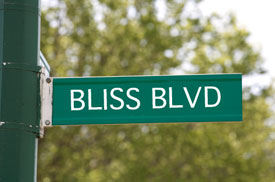
As I was returning from an early morning errand today, I passed a street sign that I had never noticed before … Bliss Blvd.  I looked at it with a kind of longing. That’s where I want to live. Wouldn’t you?

It’s a small side street and easy to miss as it comes up immediately after one turns left onto a well-travelled route, and I couldn’t help but wonder what it meant, that after all these years of passing it, I just noticed it today. I do always take these kinds of things as signs, and not the literal ones. So why did I just see this today?

From numerous nights of poor and/or interrupted sleep, I’m on edge. Things of minor importance become of disproportionate significance; routine but unexpected noises make me jump. And things that may normally cause me some worry cast an even greater shadow. I know sleep will help. But what I also know I need to do in these times is to just let go.

Letting go of worries often means letting go of the illusion of control. The only thing we truly have control over is our own thoughts. The rest – people,  animals, events – on both personal and global scales – is nothing we can control. Sometimes we can only stand by and watch things unfold. Sometimes we can influence things in a positive, (or negative), way. However, others are on their own path, and we don’t ever really know,  though we may glimpse it, what that path is for them – the joy, the pain, the confusion, the triumphs – but it is their path.  Ideally, we can bring to others the best of ourselves and then let the rest go.

So, I thought today, in this sleep-fractured state, that I would pack up a little black bag of worries, control, fear and all that negative crap, and surrender it on my way to a more blissful destination. I’m sure there’s a better night’s sleep to be had there and an easier time of it. And I have children’s books to write and illustrate. I’m headed for Bliss Blvd. Isn’t that where you’d like to be, too?