Tough Acts to Follow

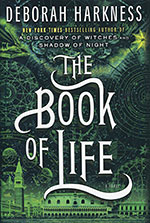
BookOfLife-DHarkness2There’s always a sense of being a bit lost after finishing a fabulous book, not to mention the third and final in a fabulous series. Here I am referring to Deborah Harkness’ The Book of Life, the final in the All Souls Trilogy. But couple that with just having seen the movie, Lucy – well, what will I read or watch that will measure up to either of them?

I can tell you the movie it isn’t and that’s August: Osage County. Great cast, but maybe I’m just not in the mood for such a visually dark movie about family dysfunction, drug and alcohol addiction, and suicide. And that was the first 20 minutes. All that was needed to take it out of the DVD player.

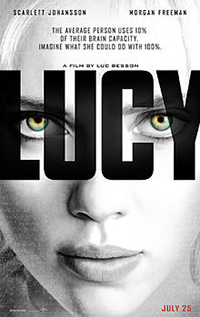
Lucy-MovieI searched my many awaiting library sale books – I realized that after Diana Bishop in The Book of Life and Scarlett Johanson in Lucy, I needed to read about another brave heroine, as totally different as those two were. Probably neither this book series nor the movie is for everyone, but both amazed and captured me. (If interested this is a description of Lucy, but it does tell you how it ends, too, and here is Deborah Harkness’ website for more info on the All Souls Trilogy.)

After a search, I came up with Gathering Blue by Lois Lowry, whom I know as a brilliant writer in another venue, picture books. Its book jacket describes it as a companion to The Giver, but it is a story that also stands independent of that book. I’m hoping Kira is the heroine who will further capture my imagination.

p.s. Cheers to our small town library! Not only had our librarian remembered my interest in reading The Book of Life, but she e-mailed me the moment it came in to let me know. When I returned it, I asked if  The Giver by Lois Lowry might be there, and sure enough, it was. With the movie so close to opening, I expected there’d be a waiting list to read it, but this is  small town … and it has its advantages, this one of many.

What Happened to the Animal in the End?

StrayDog2There is never a shortage of amazing things one can find on the web, and the site I recently came across is no exception.

As both an animal and movie lover, I am particularly sensitive to animal suffering and death on film. I have a very hard time watching cruel or violent  treatment of any animal even if I know it’s an animatronic sit-in for the real animal. It’s still inordinately painful. I also much prefer to know that the animal lives happily in the end, but I know, realistically, that may not be the case. I also know, despite the oversight by a humane organization, that unacceptable behavior towards animals in film has been known to occur.

So if I’ll be upset by animal suffering, what about children? How much and at what age can they accept and understand animal suffering or the dog/cat/horse/whatever dying at the end, even though it may be a logical plot ending?

Well, here’s the site that will guide you to whatever you or your kids can tolerate – Does the Dog Die?  Does the Dog Die has currently reviewed 680 films and indicates by a happy, neutral or crying dog icon if animals live, recover or die in the end. Click on any of the film names and you’ll get details about how every animal in that film is treated and what happens to it.

There’s an awful lot of violence and death in films (and TV) today, both human and animal. Sometimes we just don’t need to watch it. So check out Does the Dog Die? and decide for yourself how much you want to take in.


The Book Thief

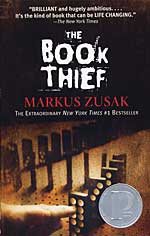
thebookthiefIt is not very often in my experience that you find a book and the movie made from it both outstanding, but in the case of The Book Thief by Markus Zusak, I do. I just finished reading it for the second time … my first a couple years ago, but after seeing the film, I dove back in and read it again, and enjoyed it even more.

The Book Thief is promoted as a YA novel, but it cannot help but reach the heart of any reading adult. Told over a period of about 5 years, the story takes place in Germany during Hitler’s rise to power. The heroine, Liesel, is being surrendered, along with her brother, to another family to foster as the mother cannot afford their care. The sickly brother passes away on the train ride to Molching, is buried in a patch of snowy land alongside that town’s train station. And this is where the book thief, Liesel, steals her first book.

The tale that follows is about Liesel’s life with her foster parents, Hans and Rosa Hubermann, her new and very dear friend, Rudy, and Max, the Jew the Hubermann’s come to hide in their basement. And, of course, it is about Liesel’s learning to read and her stealing books.

There are two factors that set this book apart from so many others. First is Zusak’s exquisite use of language; the book must be read to truly appreciate the author’s brilliance with words. Second is the narrator … Death. Not creepy Death of some stereotypic kind, but a narrator who shares what it is like to gather souls endlessly; how he is present and exhausted at every war; how he sometimes must carry the souls of numerous adults at once, perhaps over his shoulder, but how he always carries children in his arms. His experience of what it is like to be a gatherer of souls is interspersed but does not dominate his third-person narrative of Liesel and those about her.

Because of this unique take on events, the reader is made aware of this shameful period of history in a way that is like no other I’ve ever read. Zusak develops such compassion for his characters, for the Germans, the Jews they are brainwashed to despise, and even many of the soldiers. And shining in the middle of it all is a little girl, who despite losing those she loves time after time, has the courage and compassion to read to all those huddling in a neighbor’s basement during an air raid, who still can risk sneaking into the wealthy mayor’s house to steal a book, giving her one of the true joys she comes to know, reading.

In the movie, Geoffrey Rush and Emma Watson are outstanding as Hans and Rosa, (Papa and Mama). Liesel is played by a newcomer, Sophie Nelisse, one of literally hundreds of girls who auditioned for the part, and she is perfect.

If you were to choose between reading the book or seeing the movie … I can only recommend both, in whatever order suits you. I cannot imagine you will be disappointed. You can visit The Book Thief‘s official website, (click through the opening page and go to videos, upper left or find additional trailers/videos here), and perhaps gain a taste of the book. Importantly, the author was thrilled with the movie rendition of his book. More importantly, I cannot imagine you reading this book, seeing this movie, and not being touched to the core.

On the Dalai Lama, Non-Violence and more …

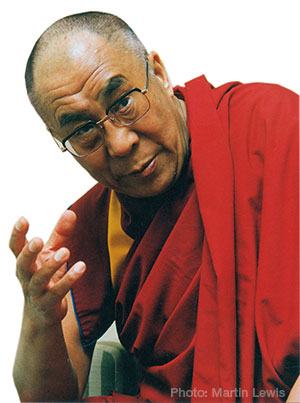
DalaiLama2I recently rented a somewhat different video from my usual fare, (whatever exactly that is), Ten Questions for the Dalai Lama. The film was made by Rick Ray, who also did the interview of His Holiness and examined a variety of issues surrounding the Dalai Lama and his native country, Tibet.

The film covered the Dalai Lama’s childhood and how he was selected to be the 14th to occupy this position which is a combination of chief spiritual and political leader. It showed the lives of  Buddhist monks and the beauty and peacefulness of the Tibetan people. It also recounted the horrific invasion and takeover of Tibet by the Chinese in 1949-1951, in which 1,200,000 Tibetans were killed, many thousands of others beaten and jailed. Even today, if a Tibetan so much as harbors an image of the Dalai Lama, he is severely beaten and imprisoned. Disguised, the Dalai Lama and his family were able to escape the country in 1959. He currently lives in political asylum in India.

Although I know China invaded and took over Tibet, I had not been aware of the details, so I am thankful to have chosen this film and learned more of this historical time. (If interested, you can learn about the event and what happened to Tibet afterwards here, which is an official website of the Dalai Lama.) But my primary interest was in the man himself.

TibetanTemple2

Interior of a Buddhist temple in Tibet

As a result of watching the Dalai Lama in this film, I can say that he is a brilliant, insightful and compassionate man with a delightful kind of kookiness about him. It would be impossible not to like him as he shares his thoughts, opinions and feelings – and sometimes laughter – on a variety of subjects. His observations about the West are not surprising, how as a people we are driven by greed, never having enough. He commented on how often the less people have, the happier they are. When asked about the parallel he might make between himself and Mahatma Gandhi and their ideas about non-violence, the Dalai Lama noted that their aims were the same, that non-violence towards others is the only way to make true progress in the world, and that he and Gandhi were of the same mind in this way.

He pointed out, however, that there was a major difference between Gandhi’s experience and that of his people’s in Tibet and that was/is the endless use of violence used to punish Tibetans at the hands of the Chinese. Gandhi and those who stood with him were not beaten with guns or shot. The numerous film clips show the brutality and violence the Tibetans were/are subjected to at the hands of the Chinese military, (which today, outside of the capital of Lhasa, is largely undercover police), and how their most basic human rights are denied.

The Dalai Lama had reached out to the Chinese Communist leadership in the past, but they were not cooperative. And so this world-famous spiritual leader continues to strive for world peace and the freedom of his country. When at home, he spends a portion of his day in communication with media and the remainder in spiritual practice. But he is often making appearances around the world discussing how his life is guided by three major commitments – the promotion of basic human values, the fostering of inter-religious harmony, and the preservation of Tibet’s Buddhist culture of peace and non-violence.

Having had only occasional exposure to the Dalai Lama, I was deeply impressed, as naive as that may sound, by the beauty and genuineness of his spirit as shown through this film. I can only imagine what a joy it might be to actually sit and talk with him.

I was also reminded, as he spoke about practicing non-violence towards all living beings, that an important aspect of being vegan, as challenging as it is, is an abstention from the violence that is routinely perpetrated on all animals that provide us with meat, dairy, or other commodities, whether during their lives or in their death.

There is clearly a peace that the Dalai Lama exudes, and to the degree that it comes from non-violence, who cannot be for it?
Children’s Books to Movies

As I’m sure you might agree, books that have been made into movies can have a rather spotty success rate. In my experience, rarely has a movie based on a book been as fulfilling as the book itself though there certainly have been some, and a few surprisingly good at that. There also have been some disastrous movies that had I not read the book first would have dissuaded me from ever reading it. But what about children’s books?

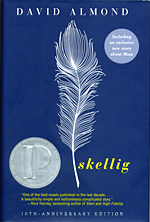
Skellig-DavidAlmondI recently took the plunge and watched movies based on two of my very favorite children’s books, both middle grade – Skellig by David Almond and A Wrinkle in Time by Madeleine L’Engle. That the Skellig movie had to add on a tag after the title – “the Owl Man” – should have been my first tip off, but I was open.  David Almond is a brilliant writer and won the Printz Award for this particular novel. One of the things that sets him apart is the sense of the unexpected, of magic, that he brings to everything he writes. Where this movie failed for me is that in attempting to reach its audience it felt it necessary to define and explain the unexplainable. The beauty of Skellig the novel was that you were left at the end still not knowing who – or what – Skellig was. Was he a man? both man and bird? an angel? The reader never knows. In the movie, he is more or less defined. And then there were several hokey, (to me anyway), visual machinations, such as Skelling taking Michael for a ride on his back while he flies, and in two instances a kind of spinning in the air where he heals Michael’s hand and later the baby sister. Plus the movie barely touches upon the wonderful and unique character of Mina and her relationship with Michael , nor of that with his friends. In sum, there were interesting things about the movie, but as a reflection of the novel, Skellig the movie fell far short for me.

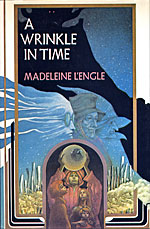
AWrinkleinTime-MLEngleA Wrinkle in Time fared a bit better in my estimation, but again, the movie couldn’t really compare to the book. I think the movie did a pretty good job of showing the characters of Meg and Charles Wallace, and I enjoyed Alfre Woodard as Mrs. Whatsit, Alison Elliott as Mrs. Who and Kate Nelligan as Mrs. Which. The visuals of the children traveling through the tesseract to get to the different planets couldn’t have had too many ways to show it, I suppose, but it was a stretch. The interesting thing about this movie, made in 2003, is that it was a made-for-TV movie. I suspect it could have been more successful if actually made as a true movie. A Wrinkle in Time, like Skellig, raises bigger issues than the surface story,  in this case, an adventure to save the children’s father. It’s a coming of age story for Meg but also asks what’s most important in life and how can evil be overcome. I think the movie did a very good job of making that clear, especially in the scene where Meg is able to pull Charles Wallace back from the tenacious evil of It. What I particularly enjoyed is that in the Bonus Features that were on the DVD there is an interview with the late Madeleine L’Engle. That alone may have been worth getting the DVD.