On Finishing A Book

Are you a book finisher? By that I mean, once into a novel, even if it isn’t fabulous or totally grabbing your interest, are you the person that will finish the book, always hoping it will get better?

Now I’m not talking about reading the first 10 pages and putting it down when you realize this isn’t for me or this isn’t the time for me to read this book. I mean when you’re well into the book, having read the premise on the book jacket or elsewhere and you truly believe that this should be a great novel. Or it’s by an author you really like.

Well, I’m a book finisher. Sometimes I plod along, absolutely sure the story will suddenly take a turn for the better. Much of the time it doesn’t, or it gets really good in the last 2 chapters. (Happily, I don’t choose books like this very often.) But sometimes I am rewarded for my pushing through a slow beginning and what seems to be a meandering first third to half of the book. Such is the case with Angel Landing by Alice Hoffman.

I find Alice Hoffman to be a brilliant writer, and she’s one of my favorite authors. That’s why I picked up this book last year at the library sale. But I must tell you, this one was slow going for me. At first. The initial unfolding of the relationship between Natalie and Carter, which was clearly lacking, didn’t intrigue me; nor did Natalie’s lack of interest and lack of proficiency in being a social worker; nor did the issue of a nuclear power plant in a north shore Long Island town. Carter’s group, Soft Skies, protests the plant and its inherent dangers, which explodes soon thereafter. Even when Michael Finn, a complex protagonist who may be the cause of the explosion, and perhaps the most interesting character, enters the picture, I was still not sucked in as I usually am by Hoffman’s novels.

But somewhere along the line, Alice Hoffman works her magic, and these ordinary people become increasingly 3-dimensional, and their pain and insecurities and the directions of their lives start to matter. Natalie’s Aunt Minnie is an endearing character, soon appreciated for both her genuine compassion for the people in the nursing home where she works and for her straight forward, common sense attitude towards life. Michael Finn, battling a lonely and painful past, soon draws us in. And then there is Michael Finn’s alcoholic and abusive father, Danny Finn.

So yes, I plodded a bit through the first third or so of this novel, not believing that Alice Hoffman would let me down. And she didn’t. On this one, I’m glad I’m a book finisher. Are you?
Taking the Easy Read

Have you had times in your life when you just couldn’t get through a book? No focus, no attention, but somewhere inside still longing to read? I think we all have, and as one who loves reading, I find it quite disconcerting, but there it is.

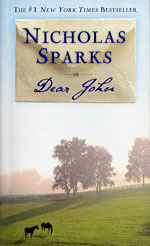
Difficult times are just a part of life, and for months there have been a bit more in my own than I’d like. During this time, I switched from book to book, but couldn’t really focus. So I returned to my ever-faithful and always-waiting selection of unread books, hoping to find the one that would ease me back into reading. And I found it, Dear John by Nicholas Sparks. I checked out all the quickie reviews, and this seems like the book for me – a love story that will engage me but not rip my heart out, that will entertain me without boring me. It’s taking the easy read, but I believe it will hit the spot right now.

And then … much like baking muffins for myself in broad daylight … I did what I really needed, (and wanted). to do. I gave myself the gift of curling up in a chair in the afternoon sun and I began to read Dear John. The cats take this sunshine-seeking in stride; they find the brightest spot of light, position themselves for maximum exposure, and luxuriate in the warmth. I decided to do the same. The dust, the vacuuming, the laundry … it’s not going anywhere.

We need to give ourselves these small gifts, whatever they may be. They make us feel whole. And happy. Why not give yourself a gift today?

Water, Water Everywhere and Not A Drop to Drink

Forgive me if I’ve misquoted that; it’s only a lead-in anyway … to books, books, and not a page to read. But that wouldn’t be true. I’ve got plenty of books to read. I just can’t seem to figure out what I want to read.

Do you go through periods like this? You want to read a good book, but it seems no matter which one you pick up, its not the right one for right now? That’s where I am. Restless Reader. I’ve turned back to my selection of yet-to-be-read books from last Spring’s book sale and perused other bookshelves and nothing is jumping out at me. I want the book that reaches out, grabs me and sucks me in with fast moving prose and a faster moving storyline. And, of course, it must be very well written. One of the books that comes to mind like that was White Oleander. I need one of those.

So I grabbed this book, Ghosts by John Banville, as the jacket flap reminds me of why I picked it up in the first place. Who can’t get into a good ghost story? We shall see.

And I now have a backup plan. If this isn’t the one, I’m heading over to my local library and getting The Girl With the Dragon Tattoo. Just saw that in the movies and it was one of the best movies I’ve seen in a long time. The book can only be better, right? But for now, I’m pinning my hopes on Ghosts.


A Wedding in December – Anita Shreve

I have read a number of Anita Shreve’s novels – some I have liked quite a bit, and a couple, really not so much. But I found this one, A Wedding in December, to be one of the most enjoyable. I honestly cannot tell if it’s because it’s so very fresh in my mind, or has just grabbed me with its very 3-dimensional characters and a slowly unwinding mystery, but it’s been a fast, entertaining, and absorbing read.

The characters are truly well drawn, but it is the way Shreve has ever-so-subtly introduced a secret, an event, that will weave throughout the book almost revealing itself in a shadow here, a whisper there, until it becomes a riveting focus towards the end of the book that also engaged me. Our characters, Harrison, Nora, Bill, Bridget, Jerry, Rob and Agnes all come with some regrets, their nature revealed gradually at what is both a reunion of friends from a school attended long ago and the wedding of two high-school sweethearts, Bill and Bridget.  She, who is also now fighting cancer,  and Bill met again, having once loved each other and been apart 27 years.

Agnes comes with a long-held secret of her own; Harrison, with regrets and longings. Nora, married to a brilliant poet, created her new life – the conversion of their home in the Berkshires to an inn – after his death, but she, too, has memories of the past and what never was. As the guests arrive and interact, their tales are slowly and quite skillfully told, at the same time dancing around the edge of the subject of their mutual friend – Stephen’s – death so many years ago. When they all become snowbound over the wedding weekend, and with some having too much to drink, many revelations come about.

Within the story of the characters at this event is a second story that Agnes is writing about the Halifax Harbor blast in 1917, killing 2,000 people during WW I. At times, jumping into the life of Innes Finch was disconcerting, and I found myself wanting to get back to the reunion/wedding. At other times, I was more involved with the secondary storyline, with Innes, his feelings for Hazel, and her sister, Louise. Agnes writing this story is also a vehicle for her to help resolve some of her own emotional issues.

A Wedding in December may not be the book that examines the deepest souls of its characters, but it does look quite clearly into how people deal with – or choose not to deal with – regrets and the longings for what might have been. What I liked about this book is that Shreve created characters that I really cared about as well as how things resolved for them. So important in a novel.

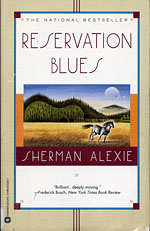
Reservation Blues – Sherman Alexie

There’s plenty written about Reservation Blues, including that written by Alexie himself, so I’m not going to write any summaries or anything like that other than what appealed to me, personally. And that’s a lot. First, I realized I’m going to have to buy the book to have my own copy, as what I read belongs to my local library. That’s so I can go back in and visit from time to time.

I am moved by Alexie’s writing style – in some ways, almost a stream of consciousness, but we all know one doesn’t get published by going with only that. It’s HOW he writes that I’m drawn to – the fluidity, the interjections of things that may seem unrelated or perhaps we just never connected before. Like Big Mom and her relationship to the slaughtered horses … how they brought their songs back to her in the forms of others – Jimi Hendrix, Janis Joplin and Marvin Gaye, (the latter two whom I was very fortunate to have seen in concert), and then they returned to earth. Is it so surprising that Robert Johnson, who bartered away his freedom, should come to Big Mom? Or that Thomas Builds-the-Fire should let Johnson’s guitar pass through his hands and Victor to become ensnared by it?

I read Reservation Blues and wished I knew Big Mom. Everyone needs Big Mom – loving, giving, spiritual, a healer, and yet objective, claiming to no particular situational outcome for anyone. I wish I couldn’t hear the horses scream … a too-piercing song. But Big Mom’s there to mourn for them and to keep their songs alive. And I am thankful. Woven into the story, the violent massacre tells part of the tribe’s history.

I am drawn in by Alexie’s subtleties,  such as the harmonica that Big Mom made for Robert Johnson and tossed to him. “He could feel a movement inside the wood, something familiar.” Was it his music, or was even Big Mom not powerful enough to out The Gentleman? Is it why Johnson decided to stay in Wellpinit? It was only one line that may have gone unnoticed but Reservation Blues seems packed with such subtleties, such fluid turns of the wrist. It’s a style I like, kind of filled with asides that maybe you get, maybe you don’t.

Reservation Blues follows a core group of characters that have strengths and weaknesses, their acceptance of life and their desires to escape or rail against it. Some of them survive the adversities, some don’t. And those who do, some better, some not so well. And if it’s hard to like Victor? a note from Junior to Big Mom tells us why he’s not as bad as he seems. But Victor’s weak and Johnson’s guitar has him in thrall. Again, maybe smaller points in the novel … maybe ones that encompass the whole story in one vignette.

And there’s magic – things that couldn’t be real, such as Junior’s appearance to Victor in the car, the guitar talking, the strings catching fire – or could they? Woven into the story, they become so believable they cannot be extricated. For me anyway. I surrender and I believe. And I follow the band Coyote Springs and its evolution, how it helps me get to know who’s in it, who they meet, where real hell is, where it’s not.

Does Reservation Blues depict life on the reservation today? I have no doubt. It doesn’t give the reader any kind of romantic view of the American Indian such as Alexie says seems common to some white people, New Agers, etc. The view is sometimes painful, sometimes simply life, sometimes just of people like the rest of us dealing with what every day brings. But it’s a different life than that of the rest of us – one with a different history, a different set of memories and tradition, and different challenges – not ours. And I like Alexie’s telling of it. He connects me. And I like how he does it.