Finding Strength, Holding on to Hope

We can easily be unaware or forget how strong kids have to be sometimes, or to remember how strong even we needed to be at certain points growing up. I don’t know anyone who had a totally blissful childhood, and even those who claim to have had one? It becomes apparent in further conversations or getting to know someone better that that’s the way they prefer to see it or maybe need to see it. We all have had our share of problems and pain growing up – some more, some less.

AlmostHome-JBauer2But if we were lucky, we had something or someone to hold onto – a best friend, a pet, a trusted teacher or adult, or a passion that saved us. And that was the saving grace of Sugar Mae Cole.

Reading Almost Home by Joan Bauer, reminded me of how some kids need to be the strong ones, maybe even the parents, when really all they want and need is their parents to take care of them. In this middle grade novel, Sugar and her mother Reba found themselves evicted and homeless. Sugar’s father, who she refers to as Mr. Leeland, failed repeatedly to be responsible to his family, gambling all their money away instead. Sugar, 12 years old, got it. Her mother, in her delusion, still believed he was their knight in shining armor who was always going to come through, but never did.

The story at first reminded me of Jeannette Wall’s The Glass Castle, her autobiography, in which her mother always believed that everything was going to turn out just fine.  She chose to see and never failed to point out the bright side in everything to her children even though they were suffering horribly. In either case, being the adult is a lot to ask of a kid when one or both parents aren’t grounded in reality.

Almost Home was a great story that drew me in the more I read. Sugar accepted a puppy name Shush from another little girl who foisted him upon her because her father was abusing him. Shush became an important constant in Sugar’s life, as pets often do for a child. The unconditional love offered by an animal is a phenomenally powerful form of healing. Sugar had something else – she wrote. She wrote poetry about what was happening in her life, and she wrote thank you letters to people frequently. She believed in the sweetness in life, though she found herself often struggling to find it during this time. She also had a teacher who believed in her and kept in touch even though Sugar and Reba had moved away.

What made this story such a winner is that I could easily relate to Sugar. I’m sure her reading audience does as well. One doesn’t have to be homeless to understand conflict and loss. Holding on to your dreams and hope in the midst of it all is the challenge, and getting to know this young heroine who wasn’t about to give up is what made this read so worthwhile.


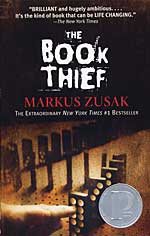
The Book Thief

thebookthiefIt is not very often in my experience that you find a book and the movie made from it both outstanding, but in the case of The Book Thief by Markus Zusak, I do. I just finished reading it for the second time … my first a couple years ago, but after seeing the film, I dove back in and read it again, and enjoyed it even more.

The Book Thief is promoted as a YA novel, but it cannot help but reach the heart of any reading adult. Told over a period of about 5 years, the story takes place in Germany during Hitler’s rise to power. The heroine, Liesel, is being surrendered, along with her brother, to another family to foster as the mother cannot afford their care. The sickly brother passes away on the train ride to Molching, is buried in a patch of snowy land alongside that town’s train station. And this is where the book thief, Liesel, steals her first book.

The tale that follows is about Liesel’s life with her foster parents, Hans and Rosa Hubermann, her new and very dear friend, Rudy, and Max, the Jew the Hubermann’s come to hide in their basement. And, of course, it is about Liesel’s learning to read and her stealing books.

There are two factors that set this book apart from so many others. First is Zusak’s exquisite use of language; the book must be read to truly appreciate the author’s brilliance with words. Second is the narrator … Death. Not creepy Death of some stereotypic kind, but a narrator who shares what it is like to gather souls endlessly; how he is present and exhausted at every war; how he sometimes must carry the souls of numerous adults at once, perhaps over his shoulder, but how he always carries children in his arms. His experience of what it is like to be a gatherer of souls is interspersed but does not dominate his third-person narrative of Liesel and those about her.

Because of this unique take on events, the reader is made aware of this shameful period of history in a way that is like no other I’ve ever read. Zusak develops such compassion for his characters, for the Germans, the Jews they are brainwashed to despise, and even many of the soldiers. And shining in the middle of it all is a little girl, who despite losing those she loves time after time, has the courage and compassion to read to all those huddling in a neighbor’s basement during an air raid, who still can risk sneaking into the wealthy mayor’s house to steal a book, giving her one of the true joys she comes to know, reading.

In the movie, Geoffrey Rush and Emma Watson are outstanding as Hans and Rosa, (Papa and Mama). Liesel is played by a newcomer, Sophie Nelisse, one of literally hundreds of girls who auditioned for the part, and she is perfect.

If you were to choose between reading the book or seeing the movie … I can only recommend both, in whatever order suits you. I cannot imagine you will be disappointed. You can visit The Book Thief‘s official website, (click through the opening page and go to videos, upper left or find additional trailers/videos here), and perhaps gain a taste of the book. Importantly, the author was thrilled with the movie rendition of his book. More importantly, I cannot imagine you reading this book, seeing this movie, and not being touched to the core.

On the Dalai Lama, Non-Violence and more …

DalaiLama2I recently rented a somewhat different video from my usual fare, (whatever exactly that is), Ten Questions for the Dalai Lama. The film was made by Rick Ray, who also did the interview of His Holiness and examined a variety of issues surrounding the Dalai Lama and his native country, Tibet.

The film covered the Dalai Lama’s childhood and how he was selected to be the 14th to occupy this position which is a combination of chief spiritual and political leader. It showed the lives of  Buddhist monks and the beauty and peacefulness of the Tibetan people. It also recounted the horrific invasion and takeover of Tibet by the Chinese in 1949-1951, in which 1,200,000 Tibetans were killed, many thousands of others beaten and jailed. Even today, if a Tibetan so much as harbors an image of the Dalai Lama, he is severely beaten and imprisoned. Disguised, the Dalai Lama and his family were able to escape the country in 1959. He currently lives in political asylum in India.

Although I know China invaded and took over Tibet, I had not been aware of the details, so I am thankful to have chosen this film and learned more of this historical time. (If interested, you can learn about the event and what happened to Tibet afterwards here, which is an official website of the Dalai Lama.) But my primary interest was in the man himself.

TibetanTemple2

Interior of a Buddhist temple in Tibet

As a result of watching the Dalai Lama in this film, I can say that he is a brilliant, insightful and compassionate man with a delightful kind of kookiness about him. It would be impossible not to like him as he shares his thoughts, opinions and feelings – and sometimes laughter – on a variety of subjects. His observations about the West are not surprising, how as a people we are driven by greed, never having enough. He commented on how often the less people have, the happier they are. When asked about the parallel he might make between himself and Mahatma Gandhi and their ideas about non-violence, the Dalai Lama noted that their aims were the same, that non-violence towards others is the only way to make true progress in the world, and that he and Gandhi were of the same mind in this way.

He pointed out, however, that there was a major difference between Gandhi’s experience and that of his people’s in Tibet and that was/is the endless use of violence used to punish Tibetans at the hands of the Chinese. Gandhi and those who stood with him were not beaten with guns or shot. The numerous film clips show the brutality and violence the Tibetans were/are subjected to at the hands of the Chinese military, (which today, outside of the capital of Lhasa, is largely undercover police), and how their most basic human rights are denied.

The Dalai Lama had reached out to the Chinese Communist leadership in the past, but they were not cooperative. And so this world-famous spiritual leader continues to strive for world peace and the freedom of his country. When at home, he spends a portion of his day in communication with media and the remainder in spiritual practice. But he is often making appearances around the world discussing how his life is guided by three major commitments – the promotion of basic human values, the fostering of inter-religious harmony, and the preservation of Tibet’s Buddhist culture of peace and non-violence.

Having had only occasional exposure to the Dalai Lama, I was deeply impressed, as naive as that may sound, by the beauty and genuineness of his spirit as shown through this film. I can only imagine what a joy it might be to actually sit and talk with him.

I was also reminded, as he spoke about practicing non-violence towards all living beings, that an important aspect of being vegan, as challenging as it is, is an abstention from the violence that is routinely perpetrated on all animals that provide us with meat, dairy, or other commodities, whether during their lives or in their death.

There is clearly a peace that the Dalai Lama exudes, and to the degree that it comes from non-violence, who cannot be for it?

A Small, Wonderful Movie – I Am

I-Am-Movie2What would you want to say to the world if it became possible that you might soon die? That’s what movie director Tom Shadyac asked himself after he suffered a severe concussion in a bicycling accident. He was told the horrible after-effects could last for 2 years or for life. Or he could die. So he asked himself what he wanted to say in the event that should happen.

I’d never heard of Tom Shadyac, but recognized his movies when he discussed them in the beginning of this beautiful documentary. He directed Jim Carrey in Ace Ventura: Pet Detective, Bruce Almighty, The Nutty Professor and several other similar minded films. He realized that where he’d been with humor and outrageous silliness was not where he wanted to go. He had two questions and wanted to make a documentary … What’s wrong with our world? and What can we do about it?

This short, (1 hour 17 min.), documentary moved me to tears at times, as Shadyac explored these questions through interviews with some of the greatest minds of our times – authors, scientists, religious leaders, poets, and others. He interviews or shows clips of Howard Zinn, Desmond Tutu, Nelson Mandela, Gandhi, Martin Luther King, the Dalai Lama and other notables, including his own father who founded St. Jude’s Research Hospital for Children with Danny Thomas. The thread of the documentary follows how mankind has lost its way in our quest for winning and competition, but shows how we are literally wired in our DNA for cooperation and compassion. He shares how intuitively the animal world works together – birds flock, fish shoal (see photo) – for the greater good, and how less technologically developed societies work cooperatively with one another. FishShoal2In American Indian tribes where sharing was the norm, hoarding was seen as a sickness, and the members of the tribe set out to heal this person.

Shadyac has gathered so many amazing clips of everything you can imagine to bring us along on his journey of inquiry – history, science, spiritual thought, the natural world. Especially moving was one short clip of something I’d never before seen except in a still … a world famous black and white photo of a slender Chinese man blocking the way of army tanks in the 1989 student protest in Tiananmen Square. In this clip, you watch him move repeatedly to block the tank each time it maneuvers. Mankind has reached out endlessly to stand up for or help others in need, in tragedies such as 9/11, Katrina, Haiti, or events such as civil rights marches and so many other instances. As he explored these issues, Shadyac came to conclusions about his own life of celebrity excess and changed that, too.

He came to realize that `What is wrong with this world?’ has an answer … I Am.  But maybe I’m asking the wrong question, he thought. Perhaps I should also ask, `What is right with this world?’  Yup …. I Am.

Unless you are one of those people who believes whoever dies with the most toys wins – and I’m sure you would never have read this far if that were true – then I feel pretty confident that you will be inspired and moved by this film.

Toni Morrison’s Paradise

Paradise-ToniMorrison2Paradise is the first book I’ve read by Toni Morrison, and I can assure you I will read more. In fact, it’s hard for me to not go back and re-read this book right now.

Here’s a couple things I can tell you – do not read this book late at night when you’re tired; do not put it down for extended periods of time and think you will be able to easily jump right back in; and do not read it when distracted. Here’s why. Toni Morrison assumes you’re paying attention. Her characters are complex as is the storyline … there’s a lot to remember … a lot you want to remember when you’re reading Paradise. This is not light reading, but it is a truly amazing read.

Toni Morrison’s use of language is exquisite; I was thrilled repeatedly with the beauty of how she chooses and uses words. Her characters are so real I wanted to either step in the pages to be with them or have them come and sit down by me and talk; tell me about their lives and how they changed being in Ruby, OK; how they changed living in the Convent with Connie and the other women; tell me more.

The storyline of Paradise is of a group of ex-slaves freed from Louisiana and Mississippi who, rejected by their fairer skinned brethren and terrified by whites, set up their own community deep in the Oklahoma country, self-sufficient and proud. The history of their forefathers was revered and their insular lives safe. Safe except for the women who had come to live at the Convent – women whose lives had been torn apart by suffering at one time or another and who made their way, tried to heal, in this isolated home outside town. Paradise is, in part, about what happens when people come to see others the same way they once were viewed and what they do about it. And, in part, about redemption and finding one’s place in the world.

This is far, far, far too simplistic a summary of this extraordinary novel. If you want to be immersed in another time and place, in the lives of people so real it can be painful, perhaps Paradise is for you. I’m not sure what I can read right after this that will not pale beside it.