Women Helping Women or ….

If you give to any charities, you are aware that most charities sell their mailing lists to other charities. So where you may be a regular supporter of a few, you receive scores of other appeals requesting your donations to support their mission.

I understand this. What I find particularly difficult is that because I truly believe in the charities I donate to, those organizations with similar missions often resonate deeply with me as well. How do we decide to whom we give when the funds available to give are limited? I already have a stack I’d like to give to and more requests continue to pour in. In the last couple weeks, I must have received at least 20 appeals, some from those I already give to, and many other charities with worthy missions that want me to come on board with them.
The piece in all of these that really caught my eye told me that:

  • One in three women worldwide are beaten, coerced into sex or otherwise abused in their lifetime
  • Up to 70% of women worldwide encounter violence.
  • As many as 6 out of 10 migrant women from Central America are raped on their journey to the United States
  • Native American and Alaska Native women are 2.5 times more likely to be raped or sexually assaulted than women in the U.S. in general
  • In 2010 alone, an estimated 15,000 women were raped in eastern Congo.

The letter went on to describe the circumstances of individual women, one in the Democratic Republic of Congo who spoke out about being raped by a soldier and was raped again and bayonetted in the stomach. There are numerous other bone-chilling instances of women being burned because their dowries were too small, stoned to death because they “dishonored” their families, etc. Reference is made to the many women who, unable to support themselves, endure years of domestic abuse.

It is hard to believe that in our so-called enlightened world with all its technological advances that we remain so utterly barbaric towards one half of the human race … women. Madeleine K. Albright said, “There is a special place in hell for women who do not help other women.”

I feel compelled to help, but how? Do I give financially? Should I give to this organization, (Amnesty International), or to local organizations? Or should I help organizations that fight mammoth industrial giants who will knowingly destroy entire geographical areas and cause widespread species extinction?  Or help American Indian elders without food and heat? Or organizations that fight the worst of animal cruelty? Or … or … or?

Is there not a special place in hell for those of us who are aware of such need and do nothing? I was profoundly struck by these egregious offenses against women, yet I am aware of the need in every corner of the planet, and I, as can we all, can always do something. Whatever it is.

Oddly enough, after reading all these appeals, I remembered why I wanted to write children’s books … I want to open children’s eyes, to show them the love and beauty in the world, but also to show them that they have the power to change what’s wrong. They needn’t know at 5 years old that women are being sexually assaulted throughout the world, but they can know that helping and caring about others, be it humans, animals or our planet, makes a difference. And a well-crafted children’s book can show that in the most un-obvious of ways. So while I’ve yet to figure out where to send my next donation, perhaps  writing from my heart is my unique gift to a troubled world, the gift I can always give.

My guess is that you, no matter how much money you do or don’t have,  have plenty to give, too.
Sad Places

OK, I give. I find in checking the stats on my blog that someone or multiple “someones” are regularly using the search term sad place, sometimes sad places. Each time I see it, I wonder if they have come specifically to my site searching for it, or if something in my site is drawing them to me. Either way, I would love that person or persons to let me know what they are looking for.

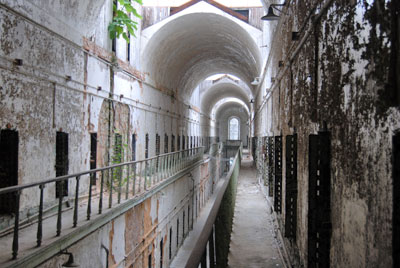
I believe a sad place can be as much a state of mind as a physical location. I started searching for photos that said sad place to me. I realized that even that could change on any given day in any given hour, plus I suspect that the response to that phrase would vary enormously from person to person. But I selected this photo of the Eastern State Penitentiary in center city Philadelphia by Mike Munchel. The prison was built in 1920 and housed prisoners until 1970. Regardless of whether or how people should be punished or not – that’s not the issue – I found this building, this facility, an extremely sad place. That any human being was kept in such utterly primitive circumstances is indeed sad in my book. I also find that many derelict buildings, once beautiful and filled with life, are often sad places for me.

I found a few other places that I – at this exact moment in time – feel were described by that phrase, but I wonder what you have in mind … what are you looking for when you search for sad place?

A Short Film – to Touch Your Heart, to Change the World

That’s a pretty big promise, I know. But don’t take my word for it. Take a mere 10 minutes from your life and be moved by this amazing film, “Change for A Dollar,” by Sharon Wright. Don’t miss this. Watch here, or for a bigger view, just click the link above.


A Way with Words – Heart Songs

I’m wondering if E. Annie Proulx is an acquired taste. She is unique among authors I’ve read for any number of reasons, perhaps most importantly … does she have a way with words!

I first met Ms. Proulx when I read The Shipping News, and found her style engrossing, challenging to read, and simply like no other. I most recently picked up her collection of short fiction, Heart Songs. She writes about people we average Americans rarely, if ever, see, in this case the longtime residents of rural New England, whose lives and lifestyles are coming into sharp collisions with wealthier newcomers embracing the “country life.” In this regard, reading about the people in these short stories was something akin to watching the movie Winter’s Bone, i.e., seeing for the first time how a segment of Americans live, people of whom we generally have no knowledge. It’s fascinating, sometimes disturbing and frightening, sometimes heartbreaking. Yet Proulx is not asking for pity or judgment for her characters. They are who they are; she is simply telling their stories.

But oh! her way with words … “Often his razor tongue stropped itself on the faults and flaws of his dead parents …”; “The corpse of a less-wise raven lay beneath a bush like a patch of melted tar. The fox rolled in the carcass, grinding his shoulders into it. He got up, shook himself and continued his tour, a black feather in the fur of his shoulder like a dart placed by a picador.“; ” … his face dark as a smoked ham, eyes like bird’s eyes, orange and inhuman.”

Whose writing could fail to be enlightened by an author whose use of words is so intense, lyrical, and magnificently descriptive. If, in each thing we read, we hope to not only gain from the enjoyment of the story itself but also some wonderful addition to our own skills as writers, then E. Annie Proulx’s Heart Songs speaks volumes on how to say what we mean. And how to say it with an incomparable richness.


The Character Who Never Grew

TradingUp-C.BushnellIt was my idea that when you read a novel, you should feel something for the character, identify with her in some way, and as you go through the course of the book, cheer her on through adversity, feeing her pain, and then rejoice in her overcoming challenges. But what if the character just never grows?

What if the character is defined at the get-go as a self-centered, manipulating, feckless social climber who proceeds to orchestrate one scenario after another, using whoever serves her purpose at the moment to get what she wants? What if, despite her repeated falls from societal grace, her redemption is always through luck, the guilt or kindness or another, kinder character, or her own delusions?  I know – why did I read this book?

I purchased Trading Up at the library’s annual sale because it was written by Candace Bushnell, author of Sex and the City. I was hoping for some of the fun and good spirited friendships of the TV series.  I was wrong.  Amazingly, Janey Wilcox, the main character, works her way through this entire novel without managing to elicit any sympathy. And even though, about 3/4 of the way through the book, we learn about why Janey may have developed this penchant for using others and sleeping with any man she thought could further her goals, it didn’t make you care about her one iota more. Even at the very end, her breathlessly described new and bright-with-possibilities future in Hollywood is merely the result of chance coupled with Janey’s own delusional idea that she deserves what she wants — just because.

I kept reading — always the optimist — certain that there was a moment of truth coming – that something would happen in Janey’s life and she would hark back to the more innocent soul she once was and become more feeling, if nothing else. Never happens. So while Trading Up does provide an interesting spotlight on the lives of the very rich and famous in NY and the Hamptons, I’m otherwise left empty in the face of a character who, throughout an entire novel, never evolves. So very odd.

It also gives me a lot of respect for Darren Star who created and executive produced the TV series Sex and the City from Bushnell’s series of essays. He  created friendships that were real and characters who grew over the seasons, and he enticed viewers who, despite learning odd things like the value of Manolo Blahnik shoes, grew along with them. That was the book I’d been hoping to read.