The Photo I’ll Never Get

Something unusual has been happening on my back porch. I’d love to get a photograph of it, but it’s not going to happen. Well, not unless I suddenly have the time to sit out there stock-still for extended periods of time. But first let me show you the photo I can get. Not very exciting, I know. But to know what I can’t photograph, you can see the other half of the picture – the stationary items.

These are the food and water bowls on my back porch adjacent to my back door. They’re there to feed aforementioned feral cat, Little Fee, and the cats next door whenever they’re inspired. The other day while busy working, I heard a nasal, one syllable, repeated caw. I knew it was a crow, but he sounded mighty close. Where was he?

I tip-toed slowly back to the kitchen, and there he was, sitting on the railing, eyeing the cat food. I stationed myself at the back door and watched as he, after surveying his surroundings for safety, dropped to the porch deck and ate a few pieces of food. This was new! And then he flew away. That’s one of the photographs I would like to have gotten. Maybe a week earlier, I had spotted a blue jay – same routine – but he took one piece and flew away, and returned some time later for more. Whether or not it was the same jay, I’ll never know, but that was also a great shot I’ll never get.
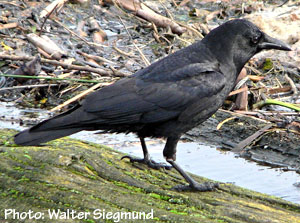
The day following the first crow’s appearance, I heard more crow chat on the back porch, and now there were two – one eating from the bowl, and another on the railing. The latter soon hopped down, pushed the other aside, and ate a bunch. I guess the word is out, so I may have to adjust what I do with the food – I don’t really need to be feeding high quality, holistic cat food to the local crow population, nor do I need them on my porch, as much as I love crows.

Did you know that crows have the highest brain-to-skull ratio of any living bird? They are considered one of the most intelligent birds alive with several species topping the avian IQ scale and as demonstrated by their construction and use of tools, creation of mid-air games such as jousting and “air-chicken” to determine the pecking order, and other feats. It is reported that although humans cannot generally tell individual crows apart, crows have been shown to have the ability to visually recognize individual humans, and to transmit information about “bad” humans by squawking to one another.

Although crows are, and have been, viewed in many different ways throughout history to the present, their presence is often thought to be symbolic of magic and creativity. (Ted Andrews discusses this at length in Animal Speak.)

Will I ever get a photograph of the crows on my porch? I’m sure not, but maybe someday I’ll be in the right spot at the right time in some other location to get just the right photo. Meanwhile, I think I have to look out for Little Fee, and make sure his food supply is not commandeered by these opportunistic black beauties.
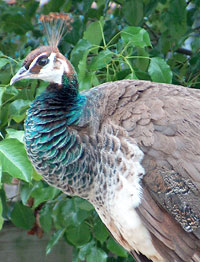
A Disdain for Flash

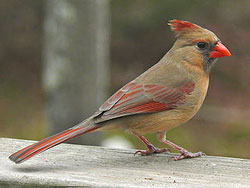
This morning I watched a female cardinal on my front porch railing. With the warmer weather having arrived early, she is already quite sleek. As she hopped along the rail I couldn’t help but admire the beauty in the subtlety of her coloration … the muted olives and golds edged with red and the bright persimmon of her beak.

I went along my morning and was still thinking … now of the beautiful coloration of the peahen. She may pale alongside the brilliant shades of turquoise and green of her male counterpart, the peacock, much as the female cardinal does when compared to the bright red male, but her beauty isn’t in the flashiness of her color. It’s in the quiet richness, with just a necklace of iridescent aquamarine.

There’s a certain pleasure in subtle beauty. In our media-driven culture, the biggest, brightest and flashiest is always being foisted upon us and honestly? I sometimes find it draining. Don’t you? Admittedly, I can be distracted by shiny objects … nothing wrong with that from time to time, but as a steady diet, the loud, the bold and the dazzling wears thin.

I will always take delight in the bright plumage of a male Cardinal or Peacock. But I also appreciate the ladies.  They have a disdain for flash. And yet are undeniably beautiful. Maybe they’re a bit more like most of us.


Photos: Cardinal courtesy of Wikipedia Commons, Penelope Peahen courtesy of Popcorn Park


Always A Bright Spot

They say every cloud has a silver lining, that even in our darkest moments there is always a bright spot. Having recently lost an animal so very dear to my heart, I wasn’t seeing too many bright spots just yet. Some unanticipated glimmers here and there, but that was about it.

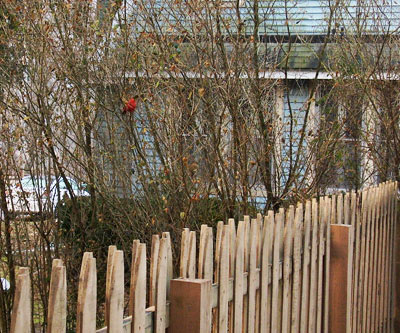
Who would have thought that my bright spot would truly BE a bright spot? I happened to glance out my side door earlier this morning, and there he was … a veritable bright spot of red among the drab winter bushes. I grabbed my camera and, figuring the male Cardinal would fly away if I opened the door, took him through my window, but with a screen, I knew I was kidding myself. Ever so slowly, I opened the inner door and then the storm door, and eased out on the porch. There he stayed while I photographed him. Again and again.

I felt as if he knew I needed a bright spot in my day and had decided to indulge me until I got the shot I wanted. I believe animals communicate with us and are far more in tune than we give them credit for, and today, he had a small, joyful message to bring. Above you see him, not nearly as vibrant as he looked in reality, but brilliant nonetheless. A small blessing, a reminder, of how many bright spots we have in our lives. Even if we don’t always see them.

The Slow Waltz of Fall

Even before the leaves surrender their greens for red and gold, there are other changes afoot – creatures prepare for the coming winter, some rallying in their final efforts to survive before their lives slowly wind down to a natural end.

Each year in this house I watch an orb-weaving spider weave a large and complex web over the top half of a kitchen window.

It doesn’t seem a very auspicious spot, as her prey would need to be flying through the web to the glass not even a half inch behind. Yet each year, through some species memory I can’t possibly understand, a spider builds her web here. She catches an occasional small insect, and each night rebuilds her web. With temperatures becoming chillier and less prey about, she becomes weaker from lack of food. With less silk to spin, her web becomes less detailed until at last, the strands are a broken tangle of fine thread, a shadow of her once articulated masterpiece. And then she is gone.

I found myself watching her, in quiet awe of her determination to survive in spite of the reality of colder nights and imminent death. Some lesson in life for me, no doubt.

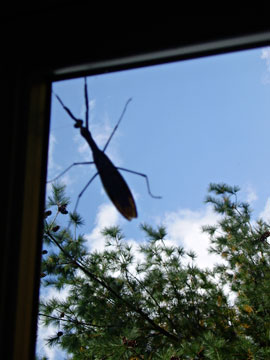
Perhaps a week or so after the spider’s web had disappeared, a seemingly small monster – from this side of the glass – cast a large shadow in the same window. A Chinese praying mantis. Where had he come from? Last year, a green praying mantis hung out all season on or around my office window, where we had several conversations and a few photo shoots. But I’d never seen the larger and brown Chinese mantis since I’ve lived here. He did his monster shadow for the morning, and then flew about my front and side porches in the awkward way they do, like a helicopter with a broken blade. No doubt he was scouting out a last meal as well. He, too, soon disappeared.

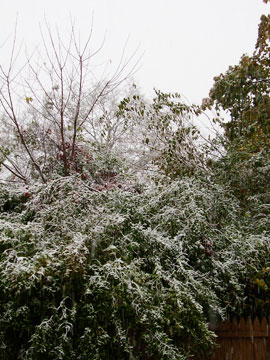
As we moved into late October, anticipating Halloween, temperatures dropped, moisture gathered and froze, and suffocated the clinging leaves, dropping trees like so many sticks.

It was unexpectedly beautiful, but deadly, and the sudden snowstorm rolled long nights over the state, especially in my area. Halloween evening arrived and bundled children with chilled parents came from other towns to ours; they still had no power, but happily, here we all had our porch lights on, tombstones eerily lit, and plenty of candy.

I took a drive around my area the following day, where the severity of the damage was evident. It looked like a war zone. Barricades and closed roads were everywhere, but so much worse was the devastation of the trees. Magnificent elders had split and cracked like twigs, graceful limbs lay on the ground. It was heartbreaking.

And then, another sign of determination – the leaf which will not fall.

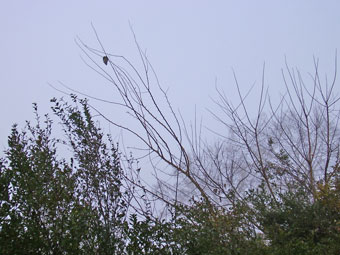
Many of the taller shrubs and a fair amount of surrounding trees still have quite a bit of their leaves. This tree? Only one stubborn leaf remains. I wonder did he win a contest this year with some other now-fallen leaf who could finally hold on no longer. Or is he a tall scout, updating the lower shrubbery on how advances the autumn. Or perhaps he’s simply the last man standing.

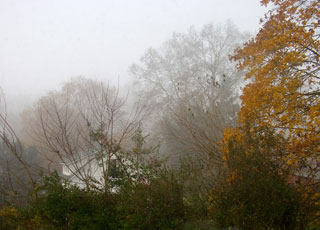
And then this morning … a thick autumn fog. It couldn’t have looked more lovely, an invitation to be lost for just a little while. I could have stayed until the sun shone through. But such is not my life.

Eggs Hatched! Live Eagle Cam at Duke Farms 2011

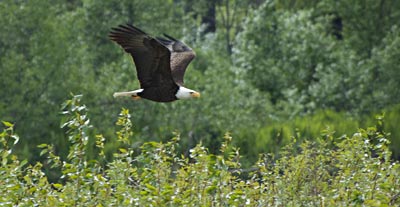
One of the most wonderful opportunities to experience wildlife, in a way that we would never be able to firsthand, is the live/streaming  eagle cam at Duke Farms in Hillsborough, NJ. Duke Farms is now working in conjunction with the Conserve Wildlife Foundation NJ, who are keeping even more current updates on the eagles and their babies as well as making available the eagle cam. Check out the latest updates on the CWF-NJ web site. 

Mama and Papa each are very active during the day, anxious to see their chicks born. According to the Duke Farms log, the pair had been visiting their nest in December and making repairs for the new nesting season.

There are currently 3 eggs in the nest, appearing February 28, March 4 and March 6 with estimated hatching dates of April 4, April 7, and April 10, respectively. As of today, no chick is seen yet, but tune in regularly and check on the nest. Once the chicks are born, they grow rapidly and  are branching before you know it.

Duke Farms is a 2,700-acre property in Hillsborough, N.J., operating for nearly 100 years, and has been a destination for the residents of The Garden State and beyond. It is one of the largest privately-owned parcels of undeveloped land in the state, rich in agricultural, horticultural and ecological resources. It was established by the late Doris Duke.

Note: The beautiful photo above is not taken at Duke Farms, but by Sarah Brucker,  available with permission for free download.