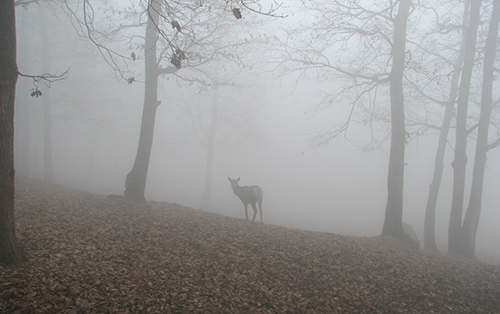
There is a way that nature speaks, that land speaks. Most of the time we are simply not patient enough, quiet enough to pay attention to the story.
~Linda Hogan
There is a way that nature speaks, that land speaks. Most of the time we are simply not patient enough, quiet enough to pay attention to the story.
~Linda Hogan
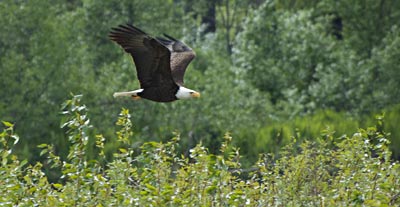
My apologies – I have been remiss! As in years previous, there has been a live eagle cam at the Duke Farms in Hillsborough, New Jersey, and I have lost track and not gotten it up in a blog post til now!
This year, the bonded pair hatched 3 eggs and have 3 growing chicks. Please check them out here! The first egg was laid on February 17, and the third egg hatched on April 1 – so they are growing!
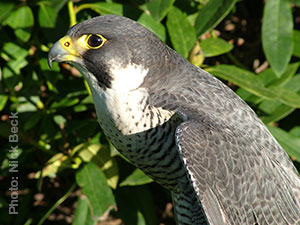 And to apologize for my negligence, nature lovers, here is a second live stream cam – on the top of a skyscraper in Jersey City, NJ – a nesting box of the endangered species, the peregrine falcon. The young falcon nestling is 23 days old today, June 3rd. Check out the baby on the Jersey City Falcon Cam.
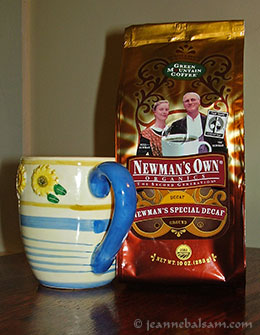 Once vilified as being a troublemaker to your health, coffee has been getting a whole new appraisal as of late. Its health benefits are now being recognized. An article in Prevention magazine wrote up how coffee can help lower your risk for Type-2 diabetes.
Researchers at Harvard University looked at 28 studies with more than a million combined participants and found that people who drank six 8-ounce cups of coffee daily had a 33% lower risk of diabetes. The good news is that each cup lowered your risk by 9%, so you don’t have to go crazy with coffee consumption, but just be aware of the possibilities.
What’s even more exciting is that it’s not the caffeine responsible for the effect, so if you drink decaf, this still applies to you. Researchers suspect that it’s a naturally occurring chemical in coffee called chlorogenic acid that reduces the rate at which the intestines absorb glucose.
So that’s how you can change your personal world, but how about expanding your vision and changing the world at large?
The coffee you drink can make an actual difference to the rainforest and to saving the lives of migratory and resident birds. With the advent of agri-technology, sun-grown coffee became the new big thing, but is not without a goodly number of drawbacks. Here are a few differences between your typical coffees and shade-grown coffees in their benefits to wildlife and the environment.
 * Migratory birds and many resident birds, (such as Poco, a rescued macaw, right), find sanctuary in the forest canopy of traditional coffee plantations, while in sun-grown coffee areas, there are 90% fewer bird species.
* Shade trees protect the coffee plants from rain and sun, help maintain soil quality, and aid in natural pest control, thanks to the birds. These traditional coffee plantations also help to conserve watersheds, leading to higher water quality and quantity for local populations. Sun grown coffee requires chemical fertilizers and pesticides and year-round labor, placing financial demands on the growers. It also leads to greater soil erosion and higher amounts of toxic runoff endangering both wildlife and people.
* Shade coffee plants can produce crops of beans for up to 50 years, while sun grown plants produce for only 10 – 15.
* The higher quality beans produced by shade grown methods produce a better tasting coffee!
 Where do you find shade-grown coffee? Most coffees marked “Organic Fair Trade” will also be shade-grown. Read the labels and check out the producers’ literature and/or web sites for details. Smaller merchants, health-oriented food stores, and, increasingly, your local supermarket now carry shade grown coffee. There is one more bonus – when you see the “Fair Trade” logo on your bag of coffee, or elsewhere, it assures you that the farmers and their families who grow the coffee are being paid a sustainable living wage for their work.
While it may be a bit more expensive than sun grown coffee, it preserves the biodiversity of our planet, the rainforest, and a multitude of bird species, plus it helps humanity. A pretty good deal all in one cup of coffee.
So you can change your personal world, and spread your wings and change a whole lot more of it.
 There is never a shortage of amazing things one can find on the web, and the site I recently came across is no exception.
As both an animal and movie lover, I am particularly sensitive to animal suffering and death on film. I have a very hard time watching cruel or violent treatment of any animal even if I know it’s an animatronic sit-in for the real animal. It’s still inordinately painful. I also much prefer to know that the animal lives happily in the end, but I know, realistically, that may not be the case. I also know, despite the oversight by a humane organization, that unacceptable behavior towards animals in film has been known to occur.
So if I’ll be upset by animal suffering, what about children? How much and at what age can they accept and understand animal suffering or the dog/cat/horse/whatever dying at the end, even though it may be a logical plot ending?
Well, here’s the site that will guide you to whatever you or your kids can tolerate – Does the Dog Die? Does the Dog Die has currently reviewed 680 films and indicates by a happy, neutral or crying dog icon if animals live, recover or die in the end. Click on any of the film names and you’ll get details about how every animal in that film is treated and what happens to it.
There’s an awful lot of violence and death in films (and TV) today, both human and animal. Sometimes we just don’t need to watch it. So check out Does the Dog Die? and decide for yourself how much you want to take in.
Although I am surrounded by country, I do live “in-town,” as they say. But perhaps it is exactly because open space surrounds us that there is no shortage of wildlife so close to our homes.
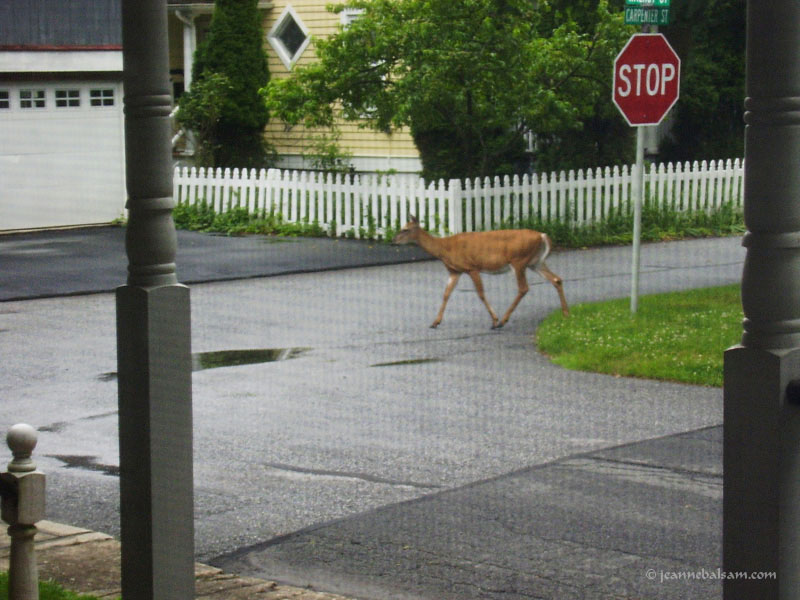
Working at my computer just this past June, I looked out front and saw a doe nonchalantly strolling down the street. She did not observe the Stop sign, but continued walking, looking for the tastiest greens she could find. Unfortunately, this is at a particular neighbor’s home who happens to be the most ardent gardener for a few blocks around. Of course! She has the delicacies!
But Ms. Doe wasn’t stopping and no sooner was she out of sight, than she came through the hedges bordering my property and casually walked down my driveway at an angle. This made me believe this may be is who is responsible for the deer tracks I see in the snow in roughly the same places – she must have a route.

Today I looked up and saw … the same doe? a different doe? and her still-spotted fawn. Mama could easily scale that white picket fence for the best nibbles while baby clearly hasn’t yet mastered leaping hurdles. I was able to go outside and get a few shots before the more worried fawn walked further down the road.
While I enjoy watching animals of all kinds, having deer so at-home in our neighborhood isn’t good. They have become accustomed to our smells and sounds and are no longer frightened. The offspring they produce will become even more acclimated to being around people. It is certainly wreaking havoc on our properties as the deer now consume shrubbery and flowers year-round even though there is plenty of browse in the nearby woods and fields.
Sadly, it just creates more enmity towards these beautiful creatures, even referred to by some as “vermin.” It’s a problem for farmers as well as residents and a complex one, yet it is we who have taken more and more of their land through endless development. It’s not a problem with an easy solution.
Meanwhile, I truly do enjoy seeing them even though they have “deer-scaped” the plantings around my home as well.
Life is an interesting journey. Here are journals, stories, reflections of a traveller of this journey. (songoftheheartsite@gmail.com)
Sharing my journey of a calm, intentional life.
Sharing Information About Writing and Illustrating for Children
Aren't songs of grief lullabies to the lost?
Immersive Tales for the Curious Explorer
Life in a flash - a bi-weekly storytelling blog
Becky Ross Michael: author & editor
Observing, Gathering, Gleaning, Sharing
Official Home of Lavinia and Rick Ross
Thoughts on life, writing, creativity and magic
Canadian Author & Memoir Writing Coach
 Still A Dreamer