Life sometimes pulls us in one direction … then another … then another. Grabs us by the collar and says, “You need to take care of this, but be sure you do this, oh! and this!” The end result is we writers look quite absent from our blogs from time to time. But be assured, this writer is still here, just pulled in all those directions.
 There’s been a boatload of work, which, as a freelancer, I will never complain about; preparation for my being a guest speaker at an Animal Writers Workshop (you can check that out here); preparation for the annual SCBWI (Society of Children’s Book Writers and Illustrators) June Conference coming up in 2 weeks; the usual (un)expected running around for all manner of things, some pleasant, some less so; and, of course, reading! No matter what else is happening, I am always reading.
To this end, I’m going to catch you up on the wonderful books I’ve enjoyed.
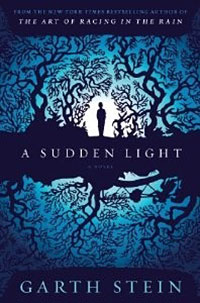
After reading The Art of Racing in the Rain by Garth Stein it was clear that I wanted to read more from this great mind. I perused Goodreads and requested A Sudden Light from my library. What a magnificent book. I will officially now read anything this man writes. A Sudden Light is a story told in the first person by 14-year-old Trevor who travels with his father to the family’s Riddell House in Oregon. His parents’ marriage is in trouble, and this trip to meet his aunt and grandfather is to allegedly settle some financial issues, put the grandfather in a nursing home, and dispose of the house. The home’s exterior is constructed of huge trees, and was built by Elijah, Trevor’s timber baron great grandfather. Trevor soon finds they are not alone in the house; there is a ghost, who has remained to see that Elijah’s last wishes be carried out, that the property be returned to a natural state as amends for the desecration he caused to the land. Somehow Stein has managed to put together an historical novel, a compelling ghost story, a tale of multi-generational conflicts and family secrets against a backdrop of the Pacific Northwest. Read more here and scroll down and visit The North Estate. Be sure not to read any spoilers!
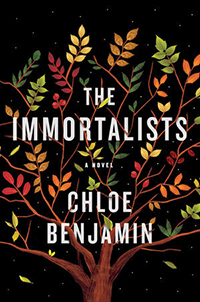 Following this, I read The Immortalists by Chloe Benjamin, a novel (her first) with a most unusual premise. Four children, brothers and sisters edging into adolescence, hot and bored in the Lower East Side summer of 1969, decide to visit a gypsy fortune teller who is said to be able to give you the exact day you will die. The kids do it on a lark, just for something to do. The eldest brags about how far in the future her date is; she’ll live to a ripe old age. Another sibling shares, but the two others are clearly shaken and will not reveal their dates. It’s all just a joke anyway, right? The following chapters follow the life of each child, as the reader, in suspended animation, follows the sibling’s choices leading up to the possible fulfillment of their individual prophecies. Warm, engrossing, a fascinating premise, and very well-written.
 I then read the next in the Inspector Armand Gamache mystery series by Louise Penny. I never thought I’d be interested in reading a series by anyone (at least not after my beloved Nancy Drew mysteries from my childhood) but Louise Penny changed my mind. Inspired by a post by fellow blogger Cynthia Reyes, I picked up a couple of Penny’s books from my local library and was very impressed. So much so, in fact, that I decided to read the entire series from the beginning (not one right after the other, but interspersed among other reading.) What a great decision! Penny is an excellent writer who knows how to hook you from beginning to end. With a cast of characters that one becomes more attached to with each book, mysteries unfold to be solved by Chief Inspector Armand Gamache of the Surété of Quebec, the premiere investigative arm of homicide in that province. The Brutal Telling is book #5 and calls upon Gamache to solve the murder of an unknown individual whose cabin is buried in the woods surrounding the quaint village of Three Pines. The evidence points to a seemingly unlikely character, which can only leave the reader quite puzzled. Are they really capable of murder? The book ends with that individual’s arrest, and we are left wondering.
 The next book in the series, Bury Your Dead, is considered a companion to this one, so I elected to read it right after, and it does pick up quite literally where The Brutal Telling ended. What is engaging about Penny’s writing is that she is not just writing simple mysteries, but increasingly complex novels which explore Canadian culture and history from Vancouver to Quebec’s founder, Samuel de Champlain, to revered artists. Her characters grow realistically and empathically, and it’s very easy to become involved in their lives and the small town of Three Pines. If you like an absorbing mystery that will also give you a little more to sink your teeth into, look into this series. I suggest you start with the first in the series, A Still Life. There is a growing richness with each subsequent novel, and Penny will always keep you guessing until the end. Oh! And another small perk – whenever characters are eating, Penny always takes a moment to describe the deliciousness of their food. It’s a tantalizing little diversion each time.
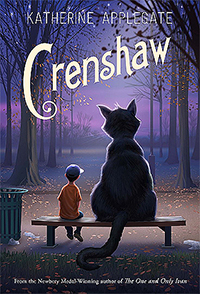 I took a turn into another age group after this and read Crenshaw, a middle grade novel by Kathlerine Applegate, the author of a book I love (and own), The One and Only Ivan, an absolutely wonderful read. This story is about Jackson, a young teenage boy, and his family whose financial situation has changed from precarious to dire with them being forced to live in their minivan. Again. The story touches on an important subject, homelessness and the challenges faced by those who may be barely getting by. But there is another important character – Crenshaw himself, a very large cat. Crenshaw is Jackson’s imaginary friend from when he was a little boy, returned to be supportive of Jackson in his time of need … whether Jackson wants him there or not. Needless to say, this lends itself to moments of humor, but at its heart, this story is about resilience, friendship, and how we survive tough times. It was a good read, but for some reason, didn’t grab me the same way Ivan did. I’d still recommend it to the middle grade readers you know because we are all always facing some challenge or other, and this age group will appreciate Jackson and Crenshaw’s approach to a problem more common than most think.
I’m now reading Flight Behavior by Barbara Kingsolver, another terrific writer. I have read at least four of her other novels, The Poisonwood Bible being a permanent resident on a particular bookcase reserved for those books that I would definitely read again. Hopefully, I’ll be able to tell you about Flight Behavior somewhere in the vague timeframe of when I finish it.
Whether you are inspired by the stories mentioned above or are on a book path of your own, I will always wish you … Happy Reading!

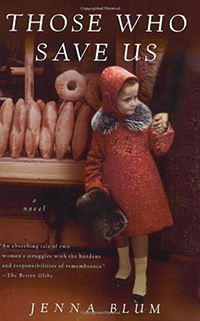 The jury is still out on this one. There were several points along the way in reading Those Who Save Us that I felt I could have put the book down and it would have been OK. Yet I didn’t. It’s not a case that it wasn’t a worthwhile book, but there was something about it that did not pull me in and engage me as I would have liked. As a writer, Blum has an excellent command of the language. You kind of knew where the book was heading – or at least, you hoped it was – but my total investment wasn’t there. Why not?
 The main character, Denny, to whom Enzo has been deeply bonded since a small pup, is a race car driver, so periodically, there is background and information about racing. But don’t think this is a story about racing either – it’s not. Racing is a metaphor for life and how to live it, particularly racing in the rain, of which Denny is a master.
 our own artwork, photography, videos, or images of our various accomplishments, is one way we do that. Even so, many of us only shyly take credit for the beauty, wisdom, intelligence, and creativity we put out into the world through our blogs. We all deserve a pat on the back, so please – give yourself one!
 Still A Dreamer