Never Bookless

This past weekend was the wonderful, huge, annual library sale that I go to every year, and below you see my haul.

EmptyShelves-Bowl-KayPat2

What? You don’t see any books? That’s because I never got there. Being under the weather for a few days, plus it was raining non-stop, I knew my best bet was to stay home and feel better. I missed the excitement of just being around the thousands of books, and certainly the traditional follow-up lunch with my friend in which we go over our multitude of finds, but in the end, I am hardly bookless.

I still have books from last year’s venture; friends share books all the time; I have bookshelves stuffed with selections I’ve yet to read or would happily read again; and … the local library is in a decent walking distance from my home. I am living in a very book-rich world.

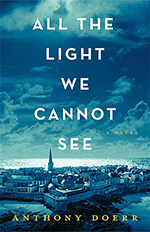
AllTheLight-ADoerr2Not to mention, I am still living in the world of Anthony Doerr, Pulitzer Prize winning author of  All the Light We Cannot See. Yesterday, before I closed-up shop for the day on my work, I read a bit online about him and his other books, and watched a video of how he came to write this phenomenal book. I also looked at photographs of Saint Malo, the walled city on the coast of Brittany, bombed practically beyond recognition at the end of World War II, and an important location for much of the story. Doerr wanted to write a different tale about the war, and much like the outstanding author of The Book Thief, Markus Zusak, he certainly has done that. I am at times brought to tears at the beauty of Doerr’s use of words, and am moved by the story he tells.
As I approach the end of the book, I am deeply saddened by what has happened to one of the characters, but am holding out hope for the others. Soon I will be returning this novel to my local library, never knowing if my next book will be in the stacks, sitting in the $1.00 shelves at the front desk, or waiting for me here at home. I don’t own a kindle, and don’t read online. I thoroughly enjoy the weight of a book in my hands, the smell of paper and ink, the turning of the pages, and the placing of a bookmark where I’ll begin again as soon as I’m able.

We who love to read are a lucky lot, are we not?

History through the Back Door (or how I’ve come to love historical fiction)

If you had asked me 5 or 6 years ago if I liked historical fiction, my answer would have been “Meh.”

Sadly, I was effectively turned off to all things history as a child, when my first learning experiences labeled “History” were nothing more than an endless dry and boring series of names, dates, places and events to be absorbed and later regurgitated on tests. In retrospect, our teachers had to cover 7 or 8 different subjects daily, so what were chances that any of them would be a real history buff and would teach us history with great enthusiasm and insight? Apparently, pretty slim.

KiteRunner-KHosseiniIt wasn’t until college when I had an exceptional professor who taught Contemporary Civilization in the context of art, (I was at an art school), and for the first time someone teaching history had neurons in my brain firing rapidly. History suddenly came alive! Unfortunately, at that point, I had very little mental framework in my brain to hang it on. But I started to take an interest in the subject.
What really kicked my interest into high gear has happened in more recent years when I would come across a novel set in a particular place and time period, so rich and textured, that I wanted to learn more. One of those books was The Kite Runner by Khaled Hosseini, and it sent me flying to the internet to learn about the Afghani people and what was transpiring in Afghanistan during the time this novel took place. I cannot recall the country of Afghanistan mentioned once in history or geography in my childhood education, but now, here was a piece of fascinating history.

ShanghaiGirle-LSee2The two novels that recently afforded me that desire to delve into history were those by author Lisa See, Shanghai Girls and Dreams of Joy.The first novel begins when Shanghai was known as the Paris of Asia, and sisters May and Pearl were  “beautiful girls”, models. With their father having lost all their money, the sisters, with their mother, must flee Shanghai as the Japanese invade China. The sisters were forced to emigrate to the United States in arranged marriages. From their interment on Angel’s Island to creating lives for themselves and their families in Los Angeles’ Chinatown, we follow the complex relationship of Pearl and May and Pearl’s daughter, Joy.
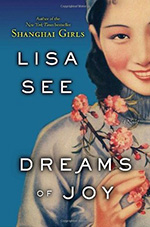
In Dreams of Joy, Joy, now in college and angry at her family’s deception and distraught over one family member’s suicide, secretly runs away to China to find her true father. Her studies have convinced her that Communism is the best of all systems, and she is determined to start her own life, although  DreamsOfJoy-LSee2she is soon to be profoundly discouraged and isolated. Pearl leaves the states to search for her daughter, encountering endless roadblocks along the way. The backdrop of much of the novel is the time under Chairman Mao and The Great Leap Forward, a time of alleged progress in which a famine took the lives of millions of Chinese people. (From Wikipedia – “The Great Leap ended in catastrophe, resulting in tens of millions of deaths, estimated from 18 million to 32.5 or 45 million. Historian Frank Dikotter asserts that “coercion, terror, and systematic violence were the foundation of the Great Leap Forward” and it “motivated one of the most deadly mass killings of human history”.)

Lisa See writes about family and relationships and this alone would have held my attention, but told against the backdrop of both China and the United States in times of political change and turmoil of every kind, I searched to know more. My knowledge of history is still spotty, but through the pages of beautifully written historical novels, I continue to learn. It seems history stands at my back door, always with a hand raised, always ready to knock.

The Magical Book

One of the (many) wonders of books is that they sometimes arrive at just the right time. Perhaps it’s not exactly a magical book but it’s the one that’s juuuust right for where we are and what we need to read right now.

MagicalBookFinal2

For example, a dear friend of mine came upon a book not long ago and was just over the moon about it. She got me so excited that I went immediately to my local library and borrowed it. I began to read. I was not excited or over the moon as I’d hoped; in fact, I was occasionally disenchanted by the author’s style, which was quite different from what I’d read of hers previously but seemed to me to be trying a little too hard to be hip and cool. I continued reading, sometimes really enjoying it, and while I felt it got better towards the end, it never made me jump up and down.

So I returned the book to the library, and talked about the book with my wonderful librarian, who is also familiar with the author, and she said she’d give it a try. Her response was that she liked it. Not crazy about it, but what had bothered me did not bother her, and she would read some more. And there you have it. Kind of like Goldilocks and the three bears, I thought.

For one of us it just wasn’t the right fit; for another it was enjoyable, but not fabulous; but for the original reader it was exactly the right size and the perfect book for her right now. And that’s what makes books so wonderful. Certain books come into our hands, into our lives, and they are exactly what we want – and/or need – to read at that moment in time. I’ve certainly encountered books like that – haven’t you? The story, or the information, is so meaningful right then that it just couldn’t be any better.

Sometimes it takes a while for that book to appear in our hands, but we always know it when it arrives. For those of us who write, or at least for me, it is my dream to write that book for children that will be exactly what they want – or need – at that moment in time. Even if it’s only one child, I’ll be happy.

Journaling with Kindness

I journal almost daily, in the morning, with my coffee, and find it a very effective way to start the day, clearing out cobwebs, jotting down ideas, organizing what-have-you, etc. I am RandomActs-Notes2generally somewhat particular about what size my journal is – as there are limits as to what is most comfortable in one’s lap – but not how plain or fancy the journal may be. After all, this isn’t some formal document, and in the long run, is not going to be kept. I often can pick up a perfectly serviceable journal in the supermarket.

As I was down to the last 2 pages in my current journal, I planned to pick up a new one when I went grocery shopping, but … there was not one to be found of a workable size. All seemed to be notebooks that kids would bring to school, at least 8″ x 10″. OK, then, as mentioned, hardly the Declaration of Independence going in here.

“Be a rainbow in someone else’s cloud.” ~Maya Angelou

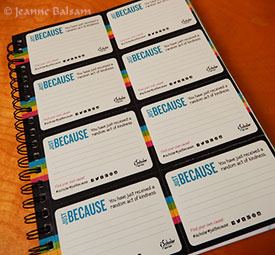
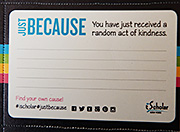
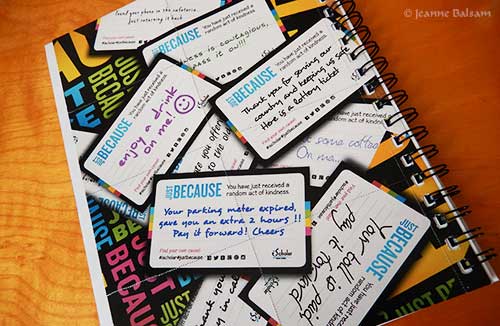
When I opened it, however, I was pleasantly surprised. There was a perforated, light cardboard page behind the cover promoting Random Acts of Kindness! Eight cards you could tear apart, write a note for someone and leave for them or give to them. Now that’s RandomActs-OneCard2pretty cool! And while it has its own hashtags from the manufacturer for learning more, it doesn’t take away from how wonderful an idea this is to put right into the hands of children, (or anyone, really.).

I have always been enamored by Random Acts of Kindness. Most of us actually perform them daily and don’t even think twice about it – holding open a door, picking something up for another, giving a compliment – kindness isn’t hard. We’ve all, I’m also sure, gone a little above and beyond from time to time. One of my personal favorites was a number of years ago when in New Hope, PA, a very popular, artsy town known for its unique shops and restaurants AND for its 25 cents for 15 minutes parking meters. One time, returning to my car, I spotted the meter maid about 6 cars down and coming my way. The meter had expired next to the car directly behind me, so I fed 4 quarters into their meter and bought them an hour. I’m sure you’ve done the same. I was amazed that something so small put such a big smile on my face, even to this day.

“Always be a little kinder than necessary.” ~James M. Barrie

RandomActs-Ideas2

Now if the purchasers of this notebook are at a loss as to what to do with the cards, the reverse side gives lots of examples. As for me, I think I’ll be tearing off at the perf and carrying one with me. You never know when the chance to do a Random Act may arise!

If you are interested in knowing more – for your kids, students, or just for yourself – of course there’s a website for Random Acts of Kindness with all kinds of resources and ideas. I suspect you’re already a kind person, and I’m sure you agree, that in addition to making a however-small difference in the life of someone else,  there’s a lot of giggly-inside, feel good to be had in a Random Act of Kindness.

“Too often we underestimate the power of a touch, a smile, a kind word, a listening ear, an honest compliment, or the smallest act of caring, all of which have the potential to turn a life around.” ~Leo Buscaglia

Ada and Laurie – Science, Imagination and Inspiration

Ada-TitlePage2Welcome and thanks for stopping by. Visiting today is debut author and friend, Laurie Wallmark. Accompanying her – at least in spirit – is the brilliant young scientist, Ada Byron Lovelace.

Ada Byron Lovelace and the Thinking Machine is a picture-book biography of the world’s first computer programmer. Ada was born two hundred years ago, long before the invention of the modern electronic computer. At a time when girls and women had few options outside the home, Ada followed her dreams and studied mathematics. This book, by Laurie Wallmark and April Chu, tells the story of a remarkable woman and her work. Kirkus Reviews describes the book as a “splendidly inspiring introduction to an unjustly overlooked woman.” [starred review]

Laurie’s blog tour hosts had some options in our presentations, so I offered some interview questions that will hopefully show us a different side of Ada. I’ve also included some of the book’s stunning artwork by April Chu.

Still A Dreamer: Having read as much as you have about Ada, what do you imagine Ada would make of social media? If alive today, would she tweet? Have a blog? Be on Facebook? How would she use them?

Laurie: Ada would most definitely use social media as a method of communication with her fellow scientists and mathematicians. She often attended evening salons at Charles Babbage’s house to connect and exchange information. Social media would have allowed her to do this more easily and frequently. Through Facebook and Twitter, she could hear about the many marvels of the Industrial Revolution without waiting for them to be published in scientific journals. With a blog, she could share her many scientific theories and receive feedback from her peers.

Ada-HorseCarriage_Page4-2

SAD: Although Ada might have laughed at the term, she was a visionary. There have been so many technological discoveries since her own, what advances/inventions might Ada make use of were she alive today? How would she have used them to advance her own knowledge?

L: The greatest technological boon to Ada’s studies would be, without doubt, the Internet. As discussed above, social media could provide her with a wealth of information. More than that, websites of organizations like the Royal Society (the UK national academy of science) and individuals like the polymath Mary Somerville would be invaluable. Even seemingly minor inventions, like e-readers, would be useful since Ada was so often ill and confined to bed. With an e-reader, she could easily keep up with her studies.

SAD: Lord Byron the poet was Ada’s father, but had little to do with her upbringing, correct? At any point, to your knowledge, did either acknowledge/praise the wonderful accomplishments of the other?

L: Ada’s mother separated her from Lord Byron when Ada was only one month old. She was never allowed to see or interact with her father after that. Lord Byron, though, lovingly wrote of Ada in his poem, Childe Harold’s Pilgrimage:

Is thy face like thy mother’s, my fair child!
Ada! sole daughter of my house and heart?
When last I saw thy young blue eyes they smiled,
And then we parted—not as now we part—
But with a hope—*

He died when Ada was only nine years old.

Ada-Sailboat-Page8-2

SAD: The $54,000 question – How can Ada’s work, which began as a child, reach girls today, (other than buying your book, of course), and inspire them?

L: Several organizations have used Ada’s name as a rallying point for their cause. The Ada Initiative (recently shut down) supported women in open-source technology and culture. One of their major achievements was to formulate a code of conduct signed by most major tech companies for appropriate behavior at technical conferences,. And of course there’s Ada Lovelace Day, a celebration of the achievements of women in STEM (science, technology, engineering, and math). On this day, people throughout the world blog about girls and women involved in technical activities. In 2015, October 13 is Ada Lovelace Day. Not coincidentally, this is also the release date of Ada Byron Lovelace and the Thinking Machine.

Join Laurie as she travels from blog to blog to introduce her debut picture book, Ada Byron Lovelace and the Thinking Machine. All stops are listed at: http://lauriewallmark.com/blogtour.php.

Laurie writes exclusively for children of all ages and has a lifetime love of, and involvement in, math and science as well. Learn more about Laurie at her
Website –  http://www.lauriewallmark.com,
on Facebook –  https://www.facebook.com/lauriewallmarkauthor
on Twitter – https://twitter.com/lauriewallmark

Better yet, come meet Laurie in person at her book launch on Sunday, Oct. 25th from 1 to 4 p.m. at The Book Garden in Frenchtown, NJ!