Learning History Backwards

History seems determined to find me. I haven’t been looking for history, but somehow I am bring coaxed into looking at periods in time of which I know little or nothing, most recently British colonial rule in Kenya in the 50’s. I know. How did that happen? (Well, one look at the photo, and you may know.)
TheFirstGrader-KerryBrown2Like the experience of many others in a time past – and perhaps still the present – history was taught in such a way that it was guaranteed to, at the very least, leave no lasting impression, and at the worst, develop in one a real distaste for it. The latter would be me. I dutifully swallowed the dry rattle of names, dates, places and events and dutifully coughed them back up for tests. Not until I got to college and had a brilliant professor who made history truly come alive did I suddenly realize the fascination of history. And by then it seemed too late; I had such a fragile and spotty framework of knowledge on which to hang any new historical insights.

But history seems to be hunting me down through  books and/or movies as of late … Afghanistan before and after the Taliban took over through The Kite Runner; the deep South during the Civil Rights movement in The Help; the Civil War period in Oklahoma in what I’m reading now, Paradise, medieval times in Britain in The Last Templar and so on. History isn’t the subject; it’s the backdrop, but it’s impossible to not be drawn into the history of the time period when reading the book or watching the movie.

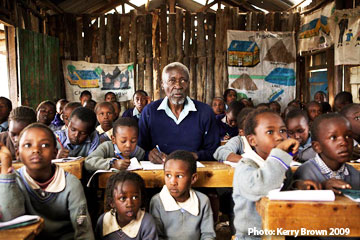
Most recently it’s The First Grader, a movie set in Kenya in 2003. It’s based on the true story of an 84 year old villager, Maruge, who, when primary education was made available to all, wanted to learn to read. The story is absolutely inspiring. There he sat, having fought repeatedly for his right to do so, with six year olds, five to a desk, learning the alphabet. His rapport with Jane Obinchu, the instructor, and the children is a testament to the spirit of those who believe in something enough to pursue that dream and love doing it in spite of all odds.

What was far more difficult to watch, shown in sporadic flashbacks, was what happened to Maruge in the early 50’s when he was sentenced to a prison camp under British colonial rule. The Mau Mau tribe, whom  Maruge had joined, had risen up against the corrupt British but were defeated and captured. To force him to renounce his vow of loyalty, his captors forced him to watch the execution of his wife and children, (this was not shown onscreen), and tortured him brutally. It was hard to not wake up the following morning flooded with sadness as to what has gone so wrong in human beings that they can treat others as they did.

But in the long run, that does not change my recommendation to see this incredibly rich and touching movie. The First Grader was filmed in Kenya, and all the children are actual attendees of one of the schools in the Kenyan bush. Their glowing faces just light up the screen. One little girl named Agnes, seemed mildly deformed and had a severe limp like Maruge. She told him she wanted to go to school so she could be a doctor … and then she could make him better. The children have almost as much impact as Maruge himself. It’s hard not to smile when thinking about this movie, in spite of the reflection of such a terrible time in history.

Maruge became the oldest recorded person in the world to ever attend first grade and drew his own bit of celebrity for his devotion to education. So much so, that he was flown to New York to speak at the UN. Should you watch The First Grader, be sure to watch the short documentary and you will see the real Maruge, Jane Obinchu and others. You will also see how the director worked with the children who had never seen a television or movie. You may be inspired.

Farewell to A Book

Putting a book away when it has offered such insight and wisdom can be quite difficult for me. When the author has brought information that is new, or even what we may know, but framed in a completely different way, it is a gift. Especially when we are being reminded throughout of the magnificence of our spirit … who wants to let that go?

In Wishes Fulfilled by Wayne Dyer, I found a reframing of things I have been learning in a different and practical way … simple tools to practice regularly to help me change some of my thinking that would result in my being happier, lighter in the world and more able to manifest my dreams. His referencing some of the renowned spiritual teachers who have walked the planet, some of whom still do, has brought home the universality of direction we all could take if we open our hearts and minds.

As with so many things, incorporating his suggestions into everyday life is something to not just keep in mind, but practice. It’s a way of changing our concepts of ourselves and all for the better. If you are seeking to manifest your dreams, which may be as basic as having improved health, you might enjoy Wishes Fulfilled, available through Hay House, its publisher, or Amazon. (The price is the same at either location, and at Hay House you will support a smaller company dedicated to growth of all kinds.)

So Dr. Dyer will go in a particular bookcase in my home and join other books that have offered their wisdom to me. On the final page of Wishes Fulfilled, he summarizes the concepts he’s shared, and then quotes the following from Rumi, the 13th Century Persian poet, which is a great reflection of this book’s direction:

You were born with potential.
You were born with goodness and trust.
You were born with ideals and dreams.
You were born with greatness.
You were born with wings.
You are not meant for crawling, so don’t.
You have wings.
Learn to use them and fly.

– Rumi

Can We Ever Have Too Many?

Probably the answer to that is `yes,’ but when I think about it being books, my head just seems to automatically move from side to side … no. We can’t.

Of course, I say this in my own defense, as well might you, in the face of Tuesday’s experience. I went to vote. Our town votes in the local library. There are no services for that day, but one can still roam about and  peruse the shelves. Well, the shelves I perused were the ones in front of the check-out desk which are always filled with used/unwanted/donated books for sale. $1.00 for hardcover, $.50 for paperback.

I asked one of the ladies helping out with voting if I could just leave the librarian some money for a few books. Of course I could, just no borrowing from the main shelves. (I bet they’re all in cahoots, I thought, conspiring to entice helpless readers.) I didn’t have change, so left a bigger bill which would cover the books and a small donation to the library along with a note.

I found another book by Amy Tan, The Kitchen God’s Wife, her next after her first big success. The Joy Luck Club. That seemed like a good bet. And then I found Toni Morrison’s latest novel, Paradise, a mystery about some evil goings-on in a convent outside a small Oklahoma town. Now that sounded interesting! And then in paperback, The Power of Silence, a later book by Carlos Castaneda, and also The Secret by Rhonda Byrne … the book. (I’ve only read the web site.) What a tasty little gathering of reads for such a pittance.

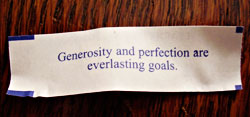
Now, that fortune cookie … technically, it belonged to my friend as I had already opened and eaten my cookie. Half of it was good advice … the generosity part. The perfection part? Well, sometimes that’s just a way to make ourselves crazy, but hey, it’s only a thought in a cellophane-wrapped, folder-over piece of fried dough, right? I have something more on my mind … I’m stalking through the freshly vacated rooms of the convent with men seeking justice in Paradise.

It’s November – PiBoIdMo Month!

November is PiBoIdMo – Picture Book Idea Month! It’s the perfect time for aspiring, (or published), picture book writers to challenge themselves by coming up with an idea a day for the 30 days in November.

Established by children’s book author Tara Lazar, PiBoIdMo is a great way of really getting those creative juices flowing, and while you can certainly do it on your own, you can sign up for PiBoIdMo on Tara’s web site. It’s free, of course, but registering gives you the opportunity of winning some cool prizes including a critique of your ideas by an agent or editor in the children’s book field. There’s still time! Registration closes Nov.4th.

You can still follow along after that date, and check out the relevant daily posts on Tara’s site, but to be eligible for prizes you must register by Nov. 4th. Check here for complete details and to sign up.

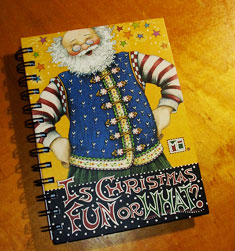
I participated in 2010 – that’s a photo of my PiBoIdMo journal which has plenty of room left for my 2012 ideas – and was amazed at how many good ones I came up with! Some were less than brilliant, I admit, but quite a few were pretty interesting. I really enjoyed my own little PiBoIdMo kick-off which included reviewing some of those ideas. Just makes me want to write!

If you aspire to write children’s picture books, why not give it a go and watch your own creativity bloom?


Stress … and what happens next

It happens to all of us at one time or another. We get stressed, overwhelmed, overworked or catch the latest bug that’s going around. Or several of the above.

And what’s one of the first things that falls by the wayside? Our good health habits. When you feel like crap, you don’t feel much like cooking the solid meals, getting the vitamins and supplements together, sticking with the exercise routine. I know I’m not alone when I say sometimes it’s just hard to keep it all together under duress.

Having a family and/or animals  staring you down on a regular schedule does keep the food prep moving, but any leftover energy is often devoted to recovering from that physical or mental stress. There are lots to ways to deal with it, but here’s an easy and convenient one that I find works for me. I pick up Spontaneous Healing by Dr. Andrew Weil. It’s a simple reminder for me to allow my life to heal and get back on track. A reminder to eat healing foods, those that support my best health, and reinvest myself at whatever rate I’m able into activities that support my well-being. Reading something inspirational – Wayne Dyer right now also has that effect for me, but it can just as easily be some other metaphysical teacher – can also be very healing.

It’s essential is to carve out some time for ourselves that soothes and heals us. Add calming music to that, light a candle, and enjoy a bit of space that is sacred, not to be encroached upon by others, family or not. Meditate, breathe, stretch.

It’s so easy in today’s world to become overwhelmed and hit that wall of exhaustion. But we owe it to ourselves to be kind to us. Being kind to ourselves isn’t selfish; it’s what allows us to recharge so we have the energy and the love available to be kind to others. When we’re worn to a nub we’re not much good to anyone. Taking proper care of our physical selves is important, as is caring for our emotional, mental and spiritual selves. We need to be whole.

So I dip into Spontaneous Healing as a reminder of what magnificent housing we live in – our bodies – which are always doing their best to heal themselves. If only we listen to what they need. Andrew Weil tells us and it’s not really what most of us are doing.

And then … I might try and find some time to read something purely for pleasure. At the moment I am reading a novel recommended by my friend’s husband, Homegoing. I’m having a difficult time, but I suspect it’s because I’m trying to cram in a little reading before it’s finally lights out at night; it’s rarely a good way to enjoy a book. Perhaps there’s a bit more time to find … somewhere, I don’t know where … but it’ll be after I cook a healthy meal, for sure.

Here’s to you and your health.