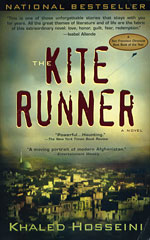
 I am still sitting with The Kite Runner. Not moving onto another book yet, and not really wanting to. That’s how powerful this book is for me.
I feel compelled to write about it, though I wonder what I can say that hasn’t been said a thousand times over. I have no intention of writing a synopsis or the like – this is personal. I can say this … Khaled Hosseini is an outstanding writer – part of the brilliance of this book is that it’s hard to imagine that it is not completely autobiographical, yet I know it is not. I can say that I don’t believe one could read The Kite Runner without easily forgiving Amir for what he felt was his horrific betrayal of Hassan. From the standpoint of an observing adult, Amir’s was the realistically-based fear of a child that he would have suffered the same cruelty as did Hassan at the hands of Assef. Yet Amir bore the burden of failing his friend, and this is a pivotal point around which spins The Kite Runner’s tale.
The relationships between the characters are so beautifully drawn … the tender yet precarious boyhood friendship between Amir and Hassan; the great need of Amir to please Baba; the much needed acceptance in Amir’s relationship with Rahim Khan, his father’s business partner; his later love with Soraya; and then his overwhelming compassion for Sohrab. I must say, I loved being taken to a land of which I know so little. Despite the telling of its tragedy and violence, it was someplace I’ve never been, and in this, Hosseini artfully painted a picture. The beginning of the story takes place against the backdrop of a beautiful, richly colored Afghanistan, but which is then torn apart and destroyed in the Soviet invasion, followed by the chaos of a civil war, leaving people in the even more cruel hands of the Taliban.
As moving as this story is to me, so artfully woven around the characters and the painful events of their lives, I was almost equally as moved by the devastation of a land, of a life, where people had known happiness. The destruction and poverty which changed all of the characters’ lives forever is, of course, a critical part of the story … broken characters, a broken country. The brutality of man against man – even amongst different sects/classes within the country itself, (Baba and Amir, Pashtun, and Ali and Hassan, Hazara), eloquently described and tragic beyond words. Thankfully, Hosseini found them.
As mentioned, I know very little about Afghanistan. That part of the world was never a subject of much attention when I was growing up and studying history. The Soviets invaded Afghanistan in the late 70’s followed by 10 years of war. Not long after the Soviet withdrawal, more chaos followed in civil wars within the country and greater world repercussions, but I am no expert here. Different parts of The Kite Runner took place over these periods, and it all brought an immense sadness to me … over man’s relentless quest for power and control over one another, of his endless and shameful inability to respect, if we cannot love, our fellow man.
Yesterday, I went online to learn more about Afghanistan – something to help me better understand The Kite Runner and the events befalling its characters. I looked at maps and traced the routes of the characters to Jalalabad, and at other times to Peshawar and Islamabad in Pakistan. I watched videos where the author spoke about this, his first novel, and his country. He is an insightful, likable and empathic man, trying still to bring attention to the plight of his people who are living in desperate poverty. Some of these videos included the Afghani … they are a very handsome people. I felt much like a child with my eyes just opening to another part of the world which has, up until now, escaped my attention, my consideration. It just got me thinking …
I wondered if the man who pumps gas in the town next to me might be from Afghanistan … did he leave his country at some point as Baba and Amir did … to try and find a better life here? Although Baba and Amir were escaping the Soviet invasion, might this man have left behind the Taliban or some other political pressure of which I know nothing? Considering the deep resentment, and often hatred, this country can have for the West, would he see a question of where he came from as a rude intrusion, or maybe a moment of unexpected friendliness from an American? I am not saying I would, (or would not), ask, but I know The Kite Runner tore open another part of my heart … a part that has more questions, more curiosity, for what I have not known … a part brimming with compassion for the Amirs, the Hassans and the Sohrabs. This is the gift Khaled Hosseini gave to me, and for which I am grateful.
p.s. I have just found that Khaled Hosseini has established his own foundation to help the Afghan people. The Khaled Hosseini Foundation‘s site lists the needs of the people, what the foundation is doing to help, and what you can do to help if you are inspired.
 Still A Dreamer