You think your pain and your heartbreak
are unprecedented in the history of the world,
and then you read.
~ James Baldwin
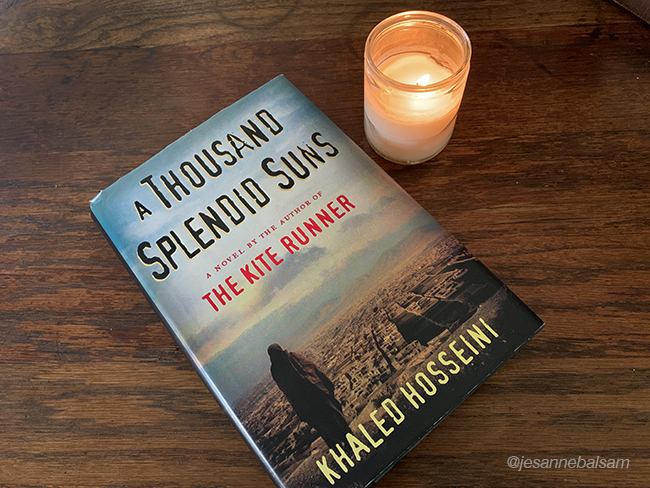
A Thousand Splendid Suns, historical fiction, by Khaled Hosseini was a very difficult read for me. For many reasons.
Most disturbing to me was the horrific brutality to women, to our two main characters, Mariam and Laila, but also to women in general under the shifting periods of leadership in Afghanistan. Under the Taliban, women were severely beaten or possibly executed for being on the street unaccompanied by a close male family member.
The abuse perpetrated on Mariam and Laila in their home by their husband was heinous. Rather than being happy for the two women, I was sometimes simply relieved that they somehow managed to survive. There were happy moments, but very few with him.
While the story begins in Herat, most takes place in Kabul over a period of decades when there is non-stop destruction between warring parties from within and from outside of the country. This would have been hard enough to read, but in the face of the horror going on currently in Gaza, the seemingly endless war in Ukraine, and an unfounded war in Iran, more war was painful to read about.
The fact that I am not a history buff by any means also made this novel a challenge, plus this is a culture I have little familiarity with. I had a lot to learn.
The story itself is essentially about two incredibly brave women who were not raised to be brave. In their fight to survive, Mariam and Laila became bonded like mother and daughter, repeatedly risking so much to protect their children and others they loved. How they endured and overcame so much loss and found strength through one another is at the inspiring core of this story.
As I write this, I find tears in my eyes as I think of Mariam and Laila, of Tariq, of Aziza and Kalmai, of Babi and Mammy, of Nana, and of Mullah Faizullah. Even for Jalil who, too late, came to understand what he had done. For Zaman, who ran the orphanage.
It is, in the end, a story of love, of heroism, of hope, and survival against all odds, but I now know why it sat on my TBR shelf so long after my having read The Kite Runner. Some books just ask a lot of you. This, for me, was one of them. It was worth it.
 It wasn’t until college when I had an exceptional professor who taught Contemporary Civilization in the context of art, (I was at an art school), and for the first time someone teaching history had neurons in my brain firing rapidly. History suddenly came alive! Unfortunately, at that point, I had very little mental framework in my brain to hang it on. But I started to take an interest in the subject.
 The two novels that recently afforded me that desire to delve into history were those by author Lisa See, Shanghai Girls and Dreams of Joy.The first novel begins when Shanghai was known as the Paris of Asia, and sisters May and Pearl were “beautiful girls”, models. With their father having lost all their money, the sisters, with their mother, must flee Shanghai as the Japanese invade China. The sisters were forced to emigrate to the United States in arranged marriages. From their interment on Angel’s Island to creating lives for themselves and their families in Los Angeles’ Chinatown, we follow the complex relationship of Pearl and May and Pearl’s daughter, Joy.
 she is soon to be profoundly discouraged and isolated. Pearl leaves the states to search for her daughter, encountering endless roadblocks along the way. The backdrop of much of the novel is the time under Chairman Mao and The Great Leap Forward, a time of alleged progress in which a famine took the lives of millions of Chinese people. (
 Still A Dreamer