It’s Never Too Late

Whatever our age, at one point or another, we may feel that our one big chance has passed us by. Whether it’s to be published, appear on stage, accomplish something amazing …. whatever it is, we missed that magical time. Here are some amazing facts that say we’re wrong.

At age 23, Tina Fey was working at a YMCA.
At age 23, Oprah was fired from her first reporting job.
At age 24, Stephen King was working as a janitor and living in a trailer.
At age 27, Vincent Van Gogh failed as a missionary and decided to go to art school.
At age 28, J.K. Rowling was a single parent living on welfare who was clinically depressed and at times has contemplated suicide.
At age 28, Wayne Coyne (from The Flaming Lips) was a fry cook.
At age 30, Harrison Ford was a carpenter.
At age 30, Martha Stewart was a stockbroker.
At age 37, Ang Lee was a stay-at-home-dad working odd jobs.
Julia Child released her first cookbook at age 39, and got her own cooking show at age 51.
Vera Wang failed to make the Olympic figure skating team, didn’t get the Editor-in-Chief position at Vogue, and designed her first dress at age 40.
Stan Lee didn’t release his first big comic book until he was 40.
Alan Rickman gave up his graphic design career to pursue acting at age 42.
Samuel L. Jackson didn’t get his first major movie role until he was 40.
Morgan Freeman landed his first MAJOR movie role at age 52.
Kathryn Bigelow only reached international success when she made The Hurt Locker at age 57.
Grandma Moses didn’t begin her painting career until age 76.
Louise Bourgeois didn’t become a famous artist until she was 78.

Just because we haven’t found fame and fortune by the age of 21, it doesn’t mean we’re over.
Maybe we’re still figuring out what our big dream is, what it is that sets our soul on fire.
Things can change on a dime, so never tell yourself you’re too old to make it.
Never tell yourself you missed your chance.
Or that you aren’t good enough.

It’s never too late.

.

.

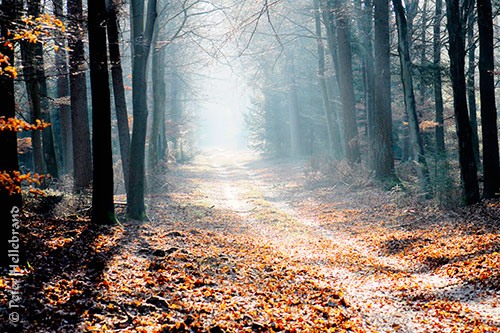
Photo by Jared Weiss on Unsplash

Hope Delivered by A Brilliant Friend

In reading about some deeply saddening events happening in the world, I began researching some quotes for the word `hope’. I came upon two brilliant ones by Fred Rogers, known to most as Mister Rogers of Mister Rogers’ Neighborhood. I was a bit older when this TV show first appeared, but had opportunities to check in from time to time with this kind man who loved, understood, and deeply respected children.

There is a great deal of information available on Fred Rogers, but I wonder if viewers knew how brilliant and insightful a man he truly was. The first quote is related to his oft-repeated sentence to the kids, “It’s you I like.”

“When I say it’s you I like, I’m talking about that part of you that knows that life is far more than anything you can ever see or hear or touch. That deep part of you that allows you to stand for those things without which humankind cannot survive. Love that conquers hate, peace that rises triumphant over war, and justice that proves more powerful than greed.” 

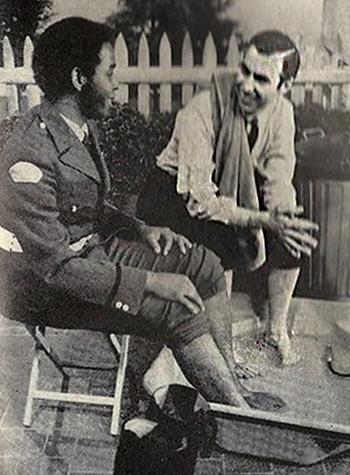
Pictured above is Mister Rogers having a foot bath with Francois Clemmons, the friendly neighborhood police officer, Officer Clemmons, on the show for 25 years. It was taken at a time when racial integration was barely beginning, but when the idea of a white man and a black man sharing a kiddie pool foot bath, and the same towel to dry off, was extremely radical. But Fred Rogers was very much into breaking barriers. This was taken in 1969.

The second quote by Fred Rogers was about disabilities, and his vastly different view of what that meant as compared to what is commonly believed.

“Part of the problem with the word ‘disabilities’ is that it immediately suggests an inability to see or hear or walk or do other things that many of us take for granted. But what of people who can’t feel? Or talk about their feelings? Or manage their feelings in constructive ways? What of people who aren’t able to form close and strong relationships? And people who cannot find fulfillment in their lives, or those who have lost hope, who live in disappointment and bitterness and find in life no joy, no love? These, it seems to me, are the real disabilities.” 

President George W. Bush presents the Presidential Medal of Freedom Award to Fred Rogers July 9, 2002, during ceremonies in the East Room. Photo by Paul Morse, Courtesy of the George W. Bush Presidential Library

In 2002, Fred Rogers was presented with the highest civilian award given in the United States, the Presidential Medal of Freedom Award. It is the highest, but by far, not the only one, he received. For more information about Fred Rogers and his many accomplishments, check out his biography on Wikipedia.

For a little extra treat, watch Fred Rogers testify in front of a U.S. Senate subcommittee, asking that his funding for pubic television and his show be renewed. His speech is so persuasive that he melts the heart of the subcommittee head who didn’t initially want to hear him.

I started out looking for a quote or two on `hope’, and came to learn quite a bit about one man who offered hope and so much more to so many children through Mr. Rogers’ Neighborhood. I believe his legacy is far greater than any of us could imagine.

The Walk Before the Green

It was only about a week and a half ago that I went out walking … the earth was still slumbering, content in its dried weeds, quiet soil, bare trees. But the warmth in the air, the sun, spoke of a greener time to come.

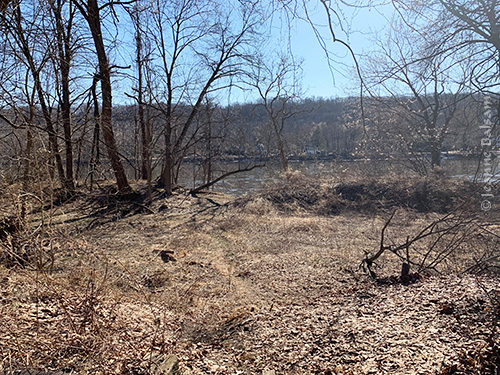
The river was high and moving swiftly towards the bay at the southern part of the state. Although turbulent and muddy-looking from this view, it was still beautiful.

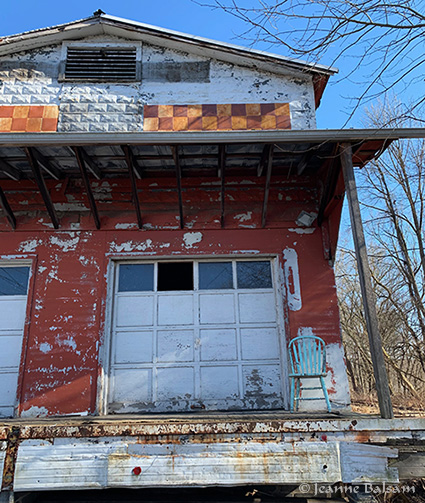
I walked past what is probably the neighborhood eyesore. It’s a long, low red building, at the end of which are a loading platform and garage doors, awaiting a shipment that has long since failed to arrive. I love the chair sitting there, keeping the faith that someday the neglected warehouse might live again. The red checkerboards above the garage doors tell me that this may have once been a Purina distributor, perhaps for large animal feed, serving the farmers who are just a few miles away. In a tonier town, this would have long since been demolished. We all seem to just take it for granted.

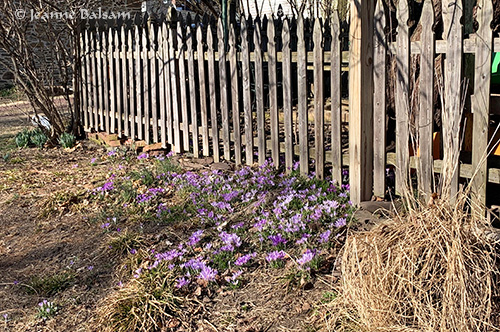
A bed of purple crocus had pushed its way through the dirt edging the road, no grass yet in, looking rather alone, barren, and brave.

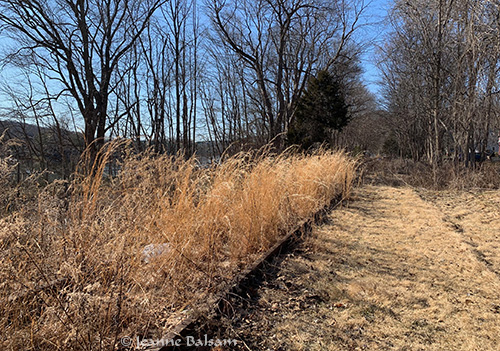
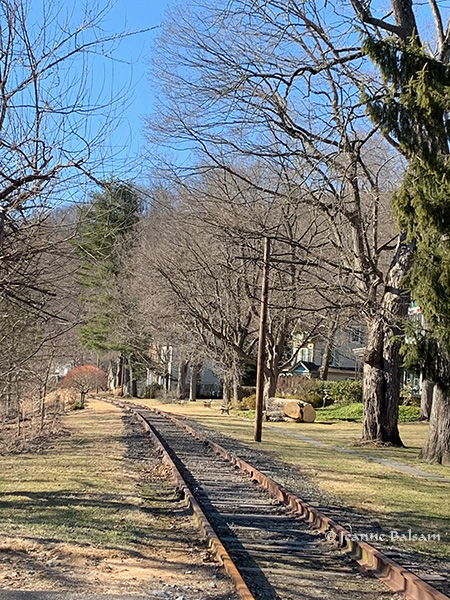
Across the street a stream of bright golden grasses filled the space between the old train rails, brilliant in the sun, and threw shadows on what was once a second set of tracks.

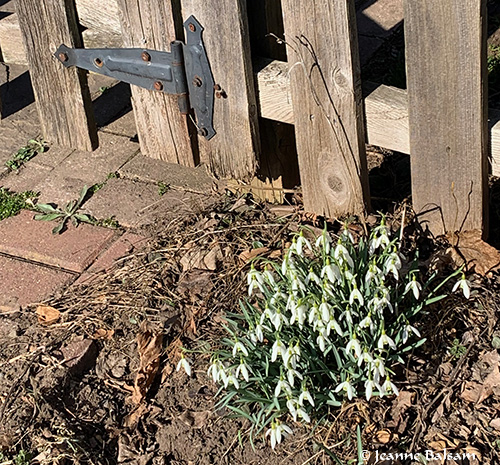
A small bunch of snowdrops struggled to announce an impending Spring among dried grasses and old walkway weeds. I couldn’t help but imagine them surrounded by a bed of rich grass or maybe even some mulch, just something more complimentary to their delicate, pioneering spirit.

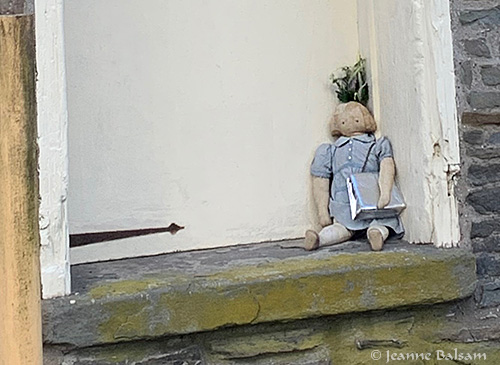
An old building on the walk to the bridge. I’m sure it’s the same age as some of the other stone buildings I’ve photographed, but I am always puzzled by the doors stacked above one another. Perhaps there was once a stairway down the front, like a fire escape, but there are no clues in the stone or cement. I’ve been told it has housed, and still does, floors of antiques and collectibles. As long as I’ve lived here, someone (I suspect the owner) always places one item in the doorway, there for the taking by whoever passes by.

An old-fashioned doll rests in the corner today.

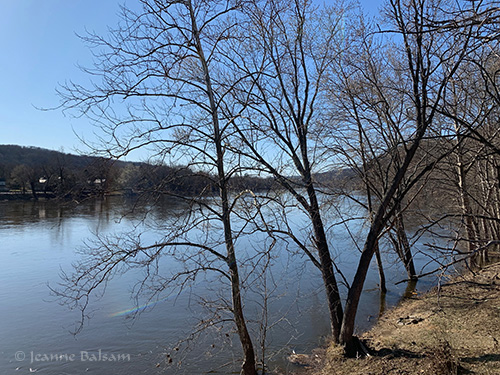
The Delaware looks stunning as always, its racing south not as immediately apparent as in the earlier view. Here it better reflects the cloudless blue sky, and wears an aura of peacefulness.

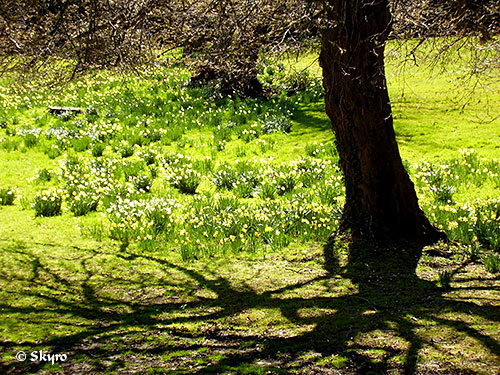
At last … the first sheen of green! That sly, subtle wash of the palest green creeping into the grassy areas, letting us know that in maybe as little as a week’s time there will be more of Spring poking its head through the ground – daffodils, more crocus and snowdrops, the blush of yellow on the forsythia.

It’s been a long winter, a long year. We’ve survived and carried with us a great weariness and a need for the promise that a greener season brings. Soon … more hope, more sun, more people about. The simple things that make our hearts grateful that we’re still here and can lift our faces to the warmth.

Here Comes the Sun

I read an article the other day – It’s title was Happiness in Hard Times. As might be suggested, it spoke about the importance of trying to maintain some degree of happiness when we are really struggling, as so many of us are in the pandemic. One of the positive points made was that we humans are actually wired for happiness. A researcher studying the genetics of joy has actually located, so far, 304 “happy genes” on our DNA.

It has been found that happiness can create and sustain emotional resilience in difficult times, and that the reverse is true as well. Finding positive meaning in circumstances can also help generate happiness. The article went on to provide concrete ways to navigate our current crisis (as well as any others); one of them is listening to music.

Which brings me to the point that had such an impact on me. Doctors and nurses in hospitals when interviewed all shared the tremendous pressure they were under during the pandemic. A pulmonologist at Lenox Hill Hospital in New York City described the relentless work in the critical care areas as a war zone. But Lenox Hill decided to do something about it. Every time a COVID-19 patient was released from the hospital or could breathe well enough to come off a ventilator, the hospital played Here Comes the Sun over the loudspeaker.

One nurse tearfully described hearing that song 20 times in one day, and every time she heard it, she felt a little better … it helped her know that all they were doing was actually making a difference.

It may be a challenge at times, but I think if we can find just one bright spot in each day, and either hold it close to our hearts, or share it with another, we’ll make a difference in these challenging times – and enjoy being what we seem wired to be – happy. Hey … here comes the sun.