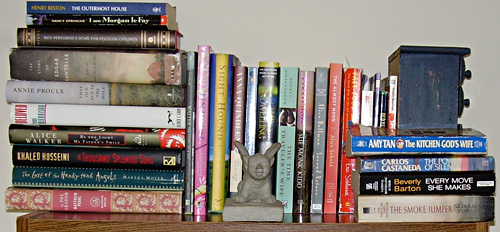
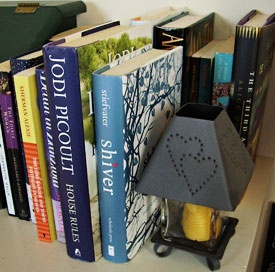
There’s something very exciting about discovering an author we’ve never read before. Sometimes we are drawn to this author by personal recommendation, subject matter or from our simply having heard of him or her along the way and wanting to check them out. It’s also often exciting to return to an author we do know and read something fresh. Clearly, we can be surprised in either instance.
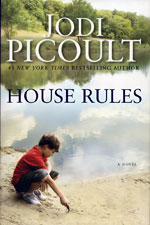 I picked up House Rules by Jodi Picoult at a friend’s book swap, a chance to try a new-to-me but very well-published author. House Rules is about a family which includes a single mom, a teenage son, Jacob, who has Asperger’s syndrome and his younger teenage brother, Theo. The father had walked out when Jacob was a toddler. He was unable to cope with the demands of a child whose symptoms were on the higher spectrum of autism, and who required enormous amounts of time and attention to continue to grow and function. Theo, who by necessity must often take back seat to Jacob, is longing for a more “normal” home and has begun to engage in dangerous behavior – breaking into people’s homes just to see what “normal” feels like. Jacob is obsessed with forensics and sometimes crashes local crime scenes, instructing the detectives on what they’re missing at the scene. When Jacob’s like-skills tutor turns up dead, he sets up the perfect crime scene to challenge the detectives, but then becomes the focus as her possible murderer.
This was really a very good read. At first, I was bothered by a little too much educating on the subject of Asperger’s, but as I read on, I realized the necessity of this baseline to truly understand Jacob’s behavior. I have some small knowledge of the subject, but Picoult’s extensive research brought a character to life who was worth a little schooling at the beginning of the book. So in House Rules, we have a family wrestling with the numerous complications of a child with Asperger’s, a murder mystery, a burgeoning love story and some great character development. I think anyone who has an Aspie child of any age in their family or works with one will appreciate this book best, but I wouldn’t limit the audience to that. It’s an engaging story on its own merit by an author with a good, clean style, a perpetually twisting plot, and an excellent grasp of her characters.
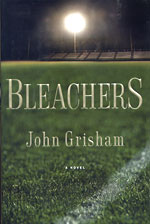 The I picked up Bleachers by John Grisham. I read a number of his legally-oriented novels quite some time ago, but the book by Grisham that really impressed me was A Painted House. It’s a story about a family in the Arkansas Delta who owns a cotton farm and hosts migrant workers in the summer for cotton picking. This particular summer, two dangerous men were among them, and life became deeply complicated for all, especially Luke, the seven year old farrner’s son. I found A Painted House to be a very powerful book that was exceptionally written and also refreshingly outside the legal genre in which Grisham usually writes. I wish I could say I was as excited about Bleachers. It was a fast read and centered around football players returning to the town of Messina because their coach was dying. The man’s brutality was experienced by the players in every year ‘s teams but because football was the life blood of the town, it was often overlooked or justified. Coach Rake was a hero to many, as were the high school Spartans, but his methods affected those around him in many ways. The premise of Bleachers is good. Maybe if I loved football, I would have liked it more, but I don’t think so. It just lacked something that A Painted House really had – a depth, conflict, that real make-you-want-to-see- what-happens-next quality. Not there for me in this book.
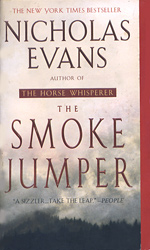 So I’ve picked up The Smoke Jumper by Nicholas Evans. He is the author of two books that I recommend highly, the acclaimed The Horse Whisperer and The Loop. about the return of a pack of wolves to a ranching community in Montana and the ensuing conflicts between a biologist who wants to save the nearly extinguished species and the ranchers who hate them. Evans is an outstanding writer, and I think he could write about football and mesmerize me. I don’t know anything about smoke jumping – those who descend into forest fires to put them out – but he already has me sucked in in the first chapter. In Evans’ case, I suspect he could use almost anything as the backdrop and still draw in the reader. I’m ready.
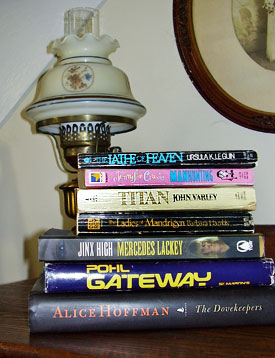 Sometimes you just get lucky. And in this instance, it certainly was me. I was unable to go to the big annual library sale held by my county library in April, the one where over 100,000 books are on sale for dirt cheap. This has become a yearly tradition with a friend and her book-loving daughter, but circumstances prevented me from attending. So how is this lucky, you ask?
 My girlfriend boxed them up and shipped them out, and here they are … most outside my usual realm of selection, but as he had personally read and recommended them, I’ m excited to try something new. The last 6-8 weeks have not had me reading very much … too many distractions and not much concentration, but the reader in me is back! And thanks to caring, book-loving friends, I’m one lucky reader to boot.