Ada and Laurie – Science, Imagination and Inspiration

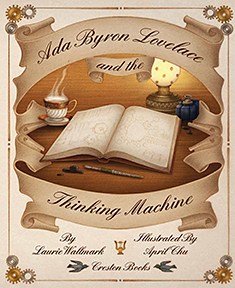
Ada-TitlePage2Welcome and thanks for stopping by. Visiting today is debut author and friend, Laurie Wallmark. Accompanying her – at least in spirit – is the brilliant young scientist, Ada Byron Lovelace.

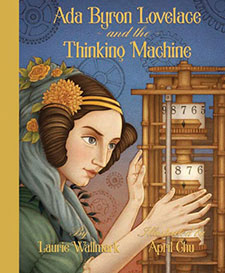
Ada Byron Lovelace and the Thinking Machine is a picture-book biography of the world’s first computer programmer. Ada was born two hundred years ago, long before the invention of the modern electronic computer. At a time when girls and women had few options outside the home, Ada followed her dreams and studied mathematics. This book, by Laurie Wallmark and April Chu, tells the story of a remarkable woman and her work. Kirkus Reviews describes the book as a “splendidly inspiring introduction to an unjustly overlooked woman.” [starred review]

Laurie’s blog tour hosts had some options in our presentations, so I offered some interview questions that will hopefully show us a different side of Ada. I’ve also included some of the book’s stunning artwork by April Chu.

Still A Dreamer: Having read as much as you have about Ada, what do you imagine Ada would make of social media? If alive today, would she tweet? Have a blog? Be on Facebook? How would she use them?

Laurie: Ada would most definitely use social media as a method of communication with her fellow scientists and mathematicians. She often attended evening salons at Charles Babbage’s house to connect and exchange information. Social media would have allowed her to do this more easily and frequently. Through Facebook and Twitter, she could hear about the many marvels of the Industrial Revolution without waiting for them to be published in scientific journals. With a blog, she could share her many scientific theories and receive feedback from her peers.
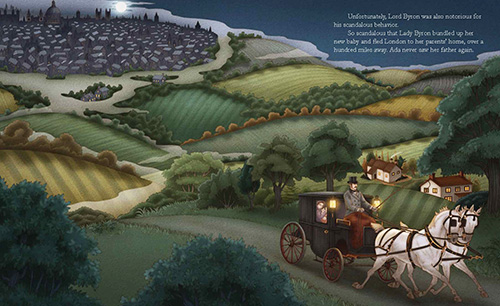
Ada-HorseCarriage_Page4-2

SAD: Although Ada might have laughed at the term, she was a visionary. There have been so many technological discoveries since her own, what advances/inventions might Ada make use of were she alive today? How would she have used them to advance her own knowledge?

L: The greatest technological boon to Ada’s studies would be, without doubt, the Internet. As discussed above, social media could provide her with a wealth of information. More than that, websites of organizations like the Royal Society (the UK national academy of science) and individuals like the polymath Mary Somerville would be invaluable. Even seemingly minor inventions, like e-readers, would be useful since Ada was so often ill and confined to bed. With an e-reader, she could easily keep up with her studies.

SAD: Lord Byron the poet was Ada’s father, but had little to do with her upbringing, correct? At any point, to your knowledge, did either acknowledge/praise the wonderful accomplishments of the other?

L: Ada’s mother separated her from Lord Byron when Ada was only one month old. She was never allowed to see or interact with her father after that. Lord Byron, though, lovingly wrote of Ada in his poem, Childe Harold’s Pilgrimage:

Is thy face like thy mother’s, my fair child!
Ada! sole daughter of my house and heart?
When last I saw thy young blue eyes they smiled,
And then we parted—not as now we part—
But with a hope—*

He died when Ada was only nine years old.
Ada-Sailboat-Page8-2

SAD: The $54,000 question – How can Ada’s work, which began as a child, reach girls today, (other than buying your book, of course), and inspire them?

L: Several organizations have used Ada’s name as a rallying point for their cause. The Ada Initiative (recently shut down) supported women in open-source technology and culture. One of their major achievements was to formulate a code of conduct signed by most major tech companies for appropriate behavior at technical conferences,. And of course there’s Ada Lovelace Day, a celebration of the achievements of women in STEM (science, technology, engineering, and math). On this day, people throughout the world blog about girls and women involved in technical activities. In 2015, October 13 is Ada Lovelace Day. Not coincidentally, this is also the release date of Ada Byron Lovelace and the Thinking Machine.

Join Laurie as she travels from blog to blog to introduce her debut picture book, Ada Byron Lovelace and the Thinking Machine. All stops are listed at: http://lauriewallmark.com/blogtour.php.

Laurie writes exclusively for children of all ages and has a lifetime love of, and involvement in, math and science as well. Learn more about Laurie at her
Website –  http://www.lauriewallmark.com,
on Facebook –  https://www.facebook.com/lauriewallmarkauthor
on Twitter – https://twitter.com/lauriewallmark

Better yet, come meet Laurie in person at her book launch on Sunday, Oct. 25th from 1 to 4 p.m. at The Book Garden in Frenchtown, NJ!
Coming Soon – A Stop on Ada’s Blog Tour

Cover-Ada-4Blog2What I’ve learned from my friends who’ve been published is that there is no end to the things one can – and sometimes must – do to promote one’s own books. What I learned of not too long ago is what’s called a blog tour. My friend Laurie – or perhaps her main character, Ada – is on one now, and next week, I’ll be a stop on the tour. Who knew?

Laurie Wallmark‘s debut picture book, Ada Byron Lovelace and the Thinking Machine is set for release October 13th, but her blog tour began on September 12th and continues through early November. Each week Laurie does interviews, writes about her book, writing in general, and more. It’s a job in and of itself!

She and Ada will be stopping by Still A Dreamer on Friday, October 2nd, so I hope you’ll pop in for a very interesting interview, and some additional information about this fascinating young woman who created the first computer program.

Artwork for the picture book was done by the very talented April Chu, and is phenomenal. I might be able to give you a peek at that, too.

See you soon!

November Is PiBoIdMo! (Picture Book Idea Month)

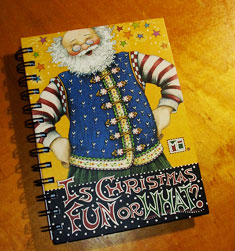
PiBoIdMoJournal2Are you a picture book writer? Aspiring or published, you will enjoy this challenge!

The idea was developed a few years ago by children’s book author, Tara Lazar, in response to the popularity of NaNoWriMo, National Novel Writers’ Month. Participating in NaNoWriMo meant that you committed to writing 50,000 words in the month of November. That was great for those who write novels, but what about those of us who were writing for the youngest readers … picture books?

Tara developed the idea of PiBoIdMo, Picture Book Idea Month, (which has developed quite a bit since it’s introduction, and now includes visiting bloggers on children’s writing and more), where your challenge is to write down one idea for a picture book each day in the month of November. Needless to say, you can jot down more if your creativity is jumping, but one is the challenge. At the end of November, you’ll have 30 ideas to pick and choose from and can develop your best into stories.

Whether you do this alone or participate in the event online, or with your writing buddies or friends, it’s a fun challenge and gets your juices flowing. I have my own little PiBoIdMo notebook, and will be starting my challenge this Saturday. Join me?


Writing What We Know

This started out to be about three aspects of writing what we know, but I see that it would be a ridiculously long post. So I’ll divvy it up and start with a fairly recent example. I received a lovely personal response from an editor at one of the publishing houses represented at an NJ SCBWI event. I am very appreciative to receive such a thoughtful and detailed reply, although, of course, I wish it were better news. She complimented me on tackling a difficult subject, but found it a bit melancholy and added that quiet stories were not selling much in the picture book market these days. Happily, she was also very encouraging about my writing and my pursuing it.

Simon's Secret Illustration by JeanneBalsamThis is where writing what we know comes in. What I know – one of the things, anyway – is about animals and their ability to affect us profoundly, both personally and through literature and imagery. This particular picture book story has a wonderful magical element to it and healing on several levels. While I don’t see it as melancholy, it still behooves me to pay attention to the perception and opinion of one who lives and breathes children’s books. But what stops me is the “quiet story” part.

I like quiet stories. I like funny stories, too, but I also like something that touches the heart and soul in some way, something that’s real, that’s a reflection of what children go through in their young lives. I get that kids like funny and action-filled, but what about the other aspects of a child? Are we no longer looking to feed that as well? Are our increasingly fast-paced and digital lives crushing the inner lives of picture-book age kids? (OK, maybe that’s extreme, but then again …)

As writers, we certainly need to be aware of the trends in the industry and what the market is looking for, otherwise we can be twirling about in our own stew of ideas that will never get published. At the same time, we need to consider what “writing what we know,” (the advice we are always given by editors and agents), actually means and where it fits in what’s being published.  It’s a challenge to all of us. So I look at the body of work I have to date. Maybe it’s time to let some of my stories go; maybe I haven’t sent them out often enough and/or to the right publisher/agent who will appreciate a particular “quiet story.”

So where does the rubber hit the road? Where do writing what we know and what’s being published intersect?


Coming Home and (Re)Finding My Path

That may sound like a contradiction in terms, but actually, it’s two different subjects.

Coming home? That would be coming home to cooking and trying something new.

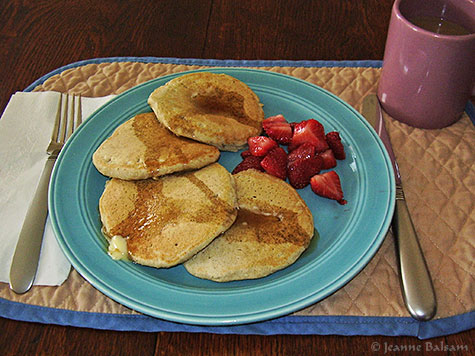
VeganPancakes2

Here you find my first effort at scratch vegan pancakes. They look pretty yummy, but in fact, were only okay. Granted, that is because the ingredients are quite different than what I’m used to. There are no eggs, instead Ener-G Egg Replacer; almond milk instead of real milk, and the least problematic, Earth Balance instead of real butter. We are very used to our fats and dairy, and eggs and butter do make a difference in taste. For a first effort, I’m okay with them, because I know what I have to do is learn how to adjust the recipe, as I always have, to make something taste better. Maybe soy milk instead of almond, maybe a touch of vanilla. I’m not giving up yet. And the texture was perfect.

I only regret I don’t have more time to cook and noodle around with things, but sooner or later, I’ll find it.

(Re)finding my path? That would be getting back on track in children’s books – setting new goals and timelines for illustrating, dummying and re-working specific stories; finding publishing houses and agents who are a good match for my work. It’s a lot of work, but it’s good work. Being on our path is always a good thing.

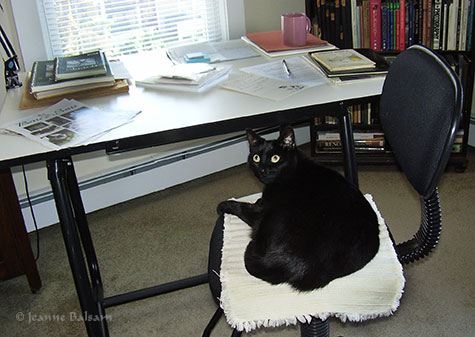
Jazzy-WorkDesk2

So after a stimulating breakfast with one of my children’s book buddies, I returned home and cleared off and cleaned both my work/art desks, sorted out where I’d left off on my projects, and yup, made a new plan, Stan! I wasn’t the only one who had plans for my studio chair … one kitty named Jazzy wanted in on the action. OK by me. Well, OK until Mama needs the chair and then there’s that lovely patch of sun by the window.