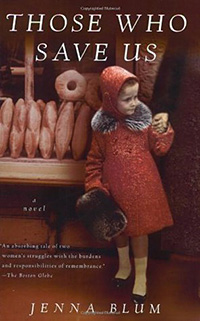
 The jury is still out on this one. There were several points along the way in reading Those Who Save Us that I felt I could have put the book down and it would have been OK. Yet I didn’t. It’s not a case that it wasn’t a worthwhile book, but there was something about it that did not pull me in and engage me as I would have liked. As a writer, Blum has an excellent command of the language. You kind of knew where the book was heading – or at least, you hoped it was – but my total investment wasn’t there. Why not?
For one thing, I don’t think Blum made me love her characters enough. Trudy, the daughter, lives a rather empty life emotionally. I understand why, but I still wanted more from her. Same with Anna, the mother. I certainly understand why she became stoic and blocked emotion, but how do you write about two such characters and still make us care? Anna went through some excruciating experiences; I should have loved her deeply. I also didn’t feel the story building with the kind of momentum that I felt it could have to a real climax.
The novel is told in alternating groups of chapters about Anna and her past and Trudy in the present. Blum weaves them together to bring Anna into the current time in Trudy’s life. The story begins in Weimar, Germany in late 1939 when the Nazis had taken control of the city and started taking Jews. Anna is a girl of eighteen, living a very comfortable life with her widowed father, who is cold, demanding, and solicitous of the Nazis’ favorable opinion. Her father’s dog becomes ill, and Anna, fearful of making the journey to the German vet across town, takes the dog to the closer veterinarian who is Jewish. The two take a liking to each other despite an age difference, and she ends up hiding Max in her large and elegant home, practically under her father’s nose. They fall in love, she conceives his child, but comes home one day to find him gone. The father has suspected and turned him in, at which point, Anna leaves home.
Hoping for some word of Max, Anna remains in Weimar, hidden by a baker, Frau Mathilde Staudt, who helps the Resistance. There, Anna gives birth. In making a secret run to hide bread in the forest for the starving prisoners, Anna is spotted by the Obersturmführer, Horst. To save her life and that of her daughter, she complies with the SS Officer who demands an often cruel sexual relationship with her.
In the current day, Trudy is a college professor of German history. Following the burial of Anna’s American husband, Trudy is putting her mother in a nursing home after a fire in Anna’s house, its source being suspicious. In picking up her mother’s belongings, Trudy finds what appears to be a gold cigarette case with a swastika on the front, and inside, a photograph of the Obersturmführer with her mother seated in front, Trudy on her lap. Trudy has always been angry with her mother’s refusal to tell her about her early childhood in Germany, but now believes her father was a Nazi. In her search for some sort of enlightenment, Trudy decides to do a special project interviewing Germans who lived through this time, and recording their views of the Holocaust in retrospect. She is shocked by the answers she hears, but also meets more than one person who will impact both her and her mother’s lives.
The story continues, weaving the lives of mother and daughter together, past to present. Despite the forward momentum of these intertwined stories coming to a resolution, I didn’t find myself on what could have been a taut and gripping journey. And yet, I never stopped reading. So the jury is out.
If nothing else, this book is a reminder of how we, who have grown up in the free world, unscathed by events such as those in World War II, can never begin to understand the torture, horror, and pain of those who lived, died, and witnessed the Holocaust. In that regard, the book never fails to be both brutally honest and a cautionary tale of what may lie beneath the surface of even the well-intentioned.

 Still A Dreamer