 In our, (and I speak for all my fellow aspiring children’s book writers), desire to be published, or to expand our horizons in terms of who we know or wish to meet, there are plenty of things we can do. One of the best is joining the SCBWI. I belong to the NJ SCBWI, which is a phenomenal chapter.
The NJ Chapter, headed up by Kathy Temean, Regional Advisor, has more exciting events on an ongoing basis than any chapter I’m aware of. This weekend, there is an Illustrator’s Intensive, a Picture Book Intensive and a Novel Writer’s Intensive, all conducted by luminaries in their field, E.B. Lewis, Sudipta Bardhan, and Agent Scott Triemel. However, I’m writing about one of the smaller of the SCBWI events, a First Page Session.
I attended one of these in Princeton, our Chapter’s usual hosting location, this past Wednesday. We were 22 attendees with two editors – Shauna Fay from G.P. Putnam and Lindsay Winget from Atheneum. For those of you not familiar with First Page Sessions, you submit your manuscript anonymously and properly formatted to fill one page, indicating only your title and genre. Each first page is read aloud and the editors spend their time critiquing it.
While this is not as in-depth as a one-on-one critique received at a mentoring workshop or other event, the input by two editors/agents on just one page can provide great information as to whether your story has a good hook, a good title, appropriate language for the targeted audience, good rhyme scheme, an original theme and so on. Ms. Fay and Winget did a great job of enlightening us to the strengths and weaknesses of our submissions. (One of them even got a little choked up when mine was read, and I am so flattered!) Most definitely worth the very modest price – for SCBWI members – of only $25. For an additional $25, for members only, you can stay for a delicious dinner and sit and chat with the editors. Another advantage for all attendees is that you may submit a MS to these editors for a limited time period and they will look at your submission as a priority vs. being sent to the bottom of the slush pile.
The humble First Page Session is not only a means of getting a lot of information about your work-in-progress, but also a connection with two editors/agents .. and, if a member, a really good dinner for what today is a pittance. Not an SCBWI member? Check out the NJ SCBWI page for upcoming events and other goings-on – if it looks good to you, click on the kite link up top and join the SCBWI!
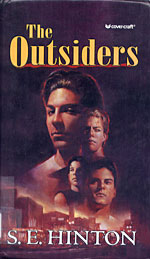 Have you ever read a book that exceeded your expectations? Great, isn’t it? I didn’t know quite what to expect from The Outsiders; I’d noticed it had a special placement in my library because it’s considered a classic, but I didn’t look twice. What got me bringing it home, was Patrick Swayze. Yup. Patrick Swayze.
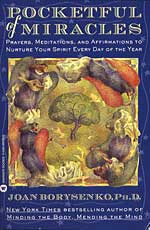 It is often said that when the pupil is ready the teacher appears. I believe that said teacher can also be in the form of a book by an inspiring author. So in addition to whatever novel, picture books, etc. I am reading at any given time, I am also reading a book of a metaphysical/inspirational nature. I find checking in with this book on a quasi-daily basis helps me keep my balance in a terribly hectic schedule, and where I am always trying to find time for my writing and illustrating.
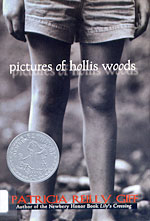 will be frightened as well, but it is impossible to put the book down. So in Clay, I might not be finding quite what I’m looking for – I don’t think. Then again, I do have an evil antagonist, so perhaps I may reconsider.
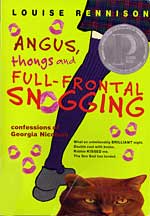 Here’s the full title – Angus, thongs and full-frontal snogging – confessions of Georgia Nicolson by Louise Rennison. (Yeah – a tad too long for a post title!) My last trip to my local library had my very wonderful librarian, Jennifer, suggest a book to me in addition to my list of MG and YA titles. So far her suggestions have been great, and this book is no exception. I am writing this very short post to recommend this book to you if you read/enjoy YA. Written in diary format, Georgia, who is British, writes about her life and its typical teenage issues, which are not nearly so racy as the title would suggest. But funny. Very funny.
