 Why such a while for Weil? No doubt there are just hordes of you out there suspecting I’m the slowest reader ever.
Just kidding – I don’t think there are hordes of you out there. But there are times when it seems that we are in one book forever. Or maybe we really are. In this case, from the time I started Spontaneous Healing, I was sick 2+ weeks. I believe that’s one of the reasons I plucked him from my “to read” stack. What better to read, when we feel like crap, than a book that gives us support to get up and feel better?
I am a firm believer in the body’s innate drive towards self-healing, so this was a perfect choice to read. I went to a little bit of it every night during a time when I dragged myself out of bed, journaled a wee bit, put in a good day’s work, and crawled away from my computer to sit in front of the telly a bit, then dragged myself to bed. Hello, Dr. Weil! He’s been great and informative company, and renewed my faith in my body’s ability to heal, as well as how I need to better focus on doing the right things to stay well.
Then came … the Hunterdon County Library’s Annual Book Sale. Thank goodness I had a time limit there! Brought home a bunch of new books, but restrained myself and read only one – Indigo – as I had plenty of work and some writing to do. Then came the realization that Angels and Demons would be opening May 15 – OK, let’s pluck that off the shelf and give that another read before I see the movie. So I’m up past my bedtime – I’ll live.
And then … the book I knew I needed to read again – one of my favorites, The Artist’s Way. This is such a wonderful book and I’ll give author Julia Cameron the credit for my daily journaling/morning pages. This is a book that encourages and helps strengthen creativity in a unique, spiritual way. And that’s why I say I need to read this. I feel some deeper period of inspiration coming on, and who better than Julia to accompany me?
But what about children’s books? Ahhhhh – in this period, I have also read – many, many times already – one of the most wonderful children’s books I’ve ever read. The story, the illustrations, the subtle sub-text … I am deeply moved each time I open it. It is giving me the inspiration to return to an aspect of my artwork where I was struggling. I’ll get to that soon; it deserves so much more than a passing mention.
Andrew Weil, don’t give up on me; I shall return. I just have a couple more Illuminati murders to try and prevent, and then it will be all about the healing.
 Get ready, fans. Angels & Demons is opening in the movies this Friday. I decided that I was going to try and reread the book so I could keep track of all the plot and intrigue that will be ricocheting around the theater. I read Angels & Demons awhile back, and after The DaVinci Code. At the time I recall liking The DaVinci Code better, but I must say, as I allowed myself the luxury of a few hours of reading yesterday, that this really is engrossing. Sometimes a book IS better the second time around.
 Although I’ve said this before, I like Alice Hoffman. I like what she writes about – essentially, magic – and how she writes about it.
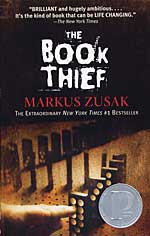 Here are two things that are connected – I couldn’t fall asleep last night. I finished reading The Book Thief. A book that keeps me up at night after I’m done reading, can often be said to be a good book. Or maybe a disturbing book. Or maybe a haunting book. I think it’s safe to say that The Book Thief is easily all three.
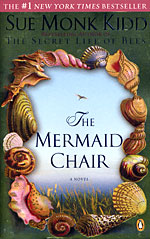 What a terrific read! In The Mermaid Chair, Sue Monk Kidd has given us a tale of a woman searching for her lost soul. Jessie Sullivan, the main character, tells us her story in first person … that of a woman deeply restless in her marriage, lost and unhappy. She is called back to the place where she grew up, Egret Island, by friends of the family on the occasion of her mother having taken a meat cleaver and chopped off one of her fingers.
