 I got a letter from John Grisham yesterday.
At least that’s what the envelope said. I found it to be an appeal on behalf of a person and an organization that I’ve heard of, but knew little about – Morris Dees, an Alabama lawyer and friend of Grisham’s, and the Southern Poverty Law Center. It is the mission of Dees and the SPLC to put hate organizations out of business and to teach tolerance.
I read the enclosed piece and was literally horrified at the abuses, savage beatings, murders and more that still go in in this country perpetrated by any number of hate groups upon innocent individuals of some minority status or other. I was beyond horrified; I was deeply saddened. (And mind you, I am not writing this to drum up donations for the Southern Poverty Law Center, but if you want to know what’s going on in this regard, you may want to visit the SPLC web site and find out for yourself – it’s very disturbing.)
What struck me were two things … I hear so many people talking about those in the world who hate and would destroy our country. I wondered, are people aware of how much hatred is alive and well, right here, within our own borders? Do they know that people are still being abducted, beaten, and hung? AND if that weren’t enough, that it’s often being done in the name of the abuser’s God? How have we become a nation with so much hate?
So … as an aspiring children’s book author and illustrator … the second thing I wondered was, what is being read to the young children of those people whose mission in life is to commit violence against people of a color, nationality or religion different than their own? What happened to love? To hope? To tolerance? Compassion? Do these people’s children read the same books as other children do?
Children’s book writers aspire to show a child a world of wonder, fun, sharing, understanding, friendship and caring. Can a mother whose husband goes out to senselessly beat a 16 year old boy into permanent physical and mental damage be reading to her child about caring for others? I am utterly confused and lost.
So I wonder, when a child is raised believing that hate towards others is an acceptable emotion, can a mere book, albeit written from our hearts and souls, have the power to change a young mind?
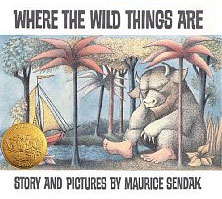 I’m assuming everyone has read this classic children’s book by Maurice Sendak, but if you haven’t seen the
  What happens when one of the picture books you’ve been working on evolves into a chapter book due to too much back-story? Then it’s recommended to be a middle grade novel because it’s getting too scary for a chapter book reader? One of the first things is to start reading more in that genre, so for me, it’s Welcome to Middle Grade!
 Example – A suspense/mystery novel I just finished by an author new to me, The Hangman’s Beautiful Daughter by Sharyn McCrumb, brought these questions up – and had me thinking about their relevance in children’s books. Particularly as we write stories of greater length, they are important points to consider, but they can be equally important in picture books.
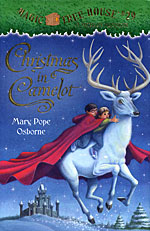 Chapter books are the next step as a child grows beyond picture books. Whereas picture books are largely illustration, chapter books are largely prose, but which still include illustration, generally in black and white. Written for the age 7-10 crowd, they feature short chapters so the book can easily be put down and picked up again by the young reader. Chapter books include a fairly good amount of dialogue, short sentences, and vocabulary that is targeted for the reader who is growing in his reading skills.
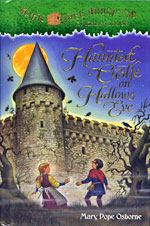 I’ve currently been reading a series within The Magic Tree House Series subtitled A Merlin Mission. These books are excellent examples for writers of what is being sought in a good chapter book, but Mary Pope Osborne has added in this selection a special richness by introducing a famous myth. In The Magic Tree House Series, our main characters are brother and sister Jack and Annie of Frog Creek, Pennsylvania. They find a tree house in the woods filled with books, and that by pointing to a picture in a book, they can go there. In time they find the tree house belongs to Morgan Le Fay of Camelot, home to King Arthur.
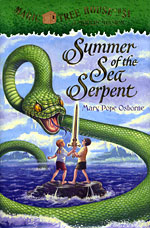 Arthur and the Round Table for children ages 7-10, filled with the symbolism of cloaks, cauldrons, magical beings and more. She has provided detailed references in the back of the book for the elements she’s introduced.
 Still A Dreamer