NJ SCBWI June Conference – A Few Thoughts

ChildReadingThe June 2009 Conference was, once again, spectacular. There was an amazing group of agents, editors, illustrators, authors, and art directors waiting to critique, guide, challenge and enlighten the 240 participants. And there was plenty of talent on the attendee side as well. Both new and familiar faces were present to submit manuscripts and illustrations, in hopes of landing that book deal or finding the perfect match in an agent or editor. And it happened or is in the works already for some of the folks who were there!

This year, I attended Saturday only, but it was no different than Friday in that critiques, first page sessions, and talks were scheduled all day long. At the same time, items were available for bids in 2 separate auctions; participating  illustrators’ work was on view; and the Book Fair was open for perusing. As we rushed from one activity to the next, up and down the stairs in Stuart Hall, it couldn’t have felt more like being back in college and trying to figure out where our next class was. It was familiar, crowded, and wacky, and more than one of us – way more, actually – were periodically to be seen standing stock still trying to figure out what we were supposed to be doing next. 

Everyone, by the end of Saturday, is totally wiped out. But in a good way. If you want to be published in children’s books and are not attending conferences, you need to consider it – you’ll be amazed at the jolt of inspiration you’ll get.

It had been my thought when I started this to offer a few tips about attending a conference such as this, but I suspect they’ve all been written up somewhere online. Or maybe a few would help. Here’s the most important ones overall I can think of …

  • Reduce your stress – The activity is non-stop, so it behooves attendees to minimize stress, and I suggest doing this by being totally prepared ahead of time – right down to what you will wear, directions, being all packed up and ready to go the night before. Be prepared by being somewhat familiar with the editors and agents who will be attending – come already having researched at least some of the author or agent’s web sites, their bios, what kind of books they’re doing, etc.,  (that is, if you didn’t do all this before you sent in your application!) When you have minimized your stress, you will also be much more able to hear your critiques.
  • Have the right attitude – being optimistic is the best way to go. Every editor’s and agent’s view on your work will be a little different, and it is important to be open to all comments. The faculty are present to offer their input with the best of intentions in helping you further your work. Be prepared for both praise and criticism and for things you do and don’t want to hear. Listen carefully, ask questions, and let what is said sink in, as you will be revisiting their suggestions later. And later again. Stay positive.
  • Follow-Up – Once home, write thank-you notes or letters to the faculty that you met with. Review the critiques you received and make additional notes while everything is fresh in your mind. Bring your experiences back to your writers’  groups, (you do belong to a writers’ group, right?), and share what you’ve learned with one another. This is another way to keep your critiques fresh in your mind, and to go over the feedback with the people who know you and your work the best. Plus, it’s a great way to figure who you may or may not want to meet with in the future, who may be most open to your particular style of work.
  • More follow-up – get down to the re-writes, the edits, the next dummy or illustration revisions. Get ready to submit to those faculty members who expressed an interest or openness in seeing your work again. But don’t wait too long – the next conference will be here before you know it!!

If you want to get the most from your writing, join SCBWI, and find where your local SCBWI is and join them, too. (New Jerseyans, you’re here.) Get in the know about the big field of children’s books. Search out a children’s book writers’ (and/or illustrators’) group nearest you. The support, encouragement and shared information is invaluable.
Kathy Temean Exhibits in PA

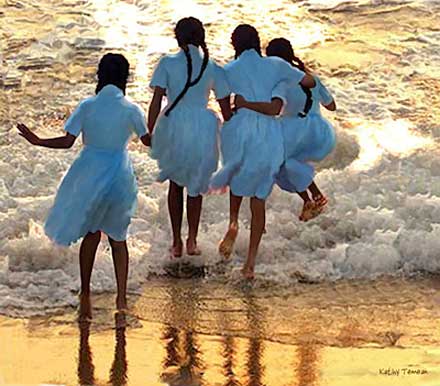
Kathy Temean is an outstanding illustrator whose work is being featured the entire month of June in a one-woman show at the Newtown Public Library in Newtown Square, PA.

KTemean-GirlsInSurf-w

While you can view Kathy’s work online at her web site, seeing the color and texture of her work in person, as is so with any artist, demonstrates the real depth of her talent. The illustration above, Girls in Surf, is just one of many images that are on view during June.  Kathy’s illustrations appear in children’s books, on book covers and in web sites she builds under Temean Consulting, and have  a unique quality which brings a richness and vibrancy to each image. Worth a look!

To see Kathy’s work on exhibit, visit the Newtown Public Library – 201 Bishop Hollow Road – Newtown Square, PA.  Phone: (610) 353-1022.  For you online art exhibit visitors, check out Kathy’s web site.

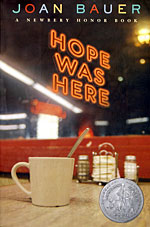
Hope Was Here – Joan Bauer


YA novel - Hope Was Here

Hope certainly was here in this Newbery Award winning YA novel. Hope is 16 and raised by her single aunt, Addie. Hope’s mother, Deena, felt the best thing she could do for her baby was to have her raised by Addie, her sister. Named Tulip at birth, Hope decides to legally change her name at 12, often wondering if she can live up to her new name.
Addie and Hope have moved several times across the U.S., Addie following needed jobs as a short order cook in diners, and Hope, a young but experienced waitress, repeatedly having to leave the friends she’s made. Hope longs to one day know her father who she wants to believe is trying to find her, while Deena occasionally shows up in her life.
The story begins with Addie and Hope arriving in Mulhoney, a Wisconsin dairy town, to run the diner for the owner who has been stricken with leukemia. Hope Was Here is about hope for so many things, not just in Hope’s own life, but in the lives of those around her … in a man hoping to go into remission who runs for office to defeat a corrupt system; in the hope that good will prevail in this small town; that the undercurrent of love that streams through so many of the characters will prove, not only that love can prevail, but that hope is worth holding on to. Much of the story’s action takes place in and around the diner, where the customers and dishes Addie whips up serve as a colorful backdrop.
Life changing experiences abound for every character in Hope Was Here, in a can’t-put-down tale, that not only manages to beautifully explore relationships, but amazingly, also weaves in politics and the difference that teenagers can make in influencing their and others’ lives. The food served up by Addie in the diner may have you wanting to find something in your fridge, but Hope’s story will have you sitting, smiling, and definitely believing in the value of hope.

Writing from the Heart

HorsesHead2One of the best recommendations I hear concerning what to write about is to write from your heart. There is no doubt in my mind that that is absolutely the truth. It’s helpful to know what’s up and coming in the market. It’s helpful to know what particular agents and editors are looking for. But writing just FOR that market, agent or editor just to be published is the ultimate betrayal of self. Where else can I write from but the heart?

Question is … what if most people really don’t want to know what I will write from my heart? What if the more I pour my heart and soul into a story, the more frightened the reader becomes … the more they begin to feel somehow responsible, if not for the individual I write about, but for how things have become this way? I can tell you – they want to turn away and run … to not think about it.

What I’m referring to at the moment, because something I read today is so fresh in my mind, is the immense suffering we, as humans, perpetrate on animals. Whether it be horses slammed together in double-decker trailers, trekked for days on end with no food or water to a brutal slaughter in Mexico, or sows imprisoned in metal-barred gestation crates their entire lives … people don’t want to know. Far too many people don’t want to know.

What’s in my heart is a deep and abiding love of animals. It is knowing they are individuals that matters to me – how can anyone simply see millions of dollars in pork sales if you look into the eyes of one desperate, intelligent pig who can never physically move? How can anyone watch a rodeo cowboy lasso a 3 month old calf, pulling back so hard that he breaks the calf’s neck? And then know this mere baby lays in agony, out of sight, sometimes for days, not being released from its suffering. How can anyone attend a circus where highly intelligent animals are beaten with bullhooks until they bleed and scream for the sake of a few tricks, and then are chained in place for 23 hours of every day? How can anyone look into just one of those elephant’s eyes and not drown in her sadness?

You may be pulling back even now – wanting to move away from the painful reality of our own part in all of this. Don’t go yet – it’s not my intention at the moment to explore the horrific suffering animals know at our hands, but rather, how do I write about it in my chosen field? How do I write picture books and bring my heart into it, without watering it down, sugaring it up, and burying the truth?

Children cannot – should not – hear what’s truly in my heart. It’s far too frightening for them, but what can they hear? How can I tell them?

Each of you has something in your heart that you yearn to write about … your heart’s desire, whatever that may be.  How do we bring our heart’s desire to the table in children’s books, to help a child learn to listen closely to his or her own heart, to know the value of all life, before the window closes and they become lost in the routine of daily life, the numbing by TV, the  brainlessness of texting?

How do we bring what’s truly in our hearts to a young child’s reading? I’m yearning to know.

Alice Hoffman’s Indigo

indigo-alicehoffmanAlthough I’ve said this before, I like Alice Hoffman. I like what she writes about – essentially, magic – and how she writes about it.

Indigo, like Green Angel, is ultimately a story about healing. Written for middle grade readers, Indigo is also a story about friendship, devotion, and love of all kinds. As with Green Angel, my only complaint is that the story is over too soon. More like a novella or short story than a novel,  (how it’s promoted), it’s 84 pages in paperback.

Back to the magic – one of the main characters, Martha Glimmer, is more an ordinary girl, but who was touched by a certain magic in her mother. Her mother has recently passed away, leaving Martha feeling unsure, adrift and missing the spark in her life that was her mom. The two other main characters, Trevor and Eli McGill, nicknamed Trout and Eel for fine webbing between their fingers and toes, long to see the ocean. All three, stuck in a dry, dusty town which has all but banished water due to destructive floods in the past, yearn for something beyond what they know.

Fiercely devoted friends in search of dreams, they set out on a journey. Magic is revealed in more ways than one as Martha, Trout and Eel discover their truths, reclaim their pasts and find richer futures. It’s a lot to accomplish in 84 pages, and I love how Alice Hoffman does it. For a fast but rewarding read, Indigo is a great way to go.

p.s. I feel like I’m cheating on Andrew Weil, the book I’m currently reading, but I hit the Hunterdon County Library’s big annual book sale this past Sunday, made out like a bandit, and couldn’t resist this fast read.