Here are two books for middle grade readers by the same author, Patricia Reilly Giff, and both winners of the Newbery Honor Award. I think, in addition to their both being very strong pieces of work, they demonstrate how an author has grown in even a few years.
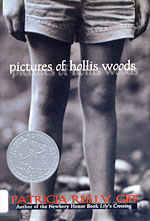 I first read Pictures of Hollis Woods a few months ago as part of a list I’d made to learn more about writing for middle grade by reading Newbery winners. This book is the strongest, most memorable, and deeply touching of any I have read to date. Hollis is an artistic 12 year old girl who was abandoned at birth, and who has been in several different foster homes ever since, ultimately running away from them all. In the present, she is placed with Josie, a retired art teacher and artist who is slowly losing her memory. Hollis develops a real fondness for Josie, and does her best to not let the foster system know that Josie is becoming incapable of caring for her.
Interspersed with chapters of the present, are chapters describing pictures that Hollis has drawn of a situation in the past, where a foster home wanted to adopt her … a home where she was truly happy. However, something terrible happened and she ran again. Giff has artfully balanced Hollis’ present day circumstances with the pictures she’s drawn telling the story of what happened in the home where she wanted to stay. The two juxtapose until they are woven together into the present. The two story lines become one, building to a great climax. I am amazed at how skillfully Giff has done this. I am deeply touched by Hollis’ character; she is so sympathetic, that it never matters a moment that she “is trouble” or can be flip or fresh. I only cared to see what had happened at that special home and how it would turn out. Talk about a book I couldn’t put down! What a wonderful story and group of characters, and what an inspiration, I would imagine, for Giff’s middle grade readers.
 I just finished reading Lily’s Crossing, written 5 years earlier. It’s a very different story, and without the alternating of present with past. Again, the story takes place in Queens, (which, having lived in NYC for quite some time, I always enjoy), in 1944 at the time of the Normandy Invasion. Lily’s Crossing brings with it a much deeper glimpse into a period in time than Hollis Woods, and for that I thoroughly enjoyed it. However, and it may not be fair to compare, Lily’s character, while very likable, isn’t as deeply sympathetic for me as that of Hollis.
Lily is cared for by her father, Poppy, and Gram, his mother. Her mother passed away when she was much younger. When school is out they go to Gram’s house in the Rockaways, where Lily meets Albert, a refugee from Hungary. He has escaped the Nazis, but lost his parents and left behind a sister, from whom he was separated, in France. As Lily and Gram prepare to go to Rockaway, Poppy is called into the service and ships out to France to fight the war. Lily is a funny, somewhat flawed but appealing character, who happens to tell lies quite often, one to her new friend Albert that later endangers his life. But for me, the dramatic tension could have been so much stronger. Still, the characters were all well drawn, the 1944 backdrop always of interest, and the ending very satisfying.
What was missing? I think I was spoiled by the strength of Pictures of Hollis Woods! These stories were written 5 years apart, and really are both ones to read. But it also showed me the growth of an insightful author who clearly cares about her characters and their growth over the course of a novel. I like it when I really care about a character and what happens to her. Patricia Reilly Giff earned those Newbery awards for a very good reason.
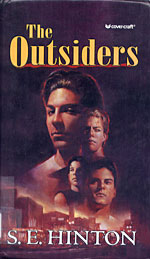 Have you ever read a book that exceeded your expectations? Great, isn’t it? I didn’t know quite what to expect from The Outsiders; I’d noticed it had a special placement in my library because it’s considered a classic, but I didn’t look twice. What got me bringing it home, was Patrick Swayze. Yup. Patrick Swayze.
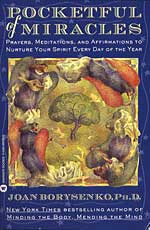 It is often said that when the pupil is ready the teacher appears. I believe that said teacher can also be in the form of a book by an inspiring author. So in addition to whatever novel, picture books, etc. I am reading at any given time, I am also reading a book of a metaphysical/inspirational nature. I find checking in with this book on a quasi-daily basis helps me keep my balance in a terribly hectic schedule, and where I am always trying to find time for my writing and illustrating.
 will be frightened as well, but it is impossible to put the book down. So in Clay, I might not be finding quite what I’m looking for – I don’t think. Then again, I do have an evil antagonist, so perhaps I may reconsider.
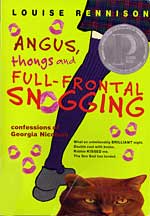 Here’s the full title – Angus, thongs and full-frontal snogging – confessions of Georgia Nicolson by Louise Rennison. (Yeah – a tad too long for a post title!) My last trip to my local library had my very wonderful librarian, Jennifer, suggest a book to me in addition to my list of MG and YA titles. So far her suggestions have been great, and this book is no exception. I am writing this very short post to recommend this book to you if you read/enjoy YA. Written in diary format, Georgia, who is British, writes about her life and its typical teenage issues, which are not nearly so racy as the title would suggest. But funny. Very funny.
 Still A Dreamer