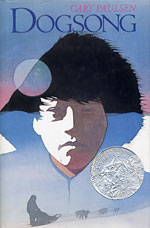
 There are times when I’ve finished a book, that I don’t quite know where to put it. In my head, that is. The book is so different from anything I’ve read, that it seems to be searching for a place to settle in my mental bookshelf, and meanwhile, it seems to hover in space.
Dogsong by Gary Paulsen is one of those books. It might be best defined as a coming-of-age story where a 14 year old Inuit boy, Russell, restless in his own life, searches to find himself. In so doing he moves in with an elder where he is taught how to hunt, run the dogs and survive. And then he lives it, gradually becoming one with his dogs. This is an oversimplification and doesn’t do justice to the nuances in the story, so let me just say it was a very compelling read.
Perhaps why it hasn’t settled in yet is that it is a vignette of a life so totally different from my own or even what I could imagine an Eskimo tribe’s life in Alaska might be, that there is not a real frame of reference for it in my head. And yet, I could not help but be in the trance with Russell, in the dream, to merge with the spirits of the dogs, as he trekked blindly in the snow for days, never seeing a single soul or a source of food.
I read up on Gary Paulsen the author of Dogsong plus a good bunch of other MG and YA novels he has written. I suspect these have the greatest appeal to boys, but maybe not. Paulsen ran away from home at 14, and his life – he is now around 70 – has been a series of amazing adventures in all kinds of situations and locations. Among his experiences has been living in Alaska where he has run the Iditarod twice. And while I am no fan of the Iditarod because of the suffering of too many of the dogs, Paulsen has truly lived that life in Alaska so as to have written this book from a deeply authentic perspective. I have to truly admire Paulsen for how he has lived his life; he’s humble, adventurous beyond what I could imagine, and just … well … very real.
Reading about him explained a lot about the book in a way; my personal connection with dogs/animals deepened the meaning; my willingness to try “living” in such a different culture helped. Soon Dogsong will find a place and settle in.
Perusing my bookshelves once again led me to one of my many finds at the annual county library sale and to as different a book from Dogsong as I could get – one by Candace Bushnell of Sex and the City fame. I loved the series, never read the book, but figured how far wrong could I go? We’ll see …
 One of the things I love about reading Alice Hoffman is that I never know quite what to expect with the exception of one thing – I will be deeply moved by her story. I find Hoffman’s writing brilliant in her ability to take us so penetratingly into her characters, characters who are not heroes, but neighbors we see every day yet whose lives we barely know. Local Girls takes us into the midst of a family who struggles with pain and loss, and whose characters cling to the idea of surviving it, or in some cases, succumb.
 What happens when one of the picture books you’ve been working on evolves into a chapter book due to too much back-story? Then it’s recommended to be a middle grade novel because it’s getting too scary for a chapter book reader? One of the first things is to start reading more in that genre, so for me, it’s Welcome to Middle Grade!
 Example – A suspense/mystery novel I just finished by an author new to me, The Hangman’s Beautiful Daughter by Sharyn McCrumb, brought these questions up – and had me thinking about their relevance in children’s books. Particularly as we write stories of greater length, they are important points to consider, but they can be equally important in picture books.
 Chapter books are the next step as a child grows beyond picture books. Whereas picture books are largely illustration, chapter books are largely prose, but which still include illustration, generally in black and white. Written for the age 7-10 crowd, they feature short chapters so the book can easily be put down and picked up again by the young reader. Chapter books include a fairly good amount of dialogue, short sentences, and vocabulary that is targeted for the reader who is growing in his reading skills.
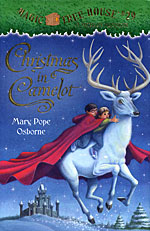
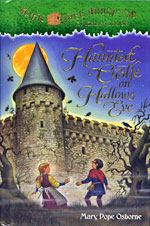 I’ve currently been reading a series within The Magic Tree House Series subtitled A Merlin Mission. These books are excellent examples for writers of what is being sought in a good chapter book, but Mary Pope Osborne has added in this selection a special richness by introducing a famous myth. In The Magic Tree House Series, our main characters are brother and sister Jack and Annie of Frog Creek, Pennsylvania. They find a tree house in the woods filled with books, and that by pointing to a picture in a book, they can go there. In time they find the tree house belongs to Morgan Le Fay of Camelot, home to King Arthur.
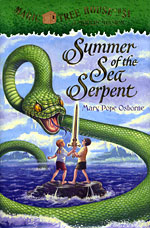 Arthur and the Round Table for children ages 7-10, filled with the symbolism of cloaks, cauldrons, magical beings and more. She has provided detailed references in the back of the book for the elements she’s introduced.
 Still A Dreamer