When Pen and Paper Heal

Journaling is a highly underrated tool in the toolbox of wellness. Do you write daily?

There is something about putting words to your thoughts and emotions that can not only lift your spirits and lighten your mental load for the day ahead, but also provide insight into so much of your life.

Once written down, the words offer us, now or later, a chance to get to know ourselves better, to find ways to heal and become more of who we’d like to be. Journaling is actually pretty powerful.

I’ve been journaling faithfully every morning for decades. There are days when it feels like a much-needed dump of the clutter in my head, but more often, it’s a way for me to sort things out, see where I am and where I’m going.

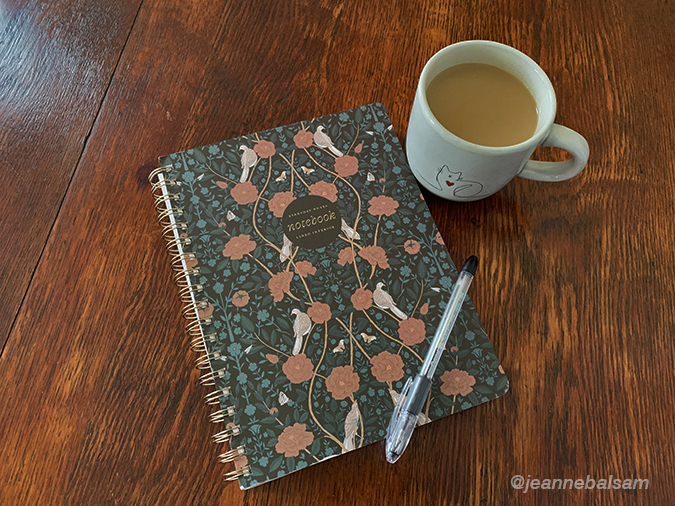
All you need is a journal or notebook and a pen. What’s to lose?

Fearless

Look at that little guy … a young praying mantis, sitting next to Pumpkin (R.I.P.), one of the most fearless animals I have ever known.

How is the mantis so brave? Is this innate to his species, or an individual who takes risks or is just naive and inexperienced?

Looking at ourselves, if we aren’t fearless like the mantis, how did we get this way? Perhaps the bigger question is can we become more brave?

I believe there are two core emotions – fear and love, the opposite of one another. To become fearless, or start heading in that direction, we need to love ourselves more, to tip the scales. We need to let go of things we were told that we were. These often had nothing to do with us, but more to do with the individuals that told us. Think about it.

Many of our behaviors that make us unhappy today were once developed as children because we needed them in order to cope or survive, whether to make others happy or comfortable or just to leave us alone. But we can look at ourselves now, at our fears, our outer coats of beliefs that no longer work in our lives, and release them.

It was Socrates who said, “The unexamined life is not worth living.” Looking and seeing who we are underneath those once-needed layers, we can love and accept ourselves for what we find, forgive ourselves for behaving in ways we have not understood. And we can change. It takes time, and it’s not always easy, but we are capable of change.

We are always braver than we believe.

p.s. As for the yet-unnoticed, young praying mantis … I called Pumpkin over to my back door for a snack, and the little one, apparently having made his point (to me), quickly disappeared.
Find Someplace Beautiful

My guess is that there is someplace beautiful within walking distance or a short drive from where you live.

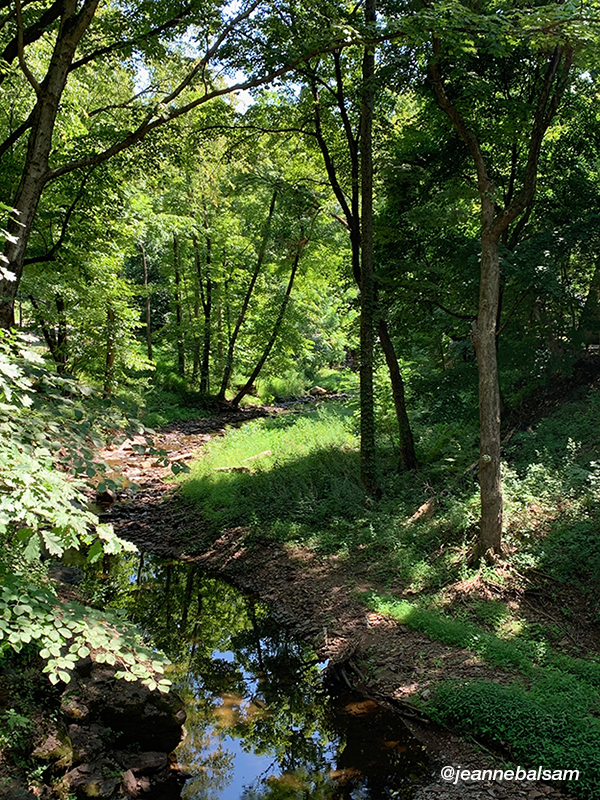
This is one of the views walking along the bike/footpath in Frenchtown. So gorgeous. A friend and I had stopped in to The Bridge Cafe for coffee and some pastry, and decided to walk.

We can all get stuck in our homes and/or digital lives and forget that it’s not all that far to find some beauty. It doesn’t have to be nature; it can just as easily be in the city, in a park, or a walk in the neighborhood.

Get outside and look around. Find someplace beautiful. Take pictures. Enjoy your life.

Room for Growth

You mean personal growth? In a drawer? Yes. Here’s how.

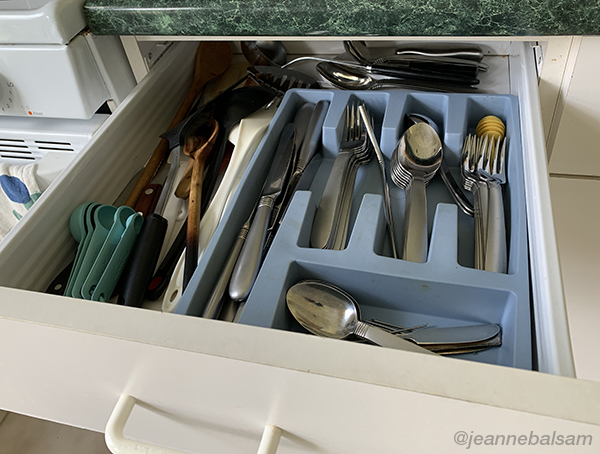
In the far back of this drawer were several bundles of tableware that I had not so much as looked at in all the years I’ve lived here. Service for eight, plus an odd assortment of spoons and serving pieces. I decided to see if they were worth anything.

After appraisal, there was one lone spoon that was sterling silver, for which I got $33.00. That was nice. I let the rest go.

The next payoff came in my taking everything out of the drawer; thoroughly cleaning it all, plus the interior of the drawer itself. With the extra space, I did some happy re-arranging.

Now my life is not just cleaner, but lighter, and has more room. When we let go of what no longer serves us, even in small ways, we have more room, and that’s when we grow.

What have you been doing to allow more room for growth?

A Better Choice than`I Should’

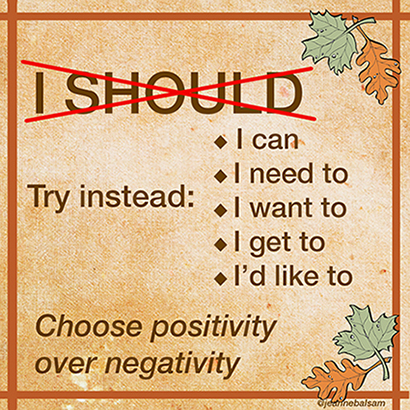
Ever noticed how often you say `I should’? Those two words negatively imply that you have already failed to do something you need, want, or don’t want to do. Flip it. Mentally cross out `I should’ and replace it with one of the choices offered.

If you make a consistent effort, you’ll notice 1) how often you are saying `I should’, and 2) an improved feeling of positivity in how you approach things.

Frequently using the words `I should’, is often the sign of having identified with and incorporated a figure in our past who criticized us. This person likely needed control over a situation, and was rarely happy with how we went about things in that it wasn’t the way they wanted it done. Thus, we ‘should’ do it some other way, at some different time, etc.

As children, we incorporate those sentiments and those words, and grow up criticizing ourselves over often meaningless things. The fact is that the one who did the criticizing was likely treated the same way, and didn’t have the skills or knowledge in raising us to approach things in better and more helpful ways.

It’s also true that we don’t have to continue criticizing ourselves. We can change, and flipping the switch – substituting positive words such as those above – is a surprisingly simple way to begin seeing ourselves and others in a more positive light. Be diligent!