This past weekend was the wonderful, huge, annual library sale that I go to every year, and below you see my haul.

What? You don’t see any books? That’s because I never got there. Being under the weather for a few days, plus it was raining non-stop, I knew my best bet was to stay home and feel better. I missed the excitement of just being around the thousands of books, and certainly the traditional follow-up lunch with my friend in which we go over our multitude of finds, but in the end, I am hardly bookless.
I still have books from last year’s venture; friends share books all the time; I have bookshelves stuffed with selections I’ve yet to read or would happily read again; and … the local library is in a decent walking distance from my home. I am living in a very book-rich world.
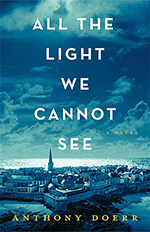 Not to mention, I am still living in the world of Anthony Doerr, Pulitzer Prize winning author of All the Light We Cannot See. Yesterday, before I closed-up shop for the day on my work, I read a bit online about him and his other books, and watched a video of how he came to write this phenomenal book. I also looked at photographs of Saint Malo, the walled city on the coast of Brittany, bombed practically beyond recognition at the end of World War II, and an important location for much of the story. Doerr wanted to write a different tale about the war, and much like the outstanding author of The Book Thief, Markus Zusak, he certainly has done that. I am at times brought to tears at the beauty of Doerr’s use of words, and am moved by the story he tells.
As I approach the end of the book, I am deeply saddened by what has happened to one of the characters, but am holding out hope for the others. Soon I will be returning this novel to my local library, never knowing if my next book will be in the stacks, sitting in the $1.00 shelves at the front desk, or waiting for me here at home. I don’t own a kindle, and don’t read online. I thoroughly enjoy the weight of a book in my hands, the smell of paper and ink, the turning of the pages, and the placing of a bookmark where I’ll begin again as soon as I’m able.
We who love to read are a lucky lot, are we not?







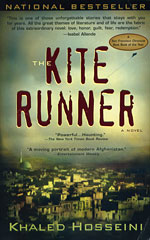 It wasn’t until college when I had an exceptional professor who taught Contemporary Civilization in the context of art, (I was at an art school), and for the first time someone teaching history had neurons in my brain firing rapidly. History suddenly came alive! Unfortunately, at that point, I had very little mental framework in my brain to hang it on. But I started to take an interest in the subject.
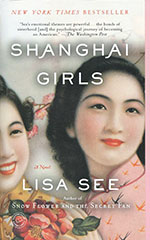 The two novels that recently afforded me that desire to delve into history were those by author Lisa See, Shanghai Girls and Dreams of Joy.The first novel begins when Shanghai was known as the Paris of Asia, and sisters May and Pearl were “beautiful girls”, models. With their father having lost all their money, the sisters, with their mother, must flee Shanghai as the Japanese invade China. The sisters were forced to emigrate to the United States in arranged marriages. From their interment on Angel’s Island to creating lives for themselves and their families in Los Angeles’ Chinatown, we follow the complex relationship of Pearl and May and Pearl’s daughter, Joy.
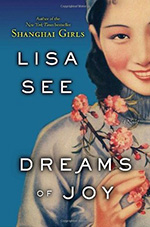 she is soon to be profoundly discouraged and isolated. Pearl leaves the states to search for her daughter, encountering endless roadblocks along the way. The backdrop of much of the novel is the time under Chairman Mao and The Great Leap Forward, a time of alleged progress in which a famine took the lives of millions of Chinese people. (
 Still A Dreamer