 One of the items on my Christmas shopping list was something my girlfriend’s son can enjoy – traditional peppermint candy canes. He has many allergies, but this is one treat that is worry free. Even so, I wanted to check the package label to hopefully find that they were not made in a facility that also processes dairy and tree nuts, (two of his allergies.)
I was at Target and picked up a nice jumbo-size box of candy canes and looked at the label. Product of Mexico. What? I picked up a different kind, to find that they were by the same manufacturer. And … Product of Mexico. I was floored. Really? Then I looked at an obviously different brand that had a real old-fashioned look and feel to the packaging. On the label … Product of Mexico. WHAT? (If I were the kind of person who said OMG, you could now imagine some strange woman maniacally grabbing every kind of candy cane in the aisles — regardless of ridiculous flavor — and yelling OMG, OMG, OMG.)
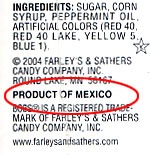 But I didn’t. And I didn’t buy any candy canes. I went to my local Shop-Rite. And there, the same old-fashioned packaging again and … Product of Mexico. Since when did the quintessentially traditional Christmas candy start getting made in another country? In truth, I’d rather they be made in Mexico than China, but still … does no one make candy canes in America? I bought a small package of these – the brand is Bobs – in the event I never found anything else.
Then I went to a local shop, (This `N That on the Corner), and checked out some larger individual candy canes. Yes! Made in Ohio! And the manufacturer, Spangler, (see candy cane below right,) had right there on the display box, the simple ingredients and that the candy canes are made on a dedicated machine, (which means no cross-contaminants of potential allergens.) So I grabbed a big handful and was happy to pay a wee bit more, knowing that I’d gotten a safe gift and helped support an American worker and company.
 Now here’s the kind of sad thing. I read online the long and detailed history of Bobs Candies. They were established in 1919 in Georgia. They survived the Great Depression, a devastating tornado in 1940 that destroyed their factory, and World War II shortages. Bobs actually introduced the crook in the candy cane. And at the end of this proud history is one line: In 2005, Farley’s & Sathers Candy Company, Inc. acquired Bobs Candies and nothing more. I’m guessing after that is when they started outsourcing the manufacture of their candy canes. Sad, eh?
But there still is Spangler’s, and I suspect there are more American companies making traditional Christmas candy canes. It only seems right.
Update: Christmas 2012 had me looking for Spangler’s again because they’d been made in the USA. On their label this year was “Made in Mexico.” In looking at their web site, I see they “operate a co-manufacturing facility in Juarez, Mexico for the production of commodity candy canes.” Other items are still made in Ohio such as Jelly Belly jelly beans, Skittles and more. The American made candy cane search is on again.


 Still A Dreamer