Books, Wonderful Books

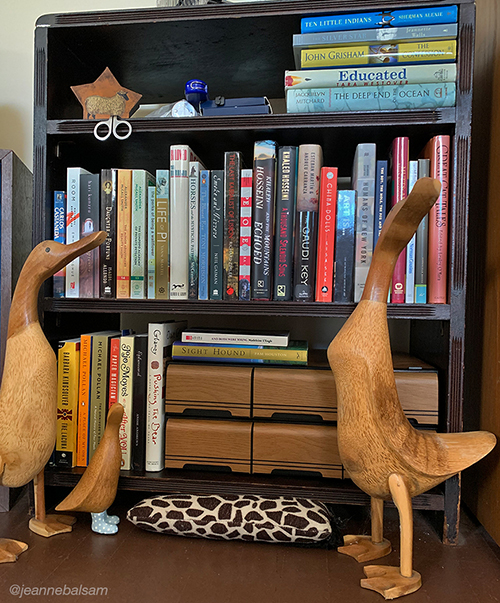
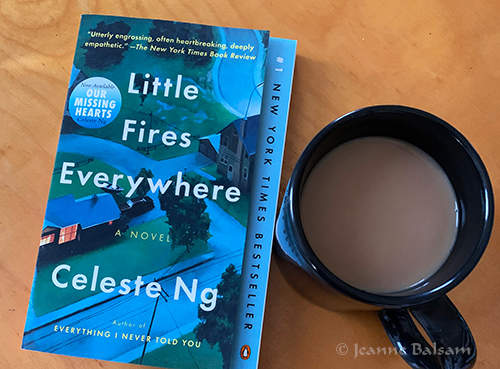
My last few posts have featured different aspects of my businesses because, truly, that is where my energies have been flowing. However, I have been reading books constantly all the same (you just haven’t heard about them yet.) I started this post Thursday in the afternoon and it had been snowing (!) for nearly 3 hours, the white sky starting to turn that dusky cloud grey. It was a great time to divert myself from the work on my desk and dwell on words … beautifully written, elegantly connected, come-hither words.

Where to start? Books and movies, or in this case, books and television. It seems fairly well-established among anyone I speak to that movies/television rarely live up to the quality of the books they’re based on, and are often disappointing. Two programs I have watched recently – one series on DVD and another of three episodes on Masterpiece Theater/PBS – were outstanding, easily the best things I’ve watched on TV all year and I highly recommend them – Big Little Lies and The Miniaturist. Each inspired me to read the books.

I must say, I was not as drawn in by Big Little Lies by Liane Moriarty as I’d hoped to be. Reese Witherspoon and Nicole Kidman optioned the series and made it into something riveting, but as to the book? For me, not so much. I decided to try another of Moriarity’s books, The Husband’s Secret, and it was significantly better.

But ah, The Miniaturist … absolutely fantastic. The story by Jessie Burton is written in the present tense from Petronella Oortman’s POV and takes place in Amsterdam in the late 1700’s. She is a young bride from another part of Holland. She has a respected family name but no money, and is married by a wealthy merchant, Johannes Brandt. While often absent, he buys her a cabinet as a wedding gift to help keep her occupied, a large and expensive dollhouse built and designed to look exactly like the house Petronella is now living in. The Miniaturist is a story about relationships, secrets, about the forbidden, prejudice, and very much, mystery. Although Nella orders miniatures to be made for her dollhouse, the miniaturist sends more, unrequested, that start to reveal a life unexpected in which the young bride finds herself inexorably tangled. Seeing the series on TV first was actually a great advantage – the settings, dress, morals, and attitudes of the Dutch at that time in history added much to the reading.  Take a peek at Petronella’s world; it will not give away the story. And then get the book. You won’t be disappointed.

Another book that I could not put down is Before We Were Yours by Lisa Wingate. This novel is also historical fiction; one part of the story takes place in Memphis, TN in 1939, the other in present day South Carolina where a young lawyer begins to research her grandmother’s buried and seemingly disturbing past. We are taken to a shantyboat on the river where the oldest child, Rill, and her four younger siblings are kidnapped and brought to the Tennessee Children’s Home Society orphanage. They soon discover they will not be reunited with their parents as promised, but will be adopted to wealthy people willing to pay handsomely for children to adopt. The stolen youngsters at the orphanage are often starved, abused, and neglected at the hands of the cruel director and her lecherous brother; a large number of children disappeared entirely. In part what makes this book so riveting is that it is based on the very real adoption operations of Georgia Tann, a notorious felon who kidnapped and sold children for decades. Excellent in every way.

While on the topic of books not to be missed, I read Snow in August by Pete Hamill. Hamill is famously known for being the publisher of major newspapers in NYC, plus a journalist and novelist. The story takes place in Brooklyn  in 1947, a tale about friendship, faith, and trust, about an 11 year-old Irish Catholic boy, Michael Devlin, and a refugee from Prague, Rabbi Hirsch. Struggling through a snowstorm to serve mass a few blocks away, Michael, though fearful, gives in to the Rabbi’s repeated calls for help and enters the synagogue. It is the sabbath, and the rabbi needs the lights turned on. It is the beginning of a remarkable friendship, set against a backdrop of ignorance of and prejudice against the Jewish people in a community of Irish, Italian and Polish Catholics. A violent act is committed against a Jewish candy store owner by the leader of a local group of thugs; Michael was in the shop as a witness, and so the story unfolds. The prose is exquisite and the story moves along quickly. Snow in August is immensely compelling.

In my journey with excellent mystery writer Louise Penny, I read the seventh book in her Chief Inspector Gamache series – A Trick of the Light. While of course there is a murder to be solved, Penny writes each novel with a new frame of reference, this time the highly competitive art scene in Montreal. The cast of characters, always perfectly drawn, and the home of the story’s activities, Three Pines, are the setting for this novel. Louise Penny has made me a fan of her superb writing and for engaging me in reading a mystery series, something I never thought I would do.

I just finished another murder mystery I spotted on the shelf in my local library, The Day of the Dead by Nicci French, actually a collaboration between a husband and wife team. The book seemed interesting and a good read while I waited for another book through inter-library loan. I was surprised to find how really good it was. Fast moving, tight writing, great plot – I could not believe how quickly I devoured this book! It may not be my usual fare, but I enjoyed every moment of this story about a renowned psychologist, Frieda Klein, whose life had been entangled with a serial killer, Dean Reeves, for a decade. She has suddenly dropped off the map and at the same time, seemingly unrelated murders  are appearing at various locations around London. These are later revealed to be at pre-determined intervals and at locations which would have meaning for Freida, clearly to draw her in and be his final victim. In the mix, and another main character, is Lola, a college student to whom it was suggested that she study Frieda Klein for her major college paper. This is apparently the last/latest in a series about Freida Klein, but worked effortlessly as a standalone.

I am now beginning  to read Raven Stole the Moon by Garth Stein. I already read The Art of the Racing in the Rain, now one of my top 5 favorite books of all time, and another excellent novel of his, Sudden Light. I would probably read anything this man writes. Quite simply, he is a brilliant and gifted writer.

Hope I’ve inspired you if you’re looking for a good read. The weather is becoming that kind of chilly that has us curling up with a good book, and if you’re lucky, in front of a warm fire.

The Mysterious Mug

This morning when I went out to the mailbox to retrieve my mail, I spied something at my front door. It was sitting quite nicely in front of my little children’s bench which holds a flower box filled with overflowing pink and white Impatiens. What could that be? I thought. I didn’t order anything. And because I was feeling a tad under the weather, I immediately wondered if it was a misdelivery, something from a company I didn’t order, etc. Whatever it was, it did get my curiosity going.

I brought it inside and looked at the label. Sure enough, it was addressed to me, and from a company I’d never heard of. More and more curious. I opened it up to find no note or identifying information, but when I brought out the one item inside, it brought tears to my eyes.

Someone had sent me one of the most meaningful and thoughtful gifts I could receive at this moment in time. Something that affirms my strength as a woman and as a writer, from someone who obviously knows the challenges I’ve faced over the last 5 or so years.

We all have our challenges; there is no doubt about that. I was joyfully on my journey of writing and illustrating children’s books, and had been for a while. It was a long-awaited return after I had studied under the renowned children’s book author and illustrator Uri Shulevitz at the New School in NY so many years ago. And then things happened. It doesn’t really matter what they were, but they had the effect of disrupting many aspects of my life, among them my children’s book journey. This was my dream. And although it had to sit on the sidelines for a while, it never sat alone. I did everything I could, however tiny, to keep it alive even though it could hardly take my full attention.

As time passed and I worked to regain my balance in all aspects of my life, I have – little by little – returned to my writing for children, to my dream of being published. I don’t have the luxury of writing full time, as most writers do not, but more and more, it is in my thoughts and in my daily plans. I know I’m back on track – maybe not sprinting yet, but I am out there and picking up speed.

And whoever sent me this mug knows that, and I thank you deeply for acknowledging it. I will find you and I will thank you.

For the rest of you women writers out there, especially those who face challenges and proceed in spite of them, tomorrow morning I am going to toast you all with my first cup of coffee in this mug. Cheers to you and your writing dreams.

After the Writing Conference …

The first thing to happen is your brain starts to slowly disintegrate on the way home. Once in the door, you need to tend to anything that needs tending to because your body is following close behind and is not going to be in an upright position too much longer. From stress? Nope – from the incredible rush of attending a two-day conference for writers and illustrators of children’s books. It’s exhausting alright, but in a good way.

Each June my New Jersey chapter of the SCBWI (Society of Children’s Book Writers and Illustrators) holds its big event. There are workshops, round tables, one-on-one critiques, a juried art show, portfolio display, keynote speeches, and more. This year, in choosing my workshops I focused entirely on writing in picture books. Other years, I have mixed things up and taken workshops in middle grade and young adult writing, picture book illustration, marketing/social media, and more. There were some truly fabulous speakers this year who inspired me and will keep me thinking long after the conference.

A highlight of the NJ event for many attendees is the availability of having one-on-one critiques, something not offered at all SCBWI (or other writing) conferences, and I picked very well this year. The picture book I submitted seemed a very good fit for Charlesbridge Publishing, and my mentor was outstanding – knowledgeable, insightful, and beyond helpful. Did I mention thorough? Yes, very thorough. A good editor or agent really knows how to show you where you need improvement without destroying your soul, acknowledge all the things that are right with your manuscript, and point out directions that will help you make your story perfect. And that I got.

The big challenge after a conference like this, for me, anyway, is to keep the momentum and all that excitement going because Monday morning rolls around pretty quickly and I am back at my desk writing and designing for everyone else, i.e., my clients. However, one of the first things I did Monday was to hit the library. I was picking up an adult novel I’d requested on inter-library loan, Before We Were Yours, and also a number of picture books that had been recommended by my mentor and other workshop leaders along the way. I also requested a few more from our main library. (As I did not take any photos of the event, I have included a handful of those books here.) I plan to read them over the next couple days for both enjoyment and to understand what makes them really good picture books. There is always much to learn.

Over the next few days I will revisit the MS I submitted and all my mentor’s notes and look to see how I can make my story shine yet brighter. For all the praise she gave me for this picture book, and there was plenty, it wasn’t enough – at least not yet – to be the one Charlesbridge wants to publish. Not yet.


Catching Up …

Life sometimes pulls us in one direction … then another … then another. Grabs us by the collar and says, “You need to take care of this, but be sure you do this, oh! and this!” The end result is we writers look quite absent from our blogs from time to time. But be assured, this writer is still here, just pulled in all those directions.

There’s been a boatload of work, which, as a freelancer, I will never complain about; preparation for my being a guest speaker at an Animal Writers Workshop (you can check that out here); preparation for the annual SCBWI (Society of Children’s Book Writers and Illustrators) June Conference coming up in 2 weeks; the usual (un)expected running around for all manner of things, some pleasant, some less so; and, of course, reading! No matter what else is happening, I am always reading.

To this end, I’m going to catch you up on the wonderful books I’ve enjoyed.

After reading The Art of Racing in the Rain by Garth Stein it was clear that I wanted to read more from this great mind. I perused Goodreads and requested A Sudden Light from my library. What a magnificent book. I will officially now read anything this man writes. A Sudden Light is a story told in the first person by 14-year-old Trevor who travels with his father to the family’s Riddell House in Oregon. His parents’ marriage is in trouble, and this trip to meet his aunt and grandfather is to allegedly settle some financial issues, put the grandfather in a nursing home, and dispose of the house. The home’s exterior is constructed of huge trees, and was built by Elijah, Trevor’s timber baron great grandfather. Trevor soon finds they are not alone in the house; there is a ghost, who has remained to see that Elijah’s last wishes be carried out, that the property be returned to a natural state as amends for the desecration he caused to the land. Somehow Stein has managed to put together an historical novel, a compelling ghost story, a tale of multi-generational conflicts and family secrets against a backdrop of the Pacific Northwest. Read more here and scroll down and visit The North Estate. Be sure not to read any spoilers!

Following this, I read The Immortalists by Chloe Benjamin, a novel (her first) with a most unusual premise. Four children, brothers and sisters edging into adolescence, hot and bored in the Lower East Side summer of 1969, decide to visit a gypsy fortune teller who is said to be able to give you the exact day you will die. The kids do it on a lark, just for something to do. The eldest brags about how far in the future her date is; she’ll live to a ripe old age. Another sibling shares, but the two others are clearly shaken and will not reveal their dates. It’s all just a joke anyway, right? The following chapters follow the life of each child, as the reader, in suspended animation, follows the sibling’s choices leading up to the possible fulfillment of their individual prophecies. Warm, engrossing, a fascinating premise, and very well-written.

I then read the next in the Inspector Armand Gamache mystery series by Louise Penny. I never thought I’d be interested in reading a series by anyone (at least not after my beloved Nancy Drew mysteries from my childhood) but Louise Penny changed my mind. Inspired by a post by fellow blogger Cynthia Reyes, I picked up a couple of Penny’s books from my local library and was very impressed. So much so, in fact, that I decided to read the entire series from the beginning (not one right after the other, but interspersed among other reading.) What a great decision! Penny is an excellent writer who knows how to hook you from beginning to end. With a cast of characters that one becomes more attached to with each book, mysteries unfold to be solved by Chief Inspector Armand  Gamache of the Surété of Quebec, the premiere investigative arm of homicide in that province. The Brutal Telling is book #5 and calls upon Gamache to solve the murder of an unknown individual whose cabin is buried in the woods surrounding the quaint village of Three Pines. The evidence points to a seemingly unlikely character, which can only leave the reader quite puzzled. Are they  really capable of murder? The book ends with that individual’s arrest, and we are left wondering.

The next book in the series, Bury Your Dead, is considered a companion to this one, so I elected to read it right after, and it does pick up quite literally where The Brutal Telling ended. What is engaging about Penny’s writing is that she is not just writing simple mysteries, but increasingly complex novels which explore Canadian culture and history from Vancouver to Quebec’s founder, Samuel de Champlain, to revered artists. Her characters grow realistically and empathically, and it’s very easy to become involved in their lives and the small town of Three Pines. If you like an absorbing mystery that will also give you a little more to sink your teeth into, look into this series. I suggest you start with the first in the series, A Still Life. There is a growing richness with each subsequent novel, and Penny will always keep you guessing until the end. Oh! And another small perk – whenever characters are eating, Penny always takes a moment to describe the deliciousness of their food. It’s a tantalizing little diversion each time.

I took a turn into another age group after this and read Crenshaw, a middle grade novel by Kathlerine Applegate, the author of a book I love (and own), The One and Only Ivan, an absolutely wonderful read. This story is about Jackson, a young teenage boy, and his family whose financial situation has changed from precarious to dire with them being forced to live in their minivan. Again. The story touches on an important subject, homelessness and the challenges faced by those who may be barely getting by. But there is another important character – Crenshaw himself, a very large cat. Crenshaw is Jackson’s imaginary friend from when he was a little boy, returned to be supportive of Jackson in his time of need … whether Jackson wants him there or not. Needless to say, this lends itself to moments of humor, but at its heart, this story is about resilience, friendship, and how we survive tough times. It was a good read, but for some reason, didn’t grab me the same way Ivan did. I’d still recommend it to the middle grade readers you know because we are all always facing some challenge or other, and this age group will appreciate Jackson and Crenshaw’s approach to a problem more common than most think.

I’m now reading Flight Behavior by Barbara Kingsolver, another terrific writer. I have read at least four of her other novels, The Poisonwood Bible being a permanent resident on a particular bookcase reserved for those books that I would definitely read again. Hopefully, I’ll be able to tell you about Flight Behavior somewhere in the vague timeframe of when I finish it.

Whether you are inspired by the stories mentioned above or are on a book path of your own, I will always wish you … Happy Reading!


Those Who Save Us

The jury is still out on this one. There were several points along the way in reading Those Who Save Us that I felt I could have put the book down and it would have been OK. Yet I didn’t. It’s not a case that it wasn’t a worthwhile book, but there was something about it that did not pull me in and engage me as I would have liked. As a writer, Blum has an excellent command of the language. You kind of knew where the book was heading – or at least, you hoped it was – but my total investment wasn’t there. Why not?

For one thing, I don’t think Blum made me love her characters enough. Trudy, the daughter, lives a rather empty life emotionally. I understand why, but I still wanted more from her. Same with Anna, the mother. I certainly understand why she became stoic and blocked emotion, but how do you write about two such characters and still make us care? Anna went through some excruciating experiences; I should have loved her deeply. I also didn’t feel the story building with the kind of momentum that I felt it could have to a real climax.

The novel is told in alternating groups of chapters about Anna and her past and Trudy in the present. Blum weaves them together to bring Anna into the current time in Trudy’s life. The story begins in Weimar, Germany in late 1939 when the Nazis had taken control of the city and started taking Jews. Anna is a girl of eighteen, living a very comfortable life with her widowed father, who is cold, demanding, and solicitous of the Nazis’ favorable opinion. Her father’s dog becomes ill, and Anna, fearful of making the journey to the German vet across town, takes the dog to the closer veterinarian who is Jewish. The two take a liking to each other despite an age difference, and she ends up hiding Max in her large and elegant home, practically under her father’s nose. They fall in love, she conceives his child, but comes home one day to find him gone. The father has suspected and turned him in, at which point, Anna leaves home.

Hoping for some word of Max, Anna remains in Weimar, hidden by a baker, Frau Mathilde Staudt, who helps the Resistance.  There, Anna gives birth. In making a secret run to hide bread in the forest for the starving prisoners, Anna is spotted by the Obersturmführer, Horst. To save her life and that of her daughter, she complies with the SS Officer who demands an often cruel sexual relationship with her.

In the current day, Trudy is a college professor of German history. Following the burial of Anna’s American husband, Trudy is putting her mother in a nursing home after a fire in Anna’s house, its source being suspicious. In picking up her mother’s belongings, Trudy finds what appears to be a gold cigarette case with a swastika on the front, and inside, a photograph of the Obersturmführer with her mother seated in front, Trudy on her lap. Trudy has always been angry with her mother’s refusal to tell her about her early childhood in Germany, but now believes her father was a Nazi. In her search for some sort of enlightenment, Trudy decides to do a special project interviewing Germans who lived through this time, and recording their views of the Holocaust in retrospect. She is shocked by the answers she hears, but also meets more than one person who will impact both her and her mother’s lives.

The story continues, weaving the lives of mother and daughter together, past to present. Despite the forward momentum of these intertwined stories coming to a resolution, I didn’t find myself on what could have been a taut and gripping journey. And yet, I never stopped reading. So the jury is out.

If nothing else, this book is a reminder of how we, who have grown up in the free world, unscathed by events such as those in World War II, can never begin to understand the torture, horror, and pain of those who lived, died, and witnessed the Holocaust. In that regard, the book never fails to be both brutally honest and a cautionary tale of what may lie beneath the surface of even the well-intentioned.