There were many things that got stalled or pushed to the back in the last year. For many of us, reading was not one of them. In fact, a good book was often a saving grace.
I thought to share with you some of the best fiction I read, often historical, starting back from the end of 2019. These books came from several sources – the library; some I purchased online; books purchased at past annual county library book sales; and my own collection.
Here is the best of what I read from late 2019 to present:
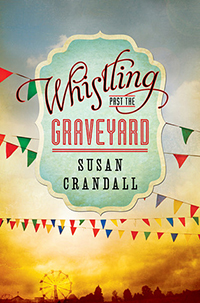
Whistling Past the Graveyard – Susan Crandall. This is certainly one of the best books I’ve read in a long time. Told in first person by a sassy, red-headed nine year old, Starla Claudelle, it takes place in 1963 Mississippi at the height of segregation. Being raised by her overly strict grandmother while her father works out on the oil rigs, Starla wants nothing more than to find her mother in Nashville, whom she believes left to become famous and then reunite her family. Upset by a turn of events, Starla decides to run away to Nashville on her own. She is offered a ride by an older black woman, traveling with a white infant, unaware of the dangerous implications of this situation. Whistling Past the Graveyard is a story with deeply felt characters set against the backdrop of the Deep South at a time in history that Starla only begins to understand for what it is, as well as what family can really mean.
One page in, and I was totally hooked.
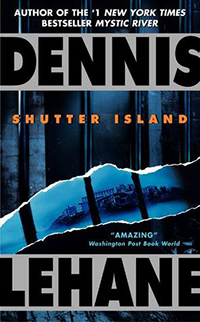
Shutter Island and Mystic River – Dennis Lehane. If you want two stories you can’t put down … Shutter Island was a book sale pick, and in it I discovered a writer with an excellent capacity for writing tense, fast moving prose with twists and turns at every corner. This story takes place in 1954 when a detective and his partner come to Shutter Island, home for the criminally insane, to investigate a patient’s disappearance, and where we soon discover nothing is as it seems. Later in the year, I read Mystic River, a psychological thriller about three boys growing up as friends, approached one day by a man in a car. One boy gets in; the others do not. And something – never fully articulated – terrible happens. Fast forward to adulthood, and this plays out in a harrowing series of events. (p.s. the movie is also excellent.)
Lehane is a terrific writer who keeps you on the edge of your seat, no matter the subject of the book. There is no doubt that I will pick up another of his novels in the future.
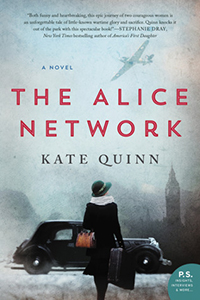
The Alice Network – Kate Quinn. Historical fiction taking place in the times of both World War I and World War II, The Alice Network is based on the true story of a group of women spies of the same name who, at tremendous risk, infiltrated the Germans to save lives in the most daring and heroic of ways. This is Goodreads’ initial description of the book, and as apt as I could write, “In an enthralling new historical novel from national bestselling author Kate Quinn, two women—a female spy recruited to the real-life Alice Network in France during World War I and an unconventional American socialite searching for her cousin in 1947—are brought together in a mesmerizing story of courage and redemption.” Please read the full review and you’ll know why this was a book I could not put down. It’s truly exceptional.
Had I not borrowed it from the library, it would be sitting in my bookcase of books that I would read again some day.
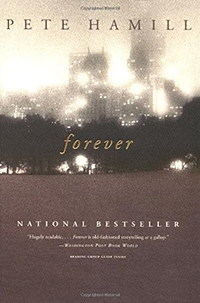
Forever – Pete Hamill. This is a masterful book — on the one hand, a magnificent love letter to New York City and all it’s history; on the other, the story of a young man in 1700’s Ireland, Cormac O’Connor, whose parents were killed by a wealthy lord. Added to the mix, we have some magic of the old religion, which allowed Cormac to live forever if he never left the island of Manhattan and successfully avenged his parents’ deaths. This is not a casual, lightly read book, but one that spans centuries as we follow Cormac’s life from childhood to an America at the moment of its birth. From the slaves in the ship’s hold that he saves and befriends through the politics, greed, and buried secrets of New York right through to 9/11, this is a story of great knowledge and depth. Pete Hamill has written Forever with such compassion. It was a long read, but I was sorry when it ended.
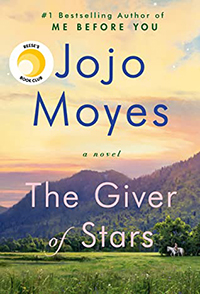
The Giver of Stars – Jojo Moyes. More engrossing historical fiction set in the Depression era in Kentucky. A small group of women who, for different reasons, join together, following the exhortation of Eleanor Roosevelt and her traveling library campaign to bring books to people who had no access to them, but who wanted to read or learn to read. Alice Wright, disillusioned in her new marriage to a distant husband and dealing with a controlling father-in-law, joins with Margery, founder of the group. Margery is strong, outspoken, and independent, and is soon joined by three other women, forming The Pack Horse Library of Kentucky (the real name of the library). The women repeatedly faced danger traversing the rugged landscape by mule and horseback, sometimes from the people who lived there, as well as from men in their lives who would control them. Their loyalty and friendship, finding true love, and always following their mission of bringing books to people in remote areas makes for a rich and rewarding read. An unforgettable story.
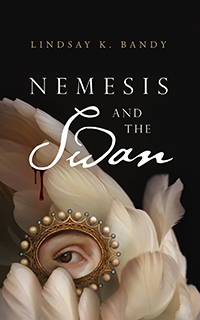
Nemesis and the Swan – Lindsay Bandy. This is mature and sophisticated YA, taking place in the French Revolution. Helene d’Aubign, an aristocrat of 19 years old, writes from her cell in a Paris prison. Her diary alternates with her story of being influenced as a young girl by her governess to become a revolutionary and to seek true love at a time when girls were only allowed arranged marriages. Forced to flee Paris as violence breaks out, Helene searches to find the answers to an intricate family mystery involving love and murder, somehow tied together by two unique, painted pins of eyes surrounded by gilt and pearls. She longs to return to her home and the jeweler’s apprentice she’s fallen in love with. When, in disguise, she finally does return to Paris, she finds everything she knows is changed or destroyed. But to make matters far worse, she is being sought – and is soon arrested – by those who suspect her true identity, which will sentence her to the guillotine.
With a richly articulated backdrop of the French Revolution, and the characters enmeshed in a family mystery, you couldn’t help but hope for Helene’s survival and an ending that seemed impossible.
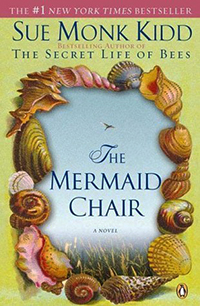
The Mermaid Chair – Sue Monk Kidd. If you have read The Secret Life of Bees, you know Kidd writes with a truly exquisite use of the English language. The Mermaid Chair brings to life the setting of Egret Island off South Carolina where Jessie Sullivan has gone to tend to her mother, now suspected of severe mental instability after severing her finger. But the story is Jessie’s – she is returning to her childhood home of marshes and sea salt, egrets and a monastery where resides the Mermaid Chair. It is a story of love and disillusionment in her marriage, love and awakening with a monk questioning his own commitment, but most importantly, the search for her own self, lost over the years. Interlaced with the loyalty of longtime friends, a mystery surrounding her beloved father’s death, and the idyllic quality of Egret Island, Jessie’s story is stirring and engrossing. This is my own book which I’ve read in the past, and couldn’t wait to return to each evening.
Other notable books – I can’t review them all, but I can mention some other books that stand out from the many I’ve read in the past year+.
The Long Way, A Great Reckoning, Glass Houses, – all by Louise Penny. This is the first series of novels I have ever read as an adult, and I love them. I began at the beginning, and am working my way through the series, always drawn in by Penny’s style, wonderful characters and mysteries, all set in her beloved Canada.
Twigs in My Hair – Cynthia Reyes, friend and fellow blogger here on WordPress
Good Hope Road – Lisa Wingate
The Last Letter from Your Lover – Jojo Moyes
Flower Net and The Interior – Lisa See
With the hope that I’ve inspired a future selection or two, I wish you Happy Reading!

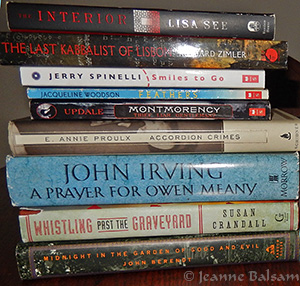 For a half hour’s drive and $24.00, I picked up the amazing selections you see here, hardbound and paperback. I do go with a list, and am happy to find anything on it, but don’t expect my top picks, especially from 2018. But I did bring home some selections from favorite authors – Lisa See, Alice Hoffman, Jodi Picoult, Barbara Kingsolver, E. Annie Proulx, and more. I also picked up a number of middle grade/YA novels including Jacqueline Woodson, Jerry Spinelli – and amazingly, the exact book by Linda Sue Park, A Long Walk to Water, that will help me in a drawing project for a client!
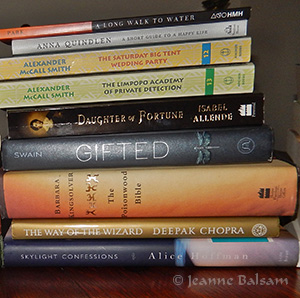 There are also authors I am not yet familiar with but had been hoping to find, and some I don’t know at all. There are a couple psychological thrillers, some historical fiction, science fiction, and mysteries – enough to keep me happily reading for quite some time.
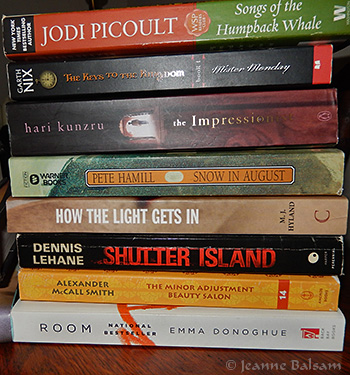 As I drove down the lovely backroads to the book sale, I couldn’t help but think that a good book and a warm and fuzzy friend to curl up with can get us through a lot of stuff in life – both good times and bad. And $24.00 isn’t much to pay to have one of those pleasures at my fingertips.
 Are you familiar with
 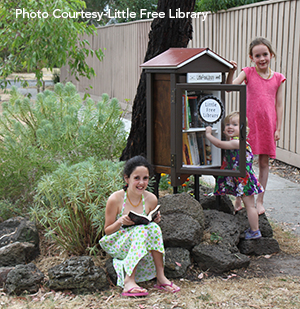 has grown to 80,000 little libraries around the world in a total of 90 countries, (as of 2019), all providing access to our most treasured possessions, books. (Second photo in Mount Martha, Victoria, Australia.)
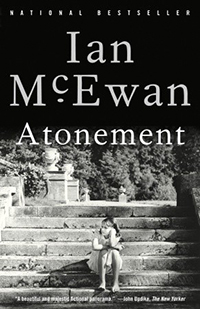 On to the books … Atonement by Ian McEwan. I wasn’t sure exactly what to expect from this, but knew it was a story whose initial chapters take place in London at the beginning of World War II and carries through the war, and then to the end of the century. It’s of a romance between the older sister in a very wealthy family, Cecilia, and the son of their housemaid, Robbie, their gardener. He’s a very bright young man, for whose education Cecelia’s father has been paying, with plans for Robbie going to medical school. But the story begins with the youngest sibling and third major character, Briony, a thirteen year old, who spends a great deal of her time writing. She is a very intellectual child, sheltered, and rather controlling. Early on in the story, she sees a flirtation between Cecilia and Robbie which she does not understand. When she witnesses another interaction in the library, she makes an assumption that will change the lives of these three characters forever. Her misinterpretation of what she saw and an incorrect confirmation of Robbie’s involvement in a separate incident results in his being sent to prison, and later, war. The story follows how the lives of these three were affected by Briony’s decision. It is a story about war, of love, and innocence. I did like the book – Robbie’s time in the war in northern France was remarkably and painfully well told – but the beginning was a bit difficult to get through, especially as Briony is not your most likable character. The writing was not in a style I usually read; the author was likened on the book jacket to Jane Austen. I did still enjoy it, and there is a wonderful twist at the very end.
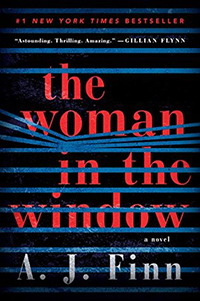 Going from soup to nuts, I then turned to something completely different – a fast-paced psychological thriller, The Woman in the Window by A.J. Finn. I read this in three days – it was hard to put down, as in you look at the clock and it’s 2 in the morning. It has been compared to two other books, Gone Girl and The Girl on the Train. The comparison is made in that the main characters are all unreliable narrators, but this book soon differentiates itself in many ways. Anna Fox, our MC, lives a secluded life; you soon find she’s an agoraphobic as a result of an unknown, horrible tragedy that occurred in her life. She’s on multiple medications, and against doctor’s orders, also drinks. She also spends a great deal of time watching her neighbors. Early on in the story, she witnesses a murder, she’s sure of it. But did she? Let me say this – The Woman in the Window reads like a house on fire, and Finn is an outstanding writer in more than one way. He (yes, it’s a `he’) spoon feeds you pieces of information, layering the suspense and all but turns the pages for you. Just when you think you know what’s going on, he throws in a major twist. Moreover, he has an exquisite use of language, not something you might expect in a thriller. I highly recommend this book. You’ll be at the (very satisfying) end in no time. Promise.
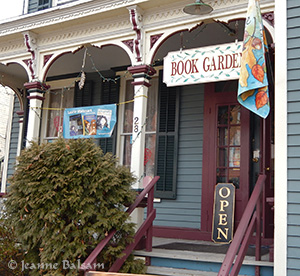 Ahhhh …. two of my favorite subjects. Something delicious to eat and something delicious to read. First, the cookies. As mentioned in an earlier post, my friend Laurie had her book launch at our little local Indie bookstore, The Book Garden. What I had not mentioned, was that Laurie and I had a cookie baking marathon the weekend before, whipping up sugar cookies for both this launch and her launch in NYC a few days earlier.

 Still A Dreamer