Following Our Path

This morning I felt called to look into my little metaphysical perpetual calendar, and as always, what I found was perfect for my day.

MonumentValleyAZ-2

“For me there is only the traveling on paths that have heart, on any path that may have heart. There I travel, and the only worthwhile challenge is to traverse its full length. And there I travel looking, looking, breathlessly.”
~ Carlos Castaneda

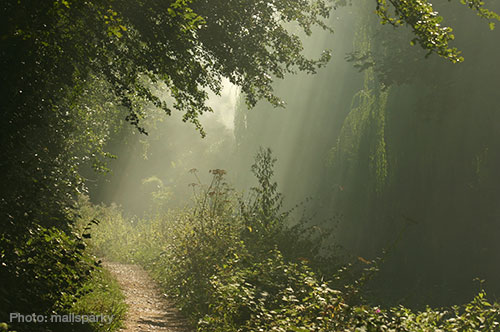
There are times in our lives when our path seems to disappear from view. We’ve been drawn down paths to the side that beckon and call, needing or demanding our attention – finances, relationship conflicts, illness, the illness or death of others, job worries, and other challenges and distractions. These paths can lead deeper and deeper into a woods of fading light until we feel quite lost. And then we remember, we have a thread — a simple, single luminous thread to follow. That thread glows more brightly with each step we take out of the darkness to find again the glowing path that is uniquely ours.

MistyForest2

May you walk your path — find or refind it — happily and bravely today. May your path be illuminated by the shimmering white light that is you and the Universe, one and the same. May it leave you breathless.

~ stilladreamer

The Rules We Make and Live By

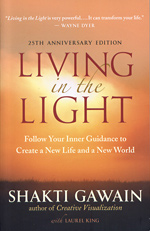
LivingInTheLight-SGawain2Those of you why stop by regularly know that there are always two books to the right – most likely a novel of some sort and below that a metaphysical, spiritual or self-help book. You may also notice that the top book changes fairly regularly and the lower one may stay there for quite some time. Although it may look like I’m an inordinately slow reader, it hovers there because I usually am “working” the book, i.e., taking my time and attending to the lessons the author has to offer.

I am really savoring Living in the Light by Shakti Gawain. In the broadest terms it is about becoming more aware of and living by your own inner guidance, learning to recognize and trust our own innate intuition, thereby creating a new life and world. The book focuses on getting to know the many aspects of ourselves and at the end of each chapter, Gawain has included exercises and meditations. The chapter I have just completed is titled Authoritarian and Rebel, two aspects that are often alive and well in each of us. To the degree that we are unconscious of these qualities, we may experience related difficulties in our lives, not the least of which is interference in hearing and trusting our own intuition.

Gawain’s exercise at the end asks, after you have read the chapter, that you identify and write down some of your rules and behaviors that feel demanding and controlling, (overly authoritarian), to you. She lists the categories of work, money, relationships and sex, encouraging you to add your own if you wish. (I did.) Gawain then asks you to do the same with rebellious behaviors, and finally to drop down into a deeper place and look at what you really want, to find what is true for you.

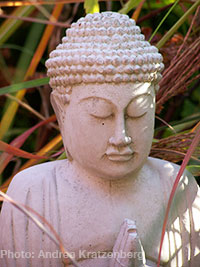
Buddha2There can be quite a difference in what we’ve written and what we really want … surprisingly so. A brief, but related digression – on my desktop at the moment is an image of Buddha, and the following quote by him: “All that we are is the result of all we have thought.” Comparing that list to what I really want is quite an eye opener, and tells me in what way my work is cut out for me and reveals afresh how my thoughts are creating my life, as Buddha said. I want to make more changes.

There is always so much to know, so much to learn, and while a book such as Living in the Light may guide us, the work is always our own. We take many journeys in our lives and perhaps the greatest journey is the one within, for it is there we find the answers we need to know, which when brought to light, transform not just ourselves, but the world around us.

Doodle 4 Google 2014 (and my idea)

Have a creative child at home or know one? They have the possibility of winning $30,000 in college scholarship funds and a $50,000 Google for Education technology grant for his or her school by entering the Doodle for Google contest.

It’s open to kids K-12, but the deadline for entries is March 20th!  So get those kids thinking and drawing. This year the theme is …. “If I Could Invent One Thing to Make the World a Better Place…”  OK, so grab a kid and go here and get started!

YesButton2Now when I first saw that theme, I got so excited I didn’t see, (or remember), that Doodle 4 Google is for kids and I just went off with my own ideas. Here’s mine – it’s a booth that anyone can go in – it’s free to everyone – inside the booth, there are buttons you can push and they have names like “No More Anger”, “No More Fears”, “No More Anxiety”, “Forgive Everyone” and so on. It would be a limited palette, but you get the idea. You close your eyes and are bathed in white light and in about 5 minutes, your anger, fears, etc. are washed away. 

No fee, no confession, no angst – just a desire to live a more loving life. Maybe there’d be an optional survey button before you leave – a Yes or No button answering “Are you feeling more loving now? Because you are loved.” 

I haven’t worked out all the details, obviously, but I guess it’s a new take on that old concept of free love. No judgment, no punishment, no expectations – just a way to get back on our path of being and feeling more love. See you on the line!

On the Dalai Lama, Non-Violence and more …

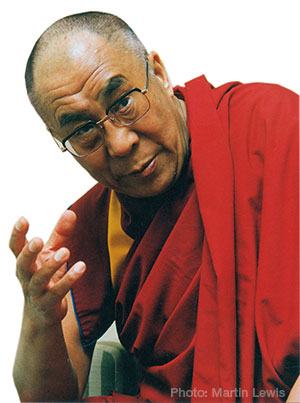
DalaiLama2I recently rented a somewhat different video from my usual fare, (whatever exactly that is), Ten Questions for the Dalai Lama. The film was made by Rick Ray, who also did the interview of His Holiness and examined a variety of issues surrounding the Dalai Lama and his native country, Tibet.

The film covered the Dalai Lama’s childhood and how he was selected to be the 14th to occupy this position which is a combination of chief spiritual and political leader. It showed the lives of  Buddhist monks and the beauty and peacefulness of the Tibetan people. It also recounted the horrific invasion and takeover of Tibet by the Chinese in 1949-1951, in which 1,200,000 Tibetans were killed, many thousands of others beaten and jailed. Even today, if a Tibetan so much as harbors an image of the Dalai Lama, he is severely beaten and imprisoned. Disguised, the Dalai Lama and his family were able to escape the country in 1959. He currently lives in political asylum in India.

Although I know China invaded and took over Tibet, I had not been aware of the details, so I am thankful to have chosen this film and learned more of this historical time. (If interested, you can learn about the event and what happened to Tibet afterwards here, which is an official website of the Dalai Lama.) But my primary interest was in the man himself.

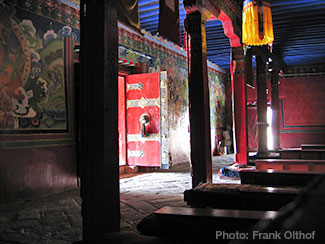
TibetanTemple2

Interior of a Buddhist temple in Tibet

As a result of watching the Dalai Lama in this film, I can say that he is a brilliant, insightful and compassionate man with a delightful kind of kookiness about him. It would be impossible not to like him as he shares his thoughts, opinions and feelings – and sometimes laughter – on a variety of subjects. His observations about the West are not surprising, how as a people we are driven by greed, never having enough. He commented on how often the less people have, the happier they are. When asked about the parallel he might make between himself and Mahatma Gandhi and their ideas about non-violence, the Dalai Lama noted that their aims were the same, that non-violence towards others is the only way to make true progress in the world, and that he and Gandhi were of the same mind in this way.

He pointed out, however, that there was a major difference between Gandhi’s experience and that of his people’s in Tibet and that was/is the endless use of violence used to punish Tibetans at the hands of the Chinese. Gandhi and those who stood with him were not beaten with guns or shot. The numerous film clips show the brutality and violence the Tibetans were/are subjected to at the hands of the Chinese military, (which today, outside of the capital of Lhasa, is largely undercover police), and how their most basic human rights are denied.

The Dalai Lama had reached out to the Chinese Communist leadership in the past, but they were not cooperative. And so this world-famous spiritual leader continues to strive for world peace and the freedom of his country. When at home, he spends a portion of his day in communication with media and the remainder in spiritual practice. But he is often making appearances around the world discussing how his life is guided by three major commitments – the promotion of basic human values, the fostering of inter-religious harmony, and the preservation of Tibet’s Buddhist culture of peace and non-violence.

Having had only occasional exposure to the Dalai Lama, I was deeply impressed, as naive as that may sound, by the beauty and genuineness of his spirit as shown through this film. I can only imagine what a joy it might be to actually sit and talk with him.

I was also reminded, as he spoke about practicing non-violence towards all living beings, that an important aspect of being vegan, as challenging as it is, is an abstention from the violence that is routinely perpetrated on all animals that provide us with meat, dairy, or other commodities, whether during their lives or in their death.

There is clearly a peace that the Dalai Lama exudes, and to the degree that it comes from non-violence, who cannot be for it?

Looking Forward …

As the New Year rapidly approaches and everyone rushes to make resolutions, I am planning on doing one thing … continuing what I have been doing all along.

Candles-Nadia-Szopinska2

And that is … trying my best to add to the positivity on this planet, to live in love and eliminate fear, a lifetime endeavor. And to always remember to be grateful for all I have been blessed with in this life.

So no New Year’s resolutions for me … just same old, same old.
If the world is to be a kinder, more loving and peaceful place, I know it begins with me. And, of course, with you.
Happy New Year.