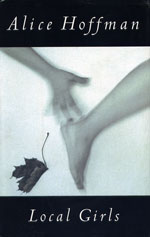
 One of the things I love about reading Alice Hoffman is that I never know quite what to expect with the exception of one thing – I will be deeply moved by her story. I find Hoffman’s writing brilliant in her ability to take us so penetratingly into her characters, characters who are not heroes, but neighbors we see every day yet whose lives we barely know. Local Girls takes us into the midst of a family who struggles with pain and loss, and whose characters cling to the idea of surviving it, or in some cases, succumb.
The local girls are Gretel Samuelson and her best friend Jill, who lives around the corner. They are teenagers no different than our own or those who live next door, struggling to find where they fit, and in their case, how to manage life in the face of parents who are stricken with cancer, are mentally ill, or who have abandoned them. We watch, with Gretel, her mother Francine’s sinking into depression after the father walks out and at the same time faces the return of her cancer. We watch Jill’s mother, a minor character, being given shock therapy for her own depression until she appears as vapor, using one of Hoffman’s desecriptions.
Gretel does her best to stand by her mother, but her own confusion, typical for her age then compounded by the pain in her family, causes her to fall in love with a boy who is terribly wrong for her. At the same time, Gretel’s brother Jason slips from an A+ student accepted to Harvard to a slow descent into drugs, unable to deal with the pain in any other way. Margot, Francine’s cousin, lives nearby and is an integral part of keeping the family on track in whatever way she can. Despite her own sadness at being left by her husband as well, she always believes in love. And then there’s Freida, Gretel’s grandmother, a strong figure, who strikes a deal with God to ler her daughter live and be taken herself.
Alice Hoffman is a writer who can pull this all off with humor, a striking depth of feeling, and an infusion of optimisn that is uniquely hers. Local Girls is the story of people you know, replete with pain, the fight to survive, and larger-than-life portions of the grit of everyday living …. plus the touch of magic that is ever-present in all our lives if we are just open to it. I could not put this book down – for me, the mark of a great read. If you have known someone devastated by loss and fear who has plodded forward in spite of it, believing/not believing in a better day ahead; if you have been close to someone battling addiction, and their drive to numb the intensity of their pain; if you have watched women rise from the ashes and try one more time, then I suspect you’d like Local Girls.
I do find this story as much or more about Gretel’s family than the friendship of Gretel and Jill, yet ultimately it is their story we follow as circumstances take them in directions neither girl would have quite expected, yet may have secretly longed for.
And last but not least, Hoffman’s use of language is no less than exquisite. It is what brings a tale of everyday people in a simple suburban town to such rich and rewarding heights making Local Girls quite the amazing read.
 What happens when one of the picture books you’ve been working on evolves into a chapter book due to too much back-story? Then it’s recommended to be a middle grade novel because it’s getting too scary for a chapter book reader? One of the first things is to start reading more in that genre, so for me, it’s Welcome to Middle Grade!
 Stalled? Change your venue!
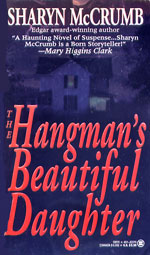 Example – A suspense/mystery novel I just finished by an author new to me, The Hangman’s Beautiful Daughter by Sharyn McCrumb, brought these questions up – and had me thinking about their relevance in children’s books. Particularly as we write stories of greater length, they are important points to consider, but they can be equally important in picture books.
 Chapter books are the next step as a child grows beyond picture books. Whereas picture books are largely illustration, chapter books are largely prose, but which still include illustration, generally in black and white. Written for the age 7-10 crowd, they feature short chapters so the book can easily be put down and picked up again by the young reader. Chapter books include a fairly good amount of dialogue, short sentences, and vocabulary that is targeted for the reader who is growing in his reading skills.
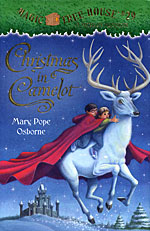
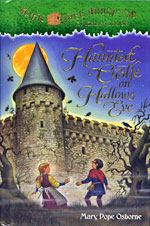 I’ve currently been reading a series within The Magic Tree House Series subtitled A Merlin Mission. These books are excellent examples for writers of what is being sought in a good chapter book, but Mary Pope Osborne has added in this selection a special richness by introducing a famous myth. In The Magic Tree House Series, our main characters are brother and sister Jack and Annie of Frog Creek, Pennsylvania. They find a tree house in the woods filled with books, and that by pointing to a picture in a book, they can go there. In time they find the tree house belongs to Morgan Le Fay of Camelot, home to King Arthur.
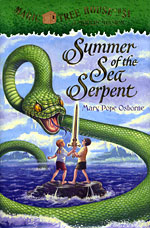 Arthur and the Round Table for children ages 7-10, filled with the symbolism of cloaks, cauldrons, magical beings and more. She has provided detailed references in the back of the book for the elements she’s introduced.
 Still A Dreamer