Having recently read The Absolutely True Diary of A Part-Time Indian, and checked out a few YouTube videos of Sherman Alexie, I am interested in reading more. But already in a different book, I decided to put two of his movies in my queue. About a half week ago, I watched Smoke Signals.
 I liked Smoke Signals; I was left thinking about a number of things afterwards — the characters, their situations, how the story was told. The two main characters, Victor Joseph and Thomas Builds-the-Fire, grew up together on the Spokane Reservation, bonded by Victor’s alcoholic father having saved Thomas when his doomed parents tossed him out the window of their home, engulfed in flames. Victor and his mother are abused by the alcoholic father, who although he loves them, will not give up drinking and leaves the rez. Sometime later, he passes away, and Victor wants to make the trip to Phoenix to pick up his father’s ashes. As Victor is unable to afford the trip, Thomas offers to pay if he can go along. Victor is troubled and angry, Thomas, nerdy, always optimistic and forever telling intricate stories. Their trip becomes one of discovering friendship, and for Victor, learning who his father really was, forgiveness and understanding.
Something I liked about Smoke Signals, (based on The Lone Ranger and Tonto Fistfight in Heaven, Alexie’s short stories), was how I could relate to the characters. The movie touches upon universal themes, yet watching it, I distinctly felt that I was watching and learning about another culture. Which I was. Much like watching the Maori in Whale Rider, I was aware of the similarities in what we all, as humans, go through, yet the differences in cultural beliefs and how the Indians go about solving some of their problems. Alexie makes clear what the issues really are on the rez. It gave me a lot to think about.
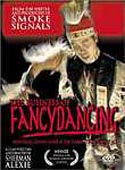 The Business of Fancydancing, based on Alexie’s poetry, was quite different. One of the successes of Smoke Signals for me was that I could really relate to Victor and Thomas. In Fancydancing, the main characters Aristotle Joseph and Seymour Polatkin are defined, yet for me, Alexie failed to create them as fully rounded characters deserving of my empathy. I believe one of the problems is the film has far too many special “techniques” or whatever one would like to call it. I get the metaphor of Seymour fancydancing, and other characters dancing in simpler blankets or more traditional Indian dress intermittently throughout the movie, but overall, there were just too many different moviemaking techniques jostling my sensibilities around. From the periodic one-on-one interviews with Seymour, to the washed-out-lighting home camera effects from the past, to Mouse playing violin in the background, or Aristotle singing in Seymour’s ear – the constant jumble of treatments really took away from the continuity of the story. And I wanted to like this movie.
Alexie’s point is well-made about how hard it is to leave the rez, and how resented Seymour is for having left and made a success of himself. It is said the stories he tells in his poems are actually Aristotle’s experiences, and that he lies. In fact, Seymour admits to lying in the interview sections, and is seen doing so later in the movie. Called back to the rez from Seattle for Mouse’s funeral, Seymour confronts his past, and those still living there. The Business of Fancydancing is interesting, but not cohesive. The violent roadside scene with the young man needing assistance seemed dropped in to make a point about Indians’ anger at the white man, but out of place.
For me, the best development of the characters was sacrificed to the use of too many distractions. It was hard to feel truly empathic towards them as I did in Smoke Signals. Aristotle had problems, sure, but I wasn’t helped to like him. Was that Alexie’s intent? Seymour had many conflicts, but I think I could have liked him a lot more, too. If I had to rate both movies I’d probably go for 4-5 stars for Smoke Signals and maybe 2 for The Business of Fancydancing. Because Alexie has access to the mainstream media and the opportunity to bring the message of the American Indian to moviegoers, it was disappointing that the message got lost in the shuffle.
I do intend at some point to read both of Sherman Alexie’s books that these movies were based on. He’s still got my attention.
 Having a children’s book Mentoring Workshop on the horizon is both exciting and a bit stressful. There’s lots to do and prepare for — in this case a NJ SCBWI Mentoring Workshop — prepping my portfolio to the best I have it so far, getting ready my first pages, critiquing my group’s MS’s, and seeing if I can complete one more illustration for my portfolio before the big day. Of course, the daily demands of my clients do not lessen any.
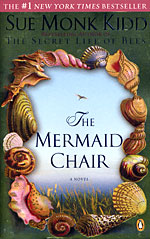 What a terrific read! In The Mermaid Chair, Sue Monk Kidd has given us a tale of a woman searching for her lost soul. Jessie Sullivan, the main character, tells us her story in first person … that of a woman deeply restless in her marriage, lost and unhappy. She is called back to the place where she grew up, Egret Island, by friends of the family on the occasion of her mother having taken a meat cleaver and chopped off one of her fingers.
  Here’s a fine case of not judging a book by its cover, or better said, an author by her previous book. The Secret Life of Bees by Sue Monk Kidd was going to be a hard act to follow. There isn’t a soul I know who didn’t think Bees wasn’t one of the best books they’d read in a long, long time. When The Mermaid Chair arrived on the scene, there seemed to be a consensus that, before even reading it, Kidd’s new book would not be able to compare to The Secret Life of Bees.
 Here’s where I’ve hitched my star – writing and illustrating children’s books – picture books, chapter books. Yet belonging to a writer’s group and SCBWI, in the company of readers and writers of other children’s genres, I find myself being drawn to those I don’t write… MG and YA fiction. And what a draw it is. My local librarian and I were discussing some of our mutual interests, and she recommended the YA novel The Absolutely True Diary of a Part-Time Indian by Sherman Alexie. I was just blown away by this book and can’t wait to read more by its author.
  Still A Dreamer