The Queen of the Night

How many times have you finished a book, and it was so good that you wanted to go back to the beginning and read it again? I’ve felt that way; I think we all have. But how many times have you actually done it? I’m guessing you haven’t, and until now, neither have I. Until I read The Queen of the Night by Alexander Chee.

This is an amazing historical novel, written in first person by a young woman, who, at the opening of the book, is making her entrance at the Sénat Bal in Paris, autumn of 1882. She is “La Genérale”,  Lilliet Berne, famed opera singer and a falcon soprano. She is approached by a novelist who dares to get her attention, and asks her to listen to his proposition – a story he has in his possession, to which a score will be written by a promising composer, an original role created just for her. Such a thing is the apex of an opera’s singer career. And then Lilliet hears how much of the story is her own past life, which, if it came to light, would destroy her career. So few know her past; who would want to see her fall? And so begins our story.

We return to Lilliet’s beginnings in the then free-state of Minnesota in 1866, sixteen years old, when she loses her entire family to scarlet fever. Alone and practically penniless, she decides to cross the country, and then the ocean, to find her mother’s only sister in Switzerland. The ensuing story unfolds in endless twists and turns of Lilliet’s trying to survive, becoming a circus equestrienne, a courtesan, later purchased by the tenor, the keeper of the empresses’s furs, and an opera singer. This all takes place largely in Paris during and after the reign of Emperor Louis Napoleon III and Empress Eugénie.

The Queen of the Night is a very complex novel. There is subterfuge, characters using each other and being used, and many unexpected betrayals. Set against the backdrop of an opulent Paris as well as the utter desolation after the Prussian attack, there is also opera, loyalty, friendship, devotion, and most importantly, love. One might say that this is a love story, but truly, it is so much more. When I decided to reread this book, I was initially aware it was because there was so much going on, that I knew I had missed certain things, and I needed to feel that I really understood everything.

But as I approach the final chapters this second time, I know that a major attraction for me is Lilliet Berne herself. I found Lilliet to be an amazing heroine, who fights to stay alive, to try to be whatever it is she is born to be, despite not knowing at all what that might be for so long. She starts our story as an orphaned girl of sixteen, and ends … well, I can’t really tell you that. I can say that this is a demanding book, not one to be read when you’re tired or distracted, because I guarantee, you will miss something critical. But it is also one you cannot put down. Alexander Chee is highly successful in writing a story with fine attention to rich historical detail, and also for creating characters who will live in your imagination between each reading and after.

A Small Bright Spot in the Garden

As the summer has ambled on, turning gently into the 40’s and 50’s at night, certain of the flowers and shrubs begin to lose their color, their energy to stand tall, their vibrancy. Such is the case each year with the beautiful snowball hydrangeas (as I call them.) They produce huge balls of snow white flowers in the spring which turn to the softest lime green as summer glides through. In late August, the canes bend low to the ground, and the once white snowballs now begin to turn to rust and copper. This is what I observed in the garden that surrounds my back porch.

And then, about a week ago, a herald appeared – a new, small white snowball. The temperatures had not gotten warmer; in fact, cooler nights had arrived when it bloomed. I am enchanted. And somehow heartened, as if a messenger of hope had appeared in the midst of so much worldly turmoil. The leaves of this large plant are drooping, crumbling at the edges, yet bright and tall stands a youngster in their midst. So I thought to photograph this resistor of cold nights, this affirmer of life among his fellow snowballs, who slowly yield to the coming of fall.

The snowball hydrangeas look equally magnificent as they dress for fall, slipping gradually into their new and deep copper attire.

I am a believer in signs and synchronicity (which people often refer to as “coincidence” or “accidents”). I can’t be sure what message this lovely upstart is meant to bring, if any, but it brought me a renewed wonder in nature and her whims; a small feeling that anything is possible; and a smile every time I look at it. And that’s quite enough.

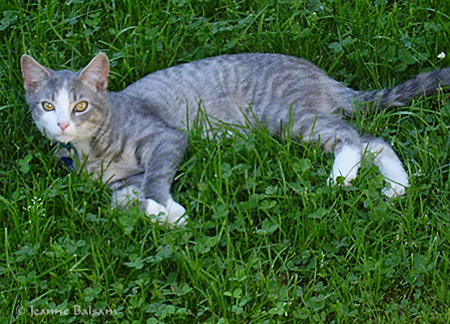
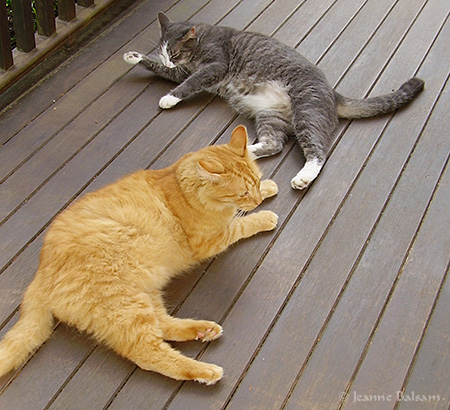
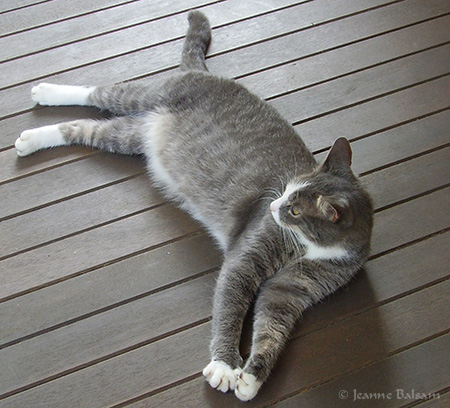
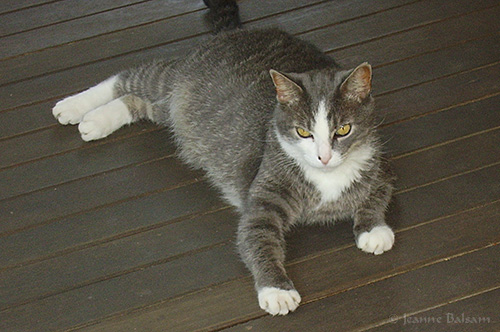
I did not go on my brief photographic venture alone. I was joined by Pumpkin, who lives next door, and who thought to also enjoy the simple wonders of a sunny morning.


Namaste on TV

This is a re-blog of a previous post of mine from 2013. In light of so many things – the mass shooting in Las Vegas, the callousness and bias of our leader(s), the weather patterns that can only get worse as we ignore the needs of our beautiful Earth – I am reminded of the ever growing need to offset – to combat – hate, and to see the divine in one another. All of us. More than ever, we need to be kind and to forgive. This TV show was always a favorite of mine, and is the epitome of finding and acknowledging the light in one another, no matter how dim it may seem to shine.

In following an unexpected trail of webby bread crumbs recently, I came to a YouTube video of Joan of Arcadia.

256px-JoaI always loved this show and also the show’s theme song by Joan Osbourne, One of Us. I loved the premise of Joan Girardi, (Amber Tamblyn), finding God each week in everyday people – a fellow student, a mime, a homeless man, a club DJ, a girl on the color guard at school, a soccer mom, the lunch lady, the dog walker,  and the list goes on.  The message is ultimately about the Divine in each of us, and the essence of the greeting Namaste. The song’s refrain is this:

What if God was one of us,
just a slob like one of us,
just a stranger on the bus
trying to make his way home.

Namaste is a greeting used by many Hindu, Taoist and Buddhists which literally means “I bow to you.” It is said with the hands together in prayer position over the heart chakra and with a bow of the head. It is the divine spark in one person acknowledging the divine spark in another. To me it is one and the same as to what Joan of Arcadia was all about … acknowledging the divine in each other – finding the divine in each other – sometimes in the most unexpected places. As said in Wikipedia, (where you can also read more about the show’s premise), “No specific mention of any “true” religion is ever made, and God quotes Bob Dylan, Emily Dickinson and the Beatles, rather than any scripture or verse”  and is always very human in his/her appearances. I suppose it may be easy to look at this TV show in the light of one religion, but  in the end … the message is the same, and enlightening from any angle.

Listen to the song –

Take a look –


Promoting Reading for Women

That’s not what we usually see, is it? More often we find articles about engendering the love of reading in kids.

So I was pretty impressed to find in the September 2017 issue of Family Circle an article about the importance of reading for pleasure. I assume that many of you reading this blog, as writers, are already immersed in a regular reading habit, but this short article with “how-to” tips addresses how we, as women, are pulled in so many directions that we often let reading slide. And it’s true; an inordinate involvement with our phones, TV, internet – not to mention the real-life issues of our families and work – can leave us feeling we have no time to read.

But a Yale linguistics professor, Kenneth Pugh, mentions the importance of reading for pleasure as highly important for our emotional health as well as strengthening our creativity. Tips on how to get back into reading include never leaving home without a book; literally penciling in time in our daily schedule for reading; swapping a chunk of our TV addiction for reading time; keeping a book on our nightstand, etc.

For anyone not sure of how to get back into reading, the article suggested as number one – your local librarian. Librarians are a fantastic source of knowledge of the books on their shelves and with a few questions, can have you in a book you love in no time. A good local bookseller can do the same. In addition, they recommended the New York Times Best Seller list, Goodreads.com, or 2017 Popsugar Reading Challenge. What I loved most about seeing this article is that Family Circle is a magazine with a huge circulation of about 17, 560 readers that reaches a very mainstream audience.

Reading – and reading for pleasure – is important. I find myself concerned about all these moms glued to their phones. What kind of inspiration is that for their children? I’m hoping that a family-oriented magazine like this one will inspire more than a few women to reconsider their habits and pick up a book – for themselves, and also to read to their kids.


Spirit Bear Drawing

It was my plan to post a drawing I did of two whales. I went through my recent sketchbooks, and they seemed to have swam away. But what kept appealing to me was this pen and ink sketch I did of a spirit bear.

Spirit bears are snow white bears, not albinos, that live only in a specific area of Canada, the Great Bear Rainforest, one of the largest unspoiled temperate rainforests on earth. This is a partly protected area in the islands and coastal areas of British Columbia. They are actually a rare subspecies of the American black bear known as a Kermode bear, most of whom have dark coats. The double recessive gene for the white coat must be carried by both parents in order to produce the white spirit, or ghost, bear. They are looked on as sacred by the indigenous tribes of the area, and have become symbolic of these people’s fight against proposed desecration of the rainforest by those wishing to build a pipeline there. It is unclear how many spirit bears there actually are, but estimates run from 150 to 200.

Learn more about the Spirit Bear.