You’ve all heard that line from a song, “A house is not a home …”, and while that’s true in some ways, I beg to differ. A house is surely a home when you love where you live.
As I’m crawling out from a week with way too much work, I’m contemplating cleaning off my wonderful deep porches, and getting together what it takes to sit out there, pot some plants, etc.. This reminds me of how lucky I’ve been that the houses I’ve lived in in this side of the state have all had fabulous porches, sometimes more than one. Then I drifted further in my continued wonder/curiosity that every place I’ve lived since I left home and left my college high-rise dorm has been in a specific time period, 1810 – 1920. So for those of you that love homes, I thought I might share some of my photographic, and other house-related, memories.

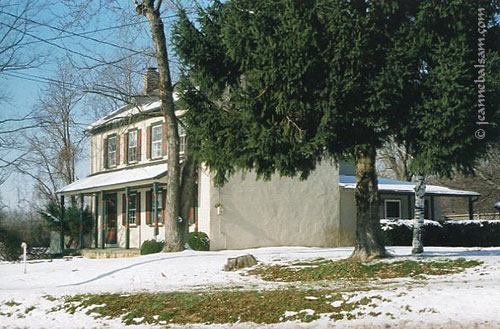
The house you see here is the oldest I lived in. The front of the house, top photo, is 1810 and that was added on to the smaller part of the house built in 1742. The 1742 portion is now the dining room, and has another room above it, connected by a narrow circular staircase. It was once the home of the farm workers who worked for the gentleman farmer who lived across the road. In the photo just above, what looks like a large addition in the back is the original house. The small section in front with hedges was my entrance and housed a full kitchen, a full bath and a huge walk-in closet, (just to give you a sense of scale.) This was added on about 30 years ago by a woman who restored the house down to the last authentic detail of each period and added those modernizations.

The dining room has original, unpainted wide-plank floors, a beamed ceiling and a walk-in stone fireplace with a bread oven and original wrought iron hooks to hold pots of cooking food and meat. When I was looking for my next place to live, I walked into this room, and knew this was it. It was so warm and cozy; I loved sitting in this room. The 1810 part of the house was built by the gentleman farmer and included two stories, a full attic and basement. He brought his family to live here after his home across the road had a fire. The 1810 portion included two large rooms in the front and the same above with another full bath. The main bedroom was approximately 18′ x 18′, and did I mention, every room had a fireplace, (all non-working, which was a good thing for me, as I know nothing about building fires, properly or otherwise.)
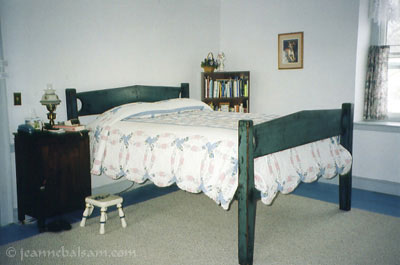
I painted much of the house when I moved in, keeping more or less to what was there before, but a bit nicer. The bedroom had in it, left by the previous owner, this gorgeous replica antique rope bed which she had custom built. The cats loved playing underneath it, and it was quite an experience at first, sleeping that high up. This house, excepting the dining room, had wonderful 9′ ceilings throughout.
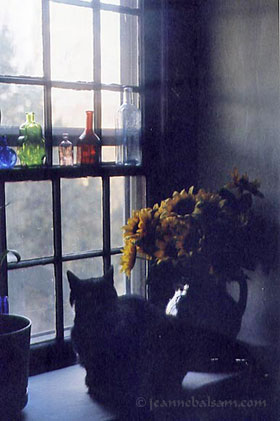
Because it was a stone farmhouse, the walls were about 18″ thick and provided outstanding built-in space for cats to enjoy at every window. Above, dining room window with Claude.
If there were any drawbacks to this house, I’d say the heating system, which was forced air and left the house feeling cold again as soon as the heat went off, but on the flip-side, it felt like air-conditioning in the summer with nothing more than a dehumidifier in the DR and an occasional fan. And then there were more than enough small creatures – centipedes the size of alligators and plenty of field mice. The centipedes were too big too kill, for me anyway, so they got used to being herded, and the mice? I had a humane mousetrap and plenty of farmland all around me where they could start a new life.
These were a small price to pay to live here – two porches, deck on the back, a wide circular staircase in front and bright, airy rooms upstairs, cozy ones down. It was a great house, and indeed it was a home.
Stay tuned … we’ll soon be going forward to 1870.
“There is no place like home.” – L. Frank Baum, The Wonderful Wizard of Oz
 Still A Dreamer