I Wanted to Feel What They Felt

Once you become engaged more seriously in writing, you become much more observant of what you’re reading. It’s not that I am judging or critiquing as I read; I just seem to be much more aware of what is and is not grabbing me.

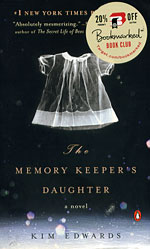
I just finished Kim Edwards’ The Memory Keeper’s Daughter, recommended by a friend. I actually found it hard to finish; it was simply not engaging me sufficiently. And I know why.

It wasn’t the premise. The premise was excellent and intriguing – David is a doctor who delivers his wife Norah’s baby in a snowstorm at his own clinic, unable to get to the hospital, further away. A healthy baby boy, Paul, and an unexpected baby girl, Phoebe, who clearly has Down’s Syndrome, are born. It is 1962 – a time in which it was sadly common to “get rid of” such babies and put them in institutions. The husband, with weighty memories of a sickly sister who died at 12, asks his nurse, Caroline, to take the girl away to such an institution, telling his wife that the infant died at birth. Caroline brings the baby girl to the institution and cannot bear to leave her there; instead, she brings Phoebe home and secretly raises her on her own. And so begin lifetimes of secrecy and deception.

The potential is here for so many feelings – Norah’s juxtaposition of  joy at her son Paul’s birth, and sorrow in her unknown daughter Phoebe’s supposed death; David’s own loss and guilt; Caroline’s joy in becoming a mother, tangled with guilt; the later developing conflictual feelings between Norah, David and Paul as he grows; and the challenges in Caroline and Phoebe’s lives. So why didn’t I feel them?

In my humble estimation, it seemed the author wrote from a distance. There was plenty of description of what these characters went through, but it wasn’t enough. I wanted to feel what they felt, and I didn’t. I wanted to spend haunted nights with Norah … I know what she did about her feelings, but I didn’t feel her heart. I wanted to feel Caroline’s conflict in a gut-wrenching way. I did not. And so it wasn’t until near the end of the book that I finally felt suspense and became more involved in possible outcomes, and that’s just too late. Overall, I was disappointed.

Granted, this is one woman’s opinion. True that I just came off reading a very powerful author, Barbara Kingsolver. But as I picked up E. Annie Proulx’ collection of short fiction, Heart Strings, I suddenly reconnected to the power of words and their ability to fully engage me, and I can’t wait to get back to this book.

Such things are always reminders of what a challenge it is to really write well, to really engage and touch a reader. Writing novels sure isn’t for sissies.

Reading Feeds Writing (still)

One of the things I love talking about with friends is what books we are reading and what we are writing. The two topics are often in the same conversation.

One friend is working very hard on her middle grade novel. I am generally working on picture books; however, a middle grade novel is slowly writing itself in my head. I’m asked if I’m not writing this down. I am not. But little by little I am getting to know my characters and I have a fair idea of where they’ve come from, what is shaping their dilemmas and where they are going. When the time is right, and when I know them better, I will begin the writing process.

Meanwhile, I read.  In talking with my friend, we discussed the 3 books I have just finished. She had not read two, but was interested in doing so for the reasons I’ll describe. She was reading, but lost interest in and abandoned, the third.

The first is The Sisterhood of the Traveling Pants by Ann Brashares. I had seen the movie – it was light, probably a “chick flick” – but I liked it.
Advantage to Writer? Observing and understanding realistic  dialogue and relationships between teenage girls.

The second is The Divide by Nicholas Evans, probably best known as the author of The Horse Whisperer. I also read The Loop by him. What a way Evans has of engaging you in a story, building up suspense, then taking a sharp turn away to another character, leaving you wanting more. I only hope, whenever I write my novel, that I can hold a reader’s interest like he does.
Advantage to Writer? Learning how to pace a novel for maximum effect.

The third, (and unfinished by my friend), is The Lovely Bones by Alice Siebold. This was a daring first novel, told from the first person POV of a 12 year old girl who is raped and murdered, and is now in heaven. This could have been really strange, quirky or sappy. It was none of these, and it had my attention through to the end.
Advantage to Writer? Learning to trust in your own unique story ideas, that writing from the deepest and most real place within is where the best stories will always come from.

I trust that all I’m learning is soaking into my unconscious and always making me a better writer. And so the enjoyment of wonderful books continues. What is your reading bringing to you?

Forgetting What We Read Late at Night ….

When I woke up the other morning and looked at the book on my night stand, I remembered I had read it the night before. But I was having a hard time remembering exactly what I had read. I had that sinking feeling that I was going to be re-reading a bunch of pages again. Sound familiar?

Sometimes in our busy lives, that most precious of times – reading time – gets put off to the very end of the day when we have the least energy. We’re so tired that even a good book can put us to sleep. What’s worse than realizing that we have  no clue as to what we read the night before?

This happens not just to me but to other women I know, as well. It’s rather discouraging. And the book I’m in now – which is fabulous – will not be the first book I start again from the beginning because I know I’ve missed too much from late night reading.

Yesterday, I thought of a solution. What if women friends, (OK – it could be guy friends, too), opened their homes – when they were out and busy with errands for a while – to other friends who needed a couple hours just to read? Outrageous, right? For example, I’m going to be gone for half a day. I give my friend my key, leave fixings for coffee or tea on the counter, maybe a snack, and she comes in with her book and actually reads! Chances are excellent that this is what will happen, because who feels obliged to clean anyone else’s house, answer their phone, or run their laundry? No one! It’s clear, guilt-free sailing!

Yes, we’re talking stolen hours … maybe once a week, or even at odd intervals … for the sheer joy of reading uninterrupted. Who wouldn’t do that for a friend?

When the Title Doesn’t Fit the Story – Taming the Star Runner

When I’m offered coffee, I don’t want tea. When I’m offered a ride, I don’t expect to walk. When I choose a book entitled Taming the Star Runner, with a number of horses on the cover, and a jacket liner which pumps up the story of a horse named Star Runner, I don’t expect a story about a teenage boy named Travis. But that’s what I got.

Taming the Star Runner  by S. E. Hinton is a coming-of-age story about a 15 year old named Travis, who, while he sees himself as very cool, is always on the edge of getting in more trouble than he can handle. After attempting to kill his abusive stepfather and doing some time, he is sent to live with his uncle on a ranch in Oklahoma. Here he meets, among others, a teen barely older than himself, Casey, rider and riding instructor, and then we finally meet who seemed to allegedly be a main character, her horse named Star Runner. Had I not been excited to read a story about this wild horse, who only first appears halfway through the book, I may have liked the story more. Or maybe not picked it up at all.

S.E. Hinton, deliberately using only her initials as an author, (lest it be realized she was a very young woman author), broke ground in the 60’s, writing about gangs. Her first published book was The Outsiders, written when she was 16. This story is similar in the sense that Travis is another angry, angst-filled teen, feeling unappreciated, isolated and ever on the edge of an emotional explosion. The story is fairly good, actually. Travis’ character is well-drawn, as are other characters, and the plot has some interesting twists and turns, even if, in my mind, they are not all tied up that well in the end. Still, this particular tale became more interesting for me when the powerful spirit of Star Runner was introduced and the girl who wanted to tame him.

Having read a number of Newbery-winning and other middle grade novels, and having learned what editors are looking for and what is being published nowadays, I can’t help but wonder if Hinton would have been published today. Or at least if she remained in her own writing style. Being mindful of what we are told at workshops, conferences, online, etc. I am sometimes amazed at how she worded things, switching tenses, using unmarked self-reflective dialogue in the same paragraph as lengthy descriptions, etc. It made me realize how much more refined the craft of writing – in this case, for teens – has become.

I don’t mean to sit and criticize S.E. Hinton for what she did – she brought a whole new way of life and type of character to light in her novels. They were groundbreaking, have become classics, and continue to resonate well with many readers today. I only wish the book had really been about what the title told me.


Me? Write A Novel?

A novel? Really? A couple years ago, Sheri, from our children’s writer’s group, said, “You have a novel in you.” I didn’t find that to be something impossible, yet didn’t see it as highly likely at the time, either.

Aside from one story of mine which hasn’t yet found its proper genre – picture book, chapter book or middle grade – I have been focusing on picture books. I read novels all the time, but had not really thought about writing one of my own. The meager story beginning I had written for a First Page Session was a starting point, and even then, I wasn’t all that focused on it. Until I got a critique from two editors on my storyline, and things that did and didn’t work for an MG reader.

Since that time, I’ve had a unique experience. The story is writing itself.

I’ve read online, and seen among my fellow writers, how some novelists just write it all down straightaway, while others make an outline, map it out, etc. This is not what’s happening. The story is telling itself to me … at odd times, when I’m relaxing, working, whenever it pleases. I mentioned this to my friend, Linda, who told me I’m channeling my story. Well, that’s kind of exciting, and makes sense. Although I envisioned a most basic structure for how the pattern of the chapters would go, beyond that, it just keeps coming.

I’m not writing anything down; there’s no way I’ll forget it. I’m allowing it to just come through. I cry, I laugh, I see who’s becoming a character. This is very new to me. Some ideas require some of my attention – for ex., should that character enter my heroine’s life in the same chapter as another? Why IS my character like that? And I let it go. The answers come back in a fairly short time.

I don’t need too many facts at this time – I can fill in the realities of horses, riding, racing, later. But I realize I can also feed my storywriter within, so am reading Taming the Star Runner by S.E. Hinton, and perhaps returning to other horse related books I have here or reading some new ones or checking out some videos. I am fortunate to have friends involved with horses who can help me with facts, as well as one of the sources for this story’s inspiration … the horses of Mylestone Equine Rescue, for whom I volunteer and help in other ways.

Perhaps the best part of all – is I’m not in a rush. It comes as it comes, and I’m quite grateful for that.

At top left is a photograph I took of Calvin, one of Mylestone‘s rescued horses.