Alice Hoffman’s Indigo

indigo-alicehoffmanAlthough I’ve said this before, I like Alice Hoffman. I like what she writes about – essentially, magic – and how she writes about it.

Indigo, like Green Angel, is ultimately a story about healing. Written for middle grade readers, Indigo is also a story about friendship, devotion, and love of all kinds. As with Green Angel, my only complaint is that the story is over too soon. More like a novella or short story than a novel,  (how it’s promoted), it’s 84 pages in paperback.

Back to the magic – one of the main characters, Martha Glimmer, is more an ordinary girl, but who was touched by a certain magic in her mother. Her mother has recently passed away, leaving Martha feeling unsure, adrift and missing the spark in her life that was her mom. The two other main characters, Trevor and Eli McGill, nicknamed Trout and Eel for fine webbing between their fingers and toes, long to see the ocean. All three, stuck in a dry, dusty town which has all but banished water due to destructive floods in the past, yearn for something beyond what they know.

Fiercely devoted friends in search of dreams, they set out on a journey. Magic is revealed in more ways than one as Martha, Trout and Eel discover their truths, reclaim their pasts and find richer futures. It’s a lot to accomplish in 84 pages, and I love how Alice Hoffman does it. For a fast but rewarding read, Indigo is a great way to go.

p.s. I feel like I’m cheating on Andrew Weil, the book I’m currently reading, but I hit the Hunterdon County Library’s big annual book sale this past Sunday, made out like a bandit, and couldn’t resist this fast read.

Writing A Synopsis

backporchIf you think I am going to be personally giving you tips here on writing  a synopsis, well, hate to disappoint. But I am going to provide a couple links to a site with a particular article that I found quite enlightening.
To date, the stories I have submitted to editors and agents at the NJ SCBWI conferences and workshops have been picture books, as I wish to, (ideally anyway), both write and illustrate. However, one of my PB stories was looked at by an editor awhile back and her comment was that there was too much backstory for a PB, and she felt I would do much better with it as a chapter book. This, of course, sent me into researching what chapter books were all about, reading a bunch, and re-working this particular story. Chapter books also have lots of illustration opportunity, so this is still a good thing.

I am submitting this for the June Conference at NJ SCBWI. If you’re anywhere in the area and able to attend, do go and learn more about this wonderful opportunity to meet editors and agents, and learn a bundle about this field. I am very pleased to be meeting with an editor that had critiqued this story at a first-page session last year, and had some good things to say. Now I shall find out if I’ve gotten 15 pages of it right. 

What needs to accompany these 15 pages is a synopsis, something I’ve not had to be concerned about with a picture book. So after asking fellow writers, reading up on the subject and searching the web for the best way to write a synopsis, I came across a two part article on the blog of Rachelle Gardner, a literary agent for Wordserve Literary. The article is written by one of her clients, Gordon Carroll, who does something no one else has done — he shows us how to write a synopsis on a story we all know, Bambi. Excellent idea.

Carroll’s using a well-known tale in developing the stages of the synopsis has made it so much easier to approach this new challenge. I’m actually now looking forward to it!  Here are Writing A Synopsis, Part 1 and Writing A Synopsis, Part 2.  Hope it may be of help to you.

As for that photo? Where I hope I’ll be doing some of my writing tomorrow … on my back porch!

The Book Thief

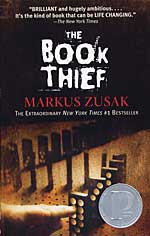
thebookthiefHere are two things that are connected – I couldn’t fall asleep last night. I finished reading The Book Thief.  A book that keeps me up at night after I’m done reading, can often be said to be a good book. Or maybe a disturbing book. Or maybe a haunting book. I think it’s safe to say that The Book Thief is easily all three.
I bought this book in a local bookshop in Clinton in December while shopping for Christmas gifts. I’d wandered over to the YA section and was looking for something interesting. I’d already found a few things for others, a couple for me, and was talking with one of their very knowledgeable staff. He recommended The Book Thief to me, saying it was one of the most incredible books he’d read in a long time, and gave me some background. I bought it.

And there it sat. And sat. And sat. I wasn’t sure if I was ready to read a book set in Germany at the time of the rise of Hitler, no matter how well recommended. I started the book in March, just finished last night.

This is a difficult book to read. Zusak is a phenomenal writer; he has a brilliant way with words that you practically have to read to believe. His idea to have Death be the narrator, sometimes writing in first person and sometimes in third was an extraordinary, if not startling, concept. But it was slow reading. I wondered if it was because I was usually reading it at night; were the realities of the economy weighing on my mind, and so on. But in the end, I believe it is simply the subject matter. This was a horrific and shameful chapter in the history of humankind, and you cannot read The Book Thief without your heart being broken a hundred times. Or at least I couldn’t.

The story really does pick up in the last third of the book where the characters’ lives are all moving into more intense situations seeking some hopeful, but never hoped for, resolution. Each character, including Death, is extremely well drawn. Liesel, Rudy, Rosa, Hans, Max, Ilsa Hermann … are, if nothing else, real people in real relationships. But it seemed for me that it took a long time reading before they had become characters that I truly cared about, and I’m not sure why. It may be that the weight of Hitler’s Germany, woven well into the story line, drew me away from feeling more. Or perhaps I was afraid to feel more for them, knowing that Death was always nearby, ready to reach in and carry their souls away. And as he says, it was a very busy time for him.

So while a story dealing with pain and persecution, it is, however, still a story about love, friendship, loyalty, forgiveness, triumph over adversity, hope, and compassion. Markus Zusak is an amazing writer, and he has woven his story and characters together well, even if there is tremendous loss throughout the book. I do recommend The Book Thief … but to whoever reads it, be prepared for being drawn in to the tragic misfortunes of others in a frightening period of history, even while it is oftentimes no more than a backdrop to everyday lives and commonplace circumstances.

What I’m wondering as I write … not even 12 hours from finishing this book … is do I want to pick it up and read it again. And I’m not sure what to make of that.

The Mermaid Chair – Part 2

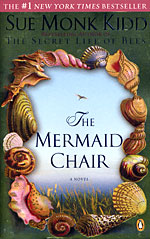
mermaidchairWhat a terrific read! In The Mermaid Chair, Sue Monk Kidd has given us a tale of a woman searching for her lost soul. Jessie Sullivan, the main character, tells us her story in first person … that of a woman deeply restless in her marriage, lost and unhappy. She is called back to the place where she grew up, Egret Island, by friends of the family on the occasion of her mother having taken a meat cleaver and chopped off one of her fingers. 
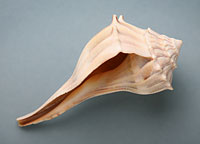
Once at the island, the plot really unfolds with this bizarre mystery, Jessie’s unforeseen attraction to a monk, her struggle with her relationship with her husband of many years, the riches of female friendship, and the mermaid chair itself. Not the least of it all, is the magnificent description of place.

For the duration of this book, I was immersed in the physical life of Egret Island, an imaginary place off Charleston, South Carolina. Monk has nothing short of an exquisite use of words in describing the island, the marshes, birds, and sultry air. I am truly in awe of her ability to bring me to a place that lives and breathes so, that surrounds me while I read. For this, I was sorry when the book ended … I loved being there.

With a richness of characters in the women – Nelle, (Jessie’s mother), friends Hepzibah and Kat, and Kat’s daughter, Benne- The Mermaid Chair weaves the mystery — what caused her mother to brutally attack her own body this way? And then, how is Jessie Sullivan attracted to a monk? Brother Thomas/Whit is also wonderfully drawn, as is Jessie’s husband Hugh. While Jessie struggles, searching for answers in her own life as well as for her mother, she paints. And paints, in ways she’s never seen herself do before.

The Mermaid Chair is described as a coming-of-middle-age novel, which could sound kind of ho-hum unless in the hands of a very skilled writer. Have no fear – Sue Monk Kidd is that writer. It really is a book I couldn’t put down and was reading past the hour when I should have been asleep. It simply has everything … a deep mystery, love and passion, the bond of female friendship and a search for one’s soul.

When all is said and done, other than Monk’s exceptional writing, the most compelling comparison I could make between The Mermaid Chair and The Secret Life of Bees,  is that I truly never knew how it was going to end. And that’s a good thing.

The Mermaid Chair – Part 1

seashell2Here’s a fine case of not judging a book by its cover, or better said, an author by her previous book. The Secret Life of Bees by Sue Monk Kidd was going to be a hard act to follow. There isn’t a soul I know who didn’t think Bees wasn’t one of the best books they’d read in a long, long time.  When The Mermaid Chair arrived on the scene, there seemed to be a consensus that, before even reading it, Kidd’s new book would not be able to compare to The Secret Life of Bees.

I am almost through The Mermaid Chair, and I think it’s amazing. It’s not long into the book before you forget who wrote it, what she wrote previously or anything like that. And that’s my advice for anyone wanting to read The Mermaid’s Chair — go in letting go of any preconceptions and ideas of comparing. The book, to me, is so totally different from Bees, it deserves to be read solely for its own merits, (as does any book, really), and enjoyed for the rich story it is.

I’ve become immersed in place alone in The Mermaid Chair.  More when I’m done ….