Teaching Tolerance through Food

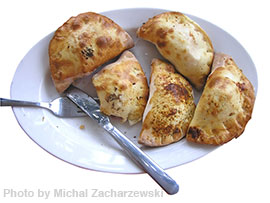
Pierogies-MichalZacharzewski2At first that may sound like a wacky idea, but who could argue with teaching tolerance to kids and who doesn’t like food? The idea is not mine*, and actually I’m focusing on just a part of the author’s three recommendations to remove judgment, be aware of your own behavior, and diversify your life as a way of inspiring your kids. The third idea is about broadening a child’s frame of reference so that those kids who might seem “different” can seem “normal.” (their words.)

The recommendation was eating out at international restaurants or creating a regular family event that features different ethnic foods while learning about that culture. This is really genius to me. Unless you have a super-picky eater, you can generally find a dish in almost any culture that is tasty and palatable, even to children. Think about starting with your own heritage. For example, I have six different nationalities between my grandparents and great grandparents. That’s where I’d start, right with one’s own family.

DimSum-xiantianmi2Let’s pick one … how about Irish? It might not be easy to find an Irish restaurant nearby, (although there is at least one in Manhattan), but we can cook up some Irish goodies at home. There’s lots of ways to cook up potatoes and cabbage, and if you eat meat, there’s corned beef for starters. Or …. Irish soda bread anyone? And perhaps some stout for the adults. These are the obvious choices, but exploration reveals greater variety in any country’s cuisine. Meanwhile, you could learn about Ireland’s history and of the Irish when they came to America, what they ate in the past and what they eat now.

Today we are seeing more different cultures than we did even a decade ago, between immigration, (the very same way so many of our own forefathers got here), but also in increased adoptions from overseas. Our children now go to school with Russian, Vietnamese, African, Chinese, Korean, and Colombian children, among others, all adopted. Understanding what these children eat in their native culture and serving something from it at our house while learning about that culture is to help them be understood and accepted.

Chimichanga-JavierArmendariz2Depending where you live, you can also visit restaurants of different cultures. Skipping the chain food restaurants, it’s still possible to find authentic Chinese, Mexican and Italian foods in many places. It’s now becoming easier to find Thai, Indian, Vietnamese, and Korean for not too long a ride. Without leaving my state, you can also find authentic Hungarian, German, Ukrainian, Polish, Szechuan, Portuguese, and Cuban food and more. The key is to learn about the culture as well as enjoying the food.

Maybe your kids have some new students in their class. They’d like to learn more about them but are feeling shy in reaching out. Let’s find some facts and enjoy their food! It’s often been said that knowledge is power, and in this idea, that’s half of it – knowledge AND good food can be the power of tolerance. Bon appétit!

* My post is inspired by one segment of the Better Homes and Gardens‘ series called The Good Kid Project which explores the qualities that are key to a happy, well-adjusted child. Their January  column is devoted to tolerance. Visit their website for more info.

Let It Snow ….

If you live anywhere in the swath of the recent and impending snowstorms that we have been having/will soon have, I know what you’re really saying, as am I, not Let It Snow, but Let It Stop.

SnowFeb4-SecondTree2

The other night I heard the weatherman on TV saying to “Embrace the cold.” I’m having a hard time with that as it just keeps on coming … and with snow and ice. But he has a point. Shaking our fists at the skies doesn’t change a thing, so we do best to try and settle into peaceful acceptance.
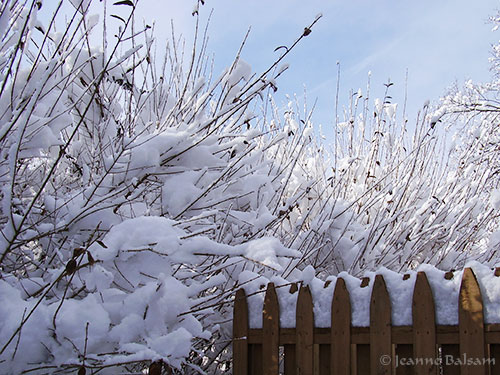
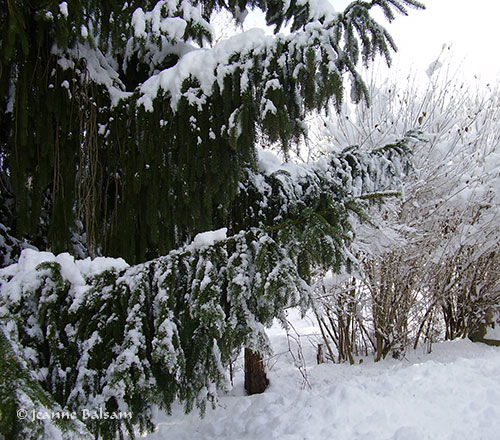
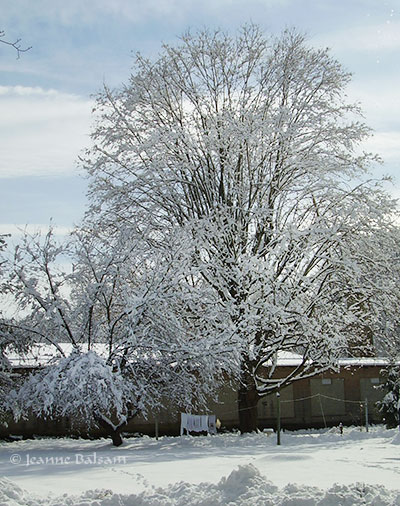
And with that, came a few photos of said snow.

Snow-Feb4-BushesFence2

SnowFeb4-BlueSpruce2

SnowFeb4-Tree2

SnowFeb4-LaundryOut2

And even after the snowiest day, once the sky clears, it’s still great to have your laundry smelling fresh.

The Book Thief

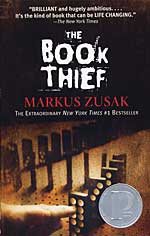
thebookthiefIt is not very often in my experience that you find a book and the movie made from it both outstanding, but in the case of The Book Thief by Markus Zusak, I do. I just finished reading it for the second time … my first a couple years ago, but after seeing the film, I dove back in and read it again, and enjoyed it even more.

The Book Thief is promoted as a YA novel, but it cannot help but reach the heart of any reading adult. Told over a period of about 5 years, the story takes place in Germany during Hitler’s rise to power. The heroine, Liesel, is being surrendered, along with her brother, to another family to foster as the mother cannot afford their care. The sickly brother passes away on the train ride to Molching, is buried in a patch of snowy land alongside that town’s train station. And this is where the book thief, Liesel, steals her first book.

The tale that follows is about Liesel’s life with her foster parents, Hans and Rosa Hubermann, her new and very dear friend, Rudy, and Max, the Jew the Hubermann’s come to hide in their basement. And, of course, it is about Liesel’s learning to read and her stealing books.

There are two factors that set this book apart from so many others. First is Zusak’s exquisite use of language; the book must be read to truly appreciate the author’s brilliance with words. Second is the narrator … Death. Not creepy Death of some stereotypic kind, but a narrator who shares what it is like to gather souls endlessly; how he is present and exhausted at every war; how he sometimes must carry the souls of numerous adults at once, perhaps over his shoulder, but how he always carries children in his arms. His experience of what it is like to be a gatherer of souls is interspersed but does not dominate his third-person narrative of Liesel and those about her.

Because of this unique take on events, the reader is made aware of this shameful period of history in a way that is like no other I’ve ever read. Zusak develops such compassion for his characters, for the Germans, the Jews they are brainwashed to despise, and even many of the soldiers. And shining in the middle of it all is a little girl, who despite losing those she loves time after time, has the courage and compassion to read to all those huddling in a neighbor’s basement during an air raid, who still can risk sneaking into the wealthy mayor’s house to steal a book, giving her one of the true joys she comes to know, reading.

In the movie, Geoffrey Rush and Emma Watson are outstanding as Hans and Rosa, (Papa and Mama). Liesel is played by a newcomer, Sophie Nelisse, one of literally hundreds of girls who auditioned for the part, and she is perfect.

If you were to choose between reading the book or seeing the movie … I can only recommend both, in whatever order suits you. I cannot imagine you will be disappointed. You can visit The Book Thief‘s official website, (click through the opening page and go to videos, upper left or find additional trailers/videos here), and perhaps gain a taste of the book. Importantly, the author was thrilled with the movie rendition of his book. More importantly, I cannot imagine you reading this book, seeing this movie, and not being touched to the core.

On the Dalai Lama, Non-Violence and more …

DalaiLama2I recently rented a somewhat different video from my usual fare, (whatever exactly that is), Ten Questions for the Dalai Lama. The film was made by Rick Ray, who also did the interview of His Holiness and examined a variety of issues surrounding the Dalai Lama and his native country, Tibet.

The film covered the Dalai Lama’s childhood and how he was selected to be the 14th to occupy this position which is a combination of chief spiritual and political leader. It showed the lives of  Buddhist monks and the beauty and peacefulness of the Tibetan people. It also recounted the horrific invasion and takeover of Tibet by the Chinese in 1949-1951, in which 1,200,000 Tibetans were killed, many thousands of others beaten and jailed. Even today, if a Tibetan so much as harbors an image of the Dalai Lama, he is severely beaten and imprisoned. Disguised, the Dalai Lama and his family were able to escape the country in 1959. He currently lives in political asylum in India.

Although I know China invaded and took over Tibet, I had not been aware of the details, so I am thankful to have chosen this film and learned more of this historical time. (If interested, you can learn about the event and what happened to Tibet afterwards here, which is an official website of the Dalai Lama.) But my primary interest was in the man himself.

TibetanTemple2

Interior of a Buddhist temple in Tibet

As a result of watching the Dalai Lama in this film, I can say that he is a brilliant, insightful and compassionate man with a delightful kind of kookiness about him. It would be impossible not to like him as he shares his thoughts, opinions and feelings – and sometimes laughter – on a variety of subjects. His observations about the West are not surprising, how as a people we are driven by greed, never having enough. He commented on how often the less people have, the happier they are. When asked about the parallel he might make between himself and Mahatma Gandhi and their ideas about non-violence, the Dalai Lama noted that their aims were the same, that non-violence towards others is the only way to make true progress in the world, and that he and Gandhi were of the same mind in this way.

He pointed out, however, that there was a major difference between Gandhi’s experience and that of his people’s in Tibet and that was/is the endless use of violence used to punish Tibetans at the hands of the Chinese. Gandhi and those who stood with him were not beaten with guns or shot. The numerous film clips show the brutality and violence the Tibetans were/are subjected to at the hands of the Chinese military, (which today, outside of the capital of Lhasa, is largely undercover police), and how their most basic human rights are denied.

The Dalai Lama had reached out to the Chinese Communist leadership in the past, but they were not cooperative. And so this world-famous spiritual leader continues to strive for world peace and the freedom of his country. When at home, he spends a portion of his day in communication with media and the remainder in spiritual practice. But he is often making appearances around the world discussing how his life is guided by three major commitments – the promotion of basic human values, the fostering of inter-religious harmony, and the preservation of Tibet’s Buddhist culture of peace and non-violence.

Having had only occasional exposure to the Dalai Lama, I was deeply impressed, as naive as that may sound, by the beauty and genuineness of his spirit as shown through this film. I can only imagine what a joy it might be to actually sit and talk with him.

I was also reminded, as he spoke about practicing non-violence towards all living beings, that an important aspect of being vegan, as challenging as it is, is an abstention from the violence that is routinely perpetrated on all animals that provide us with meat, dairy, or other commodities, whether during their lives or in their death.

There is clearly a peace that the Dalai Lama exudes, and to the degree that it comes from non-violence, who cannot be for it?

Looking Forward …

As the New Year rapidly approaches and everyone rushes to make resolutions, I am planning on doing one thing … continuing what I have been doing all along.

Candles-Nadia-Szopinska2

And that is … trying my best to add to the positivity on this planet, to live in love and eliminate fear, a lifetime endeavor. And to always remember to be grateful for all I have been blessed with in this life.

So no New Year’s resolutions for me … just same old, same old.
If the world is to be a kinder, more loving and peaceful place, I know it begins with me. And, of course, with you.
Happy New Year.